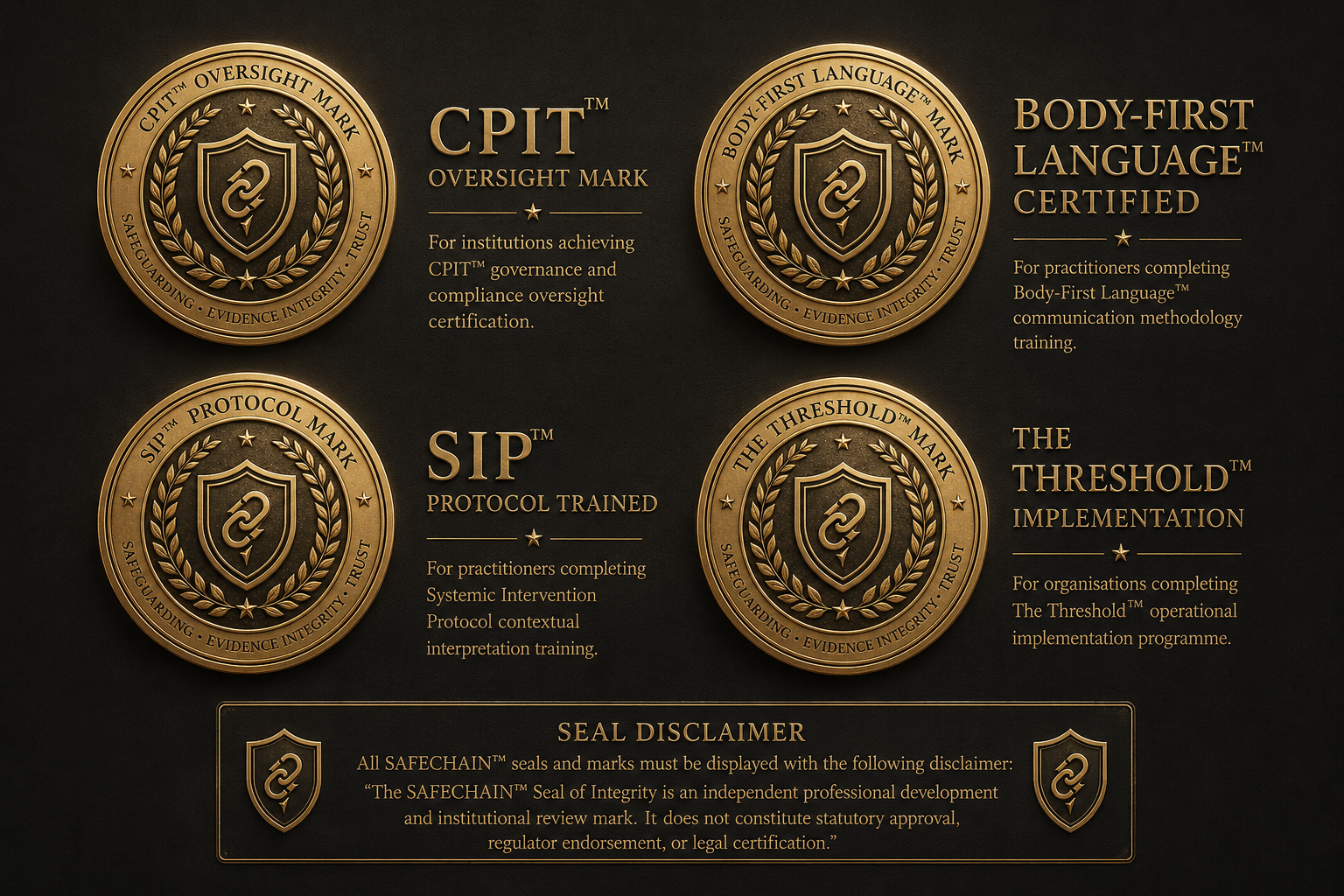
CIPID™ Technical Architecture Diagrams
CIPID™ Technical Architecture
SAFECHAIN™ Professional Programme · safe-chain.org
IP Protected
Diagram 01
CIPID™ Framework Overview
The five-layer architecture of CIPID™ — from foundational doctrine through to institutional accountability and systemic safeguarding improvement.
CIPID™ FRAMEWORK ARCHITECTURE Cognitive & Interpretive Participation Integrity Doctrine LAYER 1 — FOUNDATIONAL DOCTRINE Procedural Fairness & Participation Integrity Framework (2026) · Trauma-Blind Misinterpretation · PCV™ · Article 6 · Equality Act · Safeguarding Architecture The doctrine that governs all six modules and all professional application LAYER 2 — SIX ANALYTICAL MODULES M1: Trauma-Blind Misinterpretation · M2: PCV™ · M3: Credibility Distortion · M4: Article 6 · M5: Equality Act · M6: Documentation Each module delivers a distinct analytical layer, sequenced from recognition through to accountability LAYER 3 — PARTICIPATION-AWARE INTERPRETIVE PRACTICE Structured analytical tools applied in proceedings · Credibility discipline · PCV™ assessment · Adjustment duty compliance The professional applies the doctrine to live case analysis and institutional decision-making LAYER 4 — SAFEGUARDING DOCUMENTATION Contextual interpretation records · Participation planning frameworks · Procedural rationale records · Handover protocols Documentation creates the institutional memory of safeguarding and the evidence of professional conduct LAYER 5 — INSTITUTIONAL ACCOUNTABILITY & SYSTEMIC IMPROVEMENT SAFECHAIN™ Governance Review · R.I.S.E.™ implementation · Audit trails · Systemic reform advocacy The CIPID™ practitioner drives systemic improvement — not only individual practice change DOCTRINE MODULES PRACTICE DOCUMENT ACCOUNT. © 2026 Samantha Avril-Andreassen FRSA · SAFE-CHAINN Ltd · safe-chain.org
Layer 1
Foundational Doctrine
The Procedural Fairness & Participation Integrity Framework 2026 governs every module. No module operates outside this doctrine.
Layer 2
Six Modules
Each module delivers a distinct analytical layer. Modules are sequenced: recognition → interpretation → rights → adjustment → accountability.
Layer 3
Interpretive Practice
The professional applies structured analytical tools to live cases. Documentation is the transition between practice and accountability.
Layer 5
Institutional Accountability
CIPID™ practitioners are expected to drive systemic improvement — not only to change individual practice but to reform institutional systems.
Diagram 02
Six-Module Structure
The analytical sequence of the six CIPID™ modules, showing the progression from foundational recognition through to institutional accountability, and the inter-module dependencies.
CIPID™ SIX-MODULE ANALYTICAL SEQUENCE Each module delivers a distinct layer — sequenced from recognition to accountability MODULE 1 Trauma-Blind Misinterpretation Identifying when trauma-shaped behaviour is misread Freeze · Fawn · Dissociation · Recall fragmentation · Narrative inconsistency FOUNDATION MODULE MODULE 2 Participation Capacity Variability PCV™ — fluctuating participation ability under stress Stress load · Hearing environment · Sleep disruption · Adversarial intensity BUILDS ON: MODULE 1 MODULE 3 Credibility Distortion & Interpretive Bias Demeanour assumptions · Confidence bias · Intersectional compounding Presentation bias · Verbal fluency bias · Institutional pressure as distortion BUILDS ON: MODULES 1 & 2 MODULE 4 Article 6 Effective Participation ECHR right to a fair trial — participation as substantive right Formal presence vs. effective participation · Professional duties · Adjustments BUILDS ON: MODULES 1, 2 & 3 MODULE 5 Equality Act 2010 & Reasonable Adjustments Legal duties · Anticipatory & reactive adjustment · Reasonableness test Protected characteristics · Documentation · Institutional defensibility BUILDS ON: MODULES 1–4 MODULE 6 Safeguarding Documentation & Institutional Accountability Contextual records · Participation plans · Handover protocols · SAFECHAIN™ SYNTHESISES ALL MODULES — APEX MODULE APPLIED INTEGRATION — Cross-Module Case Analysis & Professional Implementation Planning All six analytical layers applied to a single case scenario · Integration of doctrine, practice, documentation and accountability © 2026 Samantha Avril-Andreassen FRSA · SAFE-CHAINN Ltd · safe-chain.org
Sequence
Why the Order Matters
Module 1 (recognition) must precede Module 3 (credibility analysis) which must precede Module 6 (documentation). Each module builds analytical capacity required by the next.
Module 6
Apex Module
Module 6 synthesises all preceding modules. Documentation without interpretive discipline produces records that entrench rather than correct bias.
Integration
Applied Integration
The Applied Integration component requires professionals to apply all six layers simultaneously to a single complex case — the full expression of CIPID™ competency.
Diagram 03
CIPID™ in the SAFECHAIN™ Ecosystem
How CIPID™ functions as the interpretive doctrine layer within the full SAFECHAIN™ framework — and how it connects to every other programme in the ecosystem.
CIPID™ WITHIN THE SAFECHAIN™ ECOSYSTEM CIPID™ is the interpretive doctrine layer — it connects to every programme in the ecosystem CIPID™ Interpretive Doctrine Advanced Professional SAFECHAIN™ Safeguarding Infrastructure The Compass™ Litigation Navigation Measurement Course™ PCV™ Self-Assessment REBUILD™ Participation Preparation The Threshold™ Professional Performance MOPIT™ Memory & Evidence Organisation R.I.S.E.™ Institutional Implementation Primary connection to CIPID™ Contextual connection (informs CIPID™ doctrine) © 2026 Samantha Avril-Andreassen FRSA · SAFE-CHAINN Ltd · safe-chain.org
Primary Links
SAFECHAIN™ & R.I.S.E.™
CIPID™ draws its safeguarding architecture from SAFECHAIN™ and feeds directly into R.I.S.E.™ institutional implementation.
Contextual
Individual Programme Links
CIPID™ professionals benefit from understanding MOPIT™, REBUILD™, and The Measurement Course™ — these explain how individual participants are prepared.
Parallel
The Threshold™
The Threshold™ and CIPID™ are the two professional-pathway programmes. The Threshold™ addresses performance stability; CIPID™ addresses interpretive discipline.
Diagram 04
CIPID™ Interpretive Flow
The decision pathway a CIPID™-trained professional follows from initial observation of behaviour through to safeguarding-compliant documentation and institutional accountability.
CIPID™ INTERPRETIVE DECISION FLOW From behavioural observation to safeguarding documentation BEHAVIOURAL OBSERVATION Professional encounters behaviour in proceedings or investigation Trauma Indicators Present? YES Apply M1 Trauma-Blind Correction UNCLEAR Standard Protocol with monitoring M2: PCV™ ASSESSMENT Assess participation capacity variables Identify degradation · Design accommodations M3: CREDIBILITY ANALYSIS Audit demeanour assumptions · Apply intersectional analysis Corrective reasoning documented M4: ARTICLE 6 ASSESSMENT Is effective participation assured? Identify participation failures · Remedies M5: EQUALITY ACT COMPLIANCE Are adjustment duties engaged? Design adjustments · Record decisions M6: SAFEGUARDING DOCUMENTATION Contextual interpretation record · Participation plan · Procedural rationale Handover protocol · SAFECHAIN™ architecture · Institutional accountability INSTITUTIONAL ACCOUNTABILITY LOOP Audit · Review · Systemic improvement · SAFECHAIN™ governance © 2026 Samantha Avril-Andreassen FRSA · SAFE-CHAINN Ltd
Diagram 05
CIPID™ Professional Pathway
The recommended professional development pathway for legal practitioners adopting CIPID™, showing the recommended sequence within the SAFECHAIN™ education framework.
CIPID™ PROFESSIONAL DEVELOPMENT PATHWAY Recommended sequence for legal professionals within the SAFECHAIN™ education framework STEP 1 CIPID™ Interpretive Doctrine 6 modules Applied integration CPD certification CORE PROGRAMME STEP 2 The Threshold™ Performance Stability Regulation under scrutiny Cognitive clarity Boundary integrity RECOMMENDED STEP 3 MOPIT™ Awareness Individual Preparation Understand how participants are prepared for proceedings Improve interpretation accuracy ENRICHMENT STEP 4 SAFECHAIN™ Governance Review Institutional audit Safeguarding architecture System-level reform INSTITUTIONAL LEVEL CIPID™ CONTINUING PROFESSIONAL DEVELOPMENT Annual CPD record · Peer supervision · Case reflection portfolio · Updated legal analysis Aligned to SRA, BSB, and relevant regulatory body CPD framework requirements CIPID™ DELIVERS TO THE PROFESSIONAL Interpretive Accuracy Structured analytical tools for case interpretation Safeguarding Compliance Documentation standards and institutional accountability Litigation Risk Reduction Procedural fairness awareness and participation planning Institutional Defensibility Rationale records and audit trails for institutional review © 2026 Samantha Avril-Andreassen FRSA · SAFE-CHAINN Ltd · safe-chain.org
Entry Point
Always Start with CIPID™
CIPID™ is the foundation of the professional pathway. The Threshold™ builds on CIPID™ competency — it is not a standalone programme.
Enrichment
MOPIT™ Awareness
MOPIT™ Awareness (not the full individual programme) helps CIPID™ professionals understand how participants are prepared — materially improving interpretive accuracy.
CPD
Annual Obligation
CIPID™ certification requires ongoing CPD. The annual record is aligned to SRA, BSB, and relevant regulatory CPD requirements.

© 2026 Samantha Avril-Andreassen FRSA · SAFE-CHAINN Ltd, Company No. 12038453 · samantha@safe-chain.org · safe-chain.org

CIPID™ is in development and consultation stage. No regulatory endorsement or statutory adoption is claimed. All trademarks are the intellectual property of Samantha Avril-Andreassen FRSA.