
Five Years On: The Domestic Abuse Act and the Recognition of Non-Physical Harm
Five years after the Domestic Abuse Act 2021, the law recognises that abuse is not limited to physical violence. Emotional, psychological, economic, coercive, and controlling behaviour are now central to the legal understanding of domestic abuse. Yet the real question is whether that recognition has translated into consistent protection in practice. This article examines the gap between legal definition and operational reality — and why non-physical abuse must be evidenced, understood, and acted upon with the same seriousness as physical harm.
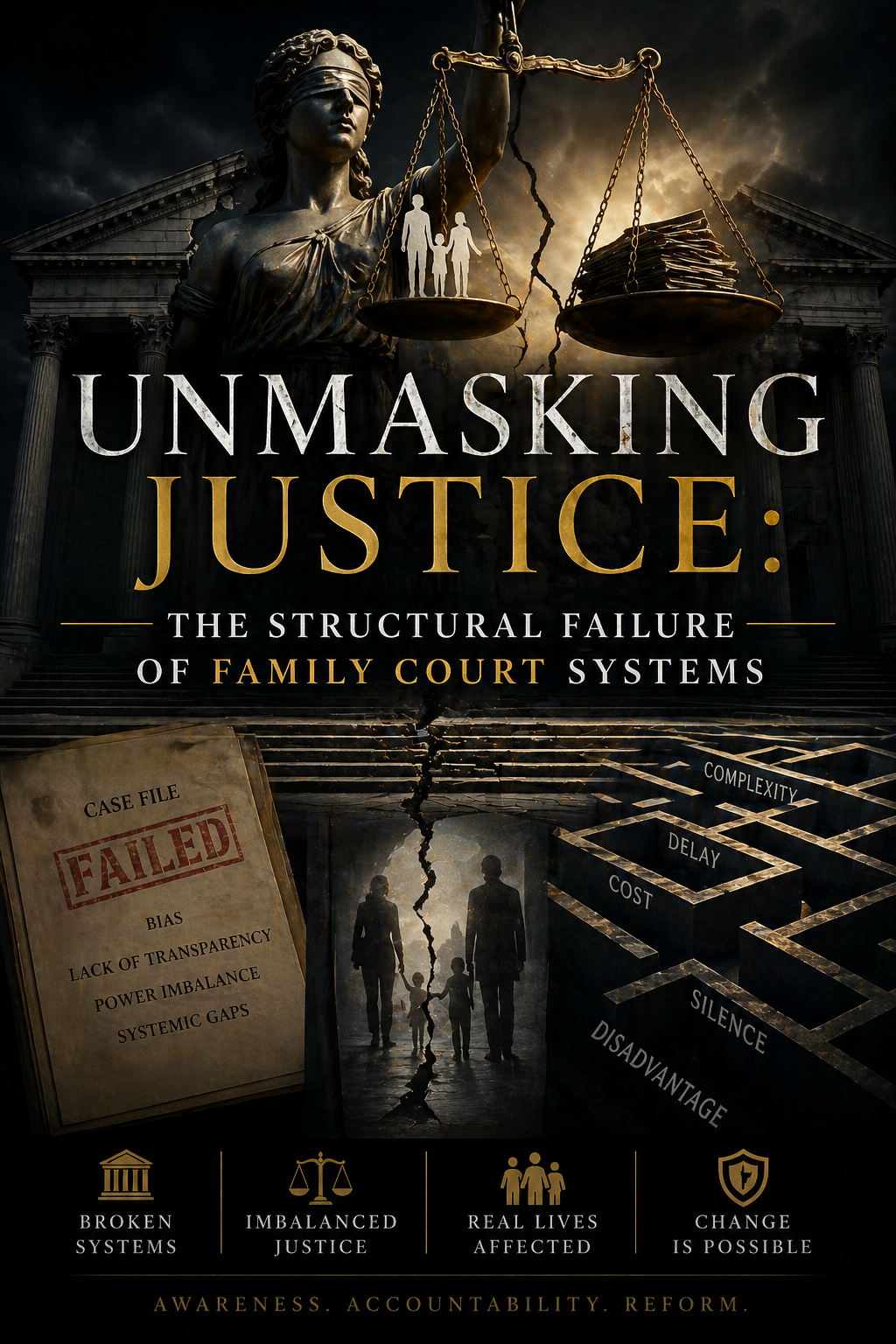
Unmasking Justice: The Structural Failure of Family Court Systems
A forensic legal series examining the structural failure of family court systems, including equality of arms, disclosure failure, procedural advantage, financial remedy proceedings, participation impairment, and the urgent need for legal reform.

Disclosure Wars: Why Financial Truth Fails in Family Court
Equality of arms is a legal requirement, not a procedural aspiration.
Yet within family court financial remedy proceedings, structural limitations—particularly the reliance on self-reported disclosure and the absence of real-time verification—can allow procedural advantage to emerge. Where one party can outlast, outspend, or out-structure the process, fairness risks becoming theoretical rather than operational.
This article examines how disclosure failure, financial complexity, and systemic fragmentation may erode the foundation of a fair hearing under Article 6 of the Human Rights Act 1998. It considers the practical limits of Form E disclosure, the challenges of evidential transparency, and the implications for those required to engage with a process that assumes visibility where, in reality, it may not exist.

Exploiting Structural Gaps: Procedural Advantage, Disclosure Failure, and the Erosion of Equality of Arms in Family Court
Equality of arms is a legal requirement, not a procedural ideal.
Yet within family court financial remedy proceedings, structural gaps—ranging from self-reported disclosure to fragmented verification systems—can allow procedural advantage to emerge. Where one party can outlast, outspend, or out-structure the process, fairness risks becoming theoretical rather than operational.
This article examines how disclosure failure, procedural imbalance, and systemic fragmentation may erode the very foundation of a fair hearing under Article 6 of the Human Rights Act 1998—and why reform is essential if justice is to function in substance, not merely in form.

WHERE THE LAW ENDS, TYRANNY BEGINS
This is not a personal grievance. It is a legal indictment. When the family court fails to recognise domestic abuse, vulnerability, financial dispossession, and participation impairment, it risks transforming procedure into a weapon. Where the law no longer restrains power, it becomes the channel through which power is exercised. That is why I call it tyranny. That is why I call it Unmasking Justice.
Unmasking Justice: When Domestic Abuse Becomes a Business Model
Season 6 of Silent Screams, Loud Strength: The Podcast launches the Unmasking Justice series — a hard-hitting forensic examination of domestic abuse, coercive control, financial abuse, family court injustice, institutional racism, and the professional cultures that can turn private devastation into procedural harm.

When Due Process Becomes the Predator’s Megaphone: How Coercive Control Mutates Inside Legal Process
Coercive control does not always end when legal process begins. It mutates. It acquires professional language, procedural respectability, and institutional amplification. And once that happens, due process itself can become the predator’s loudest weapon

Fragmented to Fail: Forum Shopping, Participation Impairment, and the Architecture of Disappearing Truth
Fragmentation is one of the least discussed and most dangerous habits within the court system. A case is moved, an issue is split, a chronology is narrowed — and slowly, what should have been seen as one coherent pattern becomes a set of disconnected inconveniences. The truth does not disappear because it is absent. It disappears because the system has broken it into pieces too small to trigger accountability.

What Happens After the Lie: How Procedural Fairness Collapses When Courts Reward Performance Over Proof
What happens after the lie is accepted in court? Not justice, but procedural collapse dressed in formal language. When documentary contradiction is subordinated to polished performance, and trauma is misread as unreliability, the process may remain intact in form while failing entirely in substance.

The Criminality of Creativity: When Judicial Acquiescence Becomes Structural Erasure
The Criminality of Creativity: How Courts Risk Rewarding Performance Over Proof
Institutional Perjury: When Legal Process Becomes a Vehicle for Erasure
When Creative Lawyering Becomes Structural Harm
Unmasking Justice: The Forensic Cost of Judicial Acquiescence
Performance, Perjury, and the Quiet Erosion of Justice
The William Hunt Illusion: When the Courtroom Becomes a Stage for Erasure
In family court, presentation can too easily be mistaken for truth. This SAFECHAIN™ article examines how polished courtroom performance, trauma misreading, and institutional culture can combine to erase the lived reality of harm.
I tuned this around current official family-justice language that is actually used in England and Wales: Part 3A requires the court to consider whether participation or evidence quality is likely to be diminished by vulnerability, and PD 3AA is the procedural framework for vulnerable persons in family proceedings. PD 12J remains central where domestic abuse is raised in relevant family proceedings.
The strongest discoverable phrases for this topic are the plainer legal and policy terms rather than only poetic framing, which is why I’ve leaned into phrases like family court, domestic abuse, coercive control, vulnerability, and participation in proceedings. Those terms align with the Family Procedure Rules and current justice-system language.

Excavating the Stench: What the Courtroom Files Didn’t Record
The courtroom files recorded the decision. They did not record the damage. They did not record the rot, the stench, the ruin, or the labour of survival left behind when legal language ended and lived reality began. In this article, Samantha Avril-Andreassen explores what it means to excavate not only a decaying home, but the physical aftermath of institutional failure — and to turn that ruin into restoration, testimony, and reform.
The courtroom file will never smell what I smelled.
It will never feel the grime under my nails, the weight of the tools in my hand, the humiliation of the ruin, or the force it took not to disappear inside it.
But I remember.
My walls remember.
My floor remembers.
My rebuilt home remembers.
And now, through this work, the public record will remember too.
Inside the UK’s Family Courts: Frustration, Tears and Long Delays
As journalists gain greater access to family court proceedings in England and Wales, a clearer picture is emerging: frustration, tears, and long delays. SAFECHAIN™ argues that these are not merely emotional by-products of difficult cases. They are structural signals about participation, safeguarding, and the human cost of procedural strain in family justice.

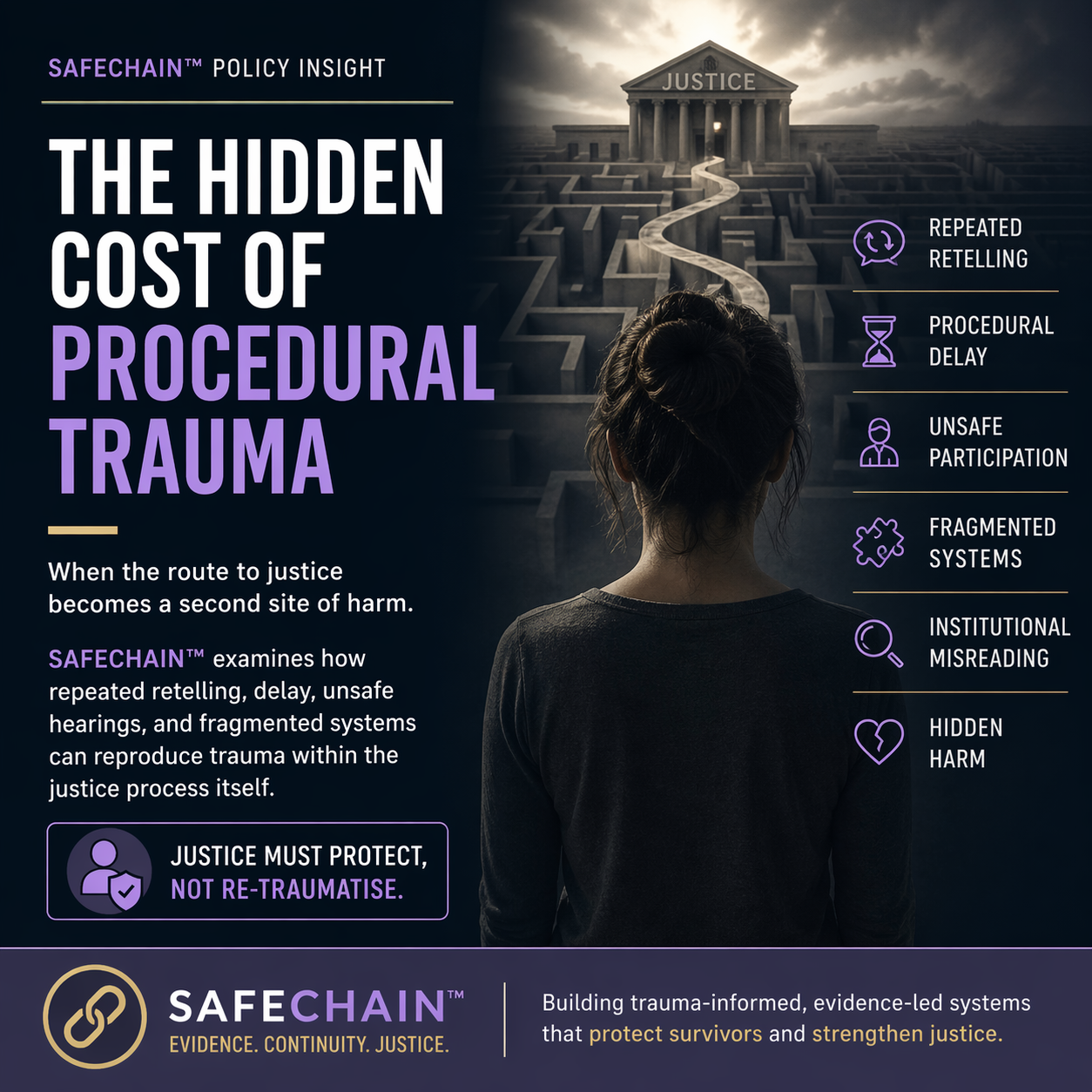
The Hidden Cost of Procedural Trauma
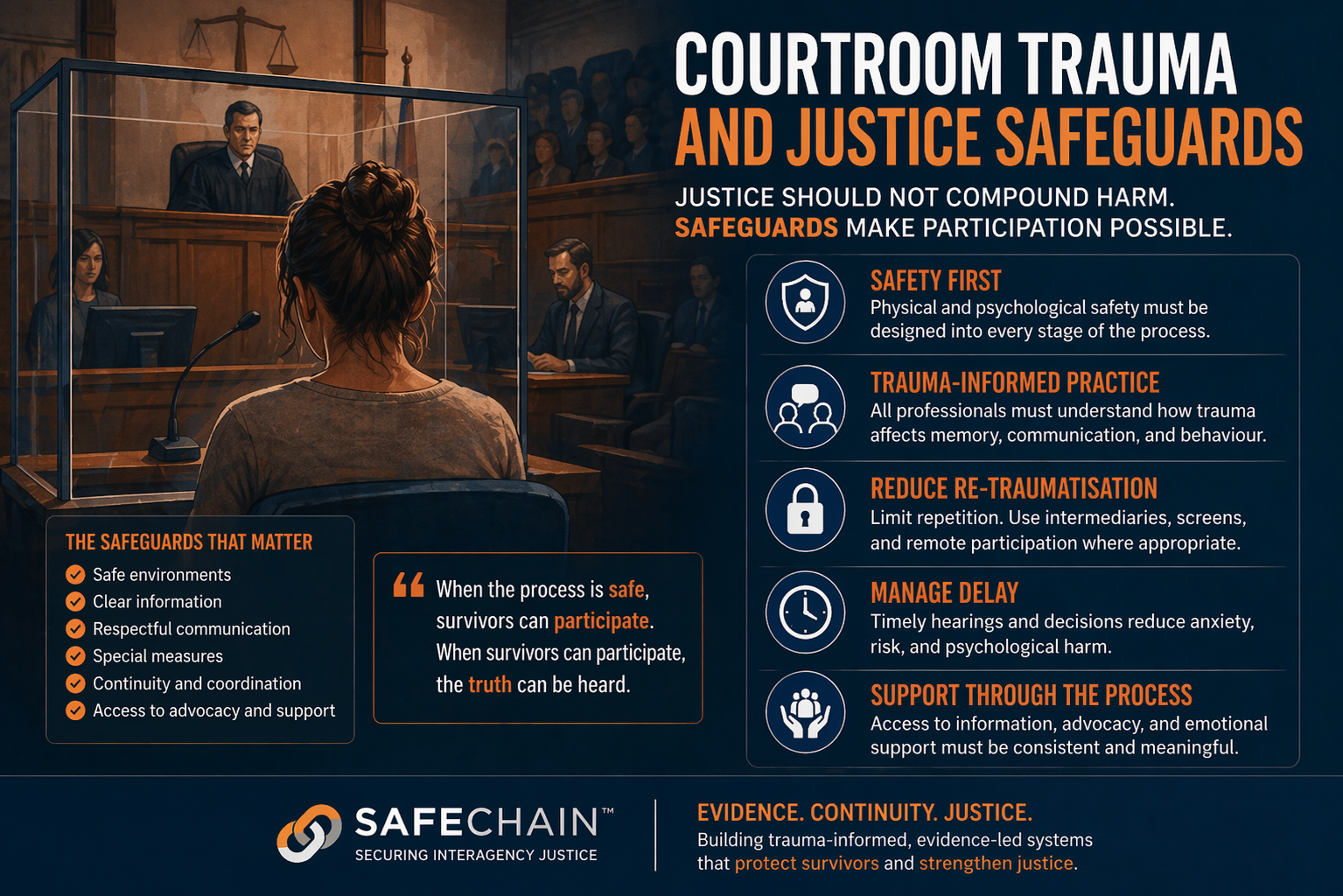
SAFECHAIN™ argues that many survivors are harmed not only by abuse itself, but by the very processes they enter to seek protection. Repeated retelling, procedural delay, unsafe participation, fragmented systems, and institutional misreading can transform the route to justice into a second site of trauma. When institutions measure only whether procedure occurred, but not what that procedure cost, they risk mistaking compliance for fairness and process for protection.
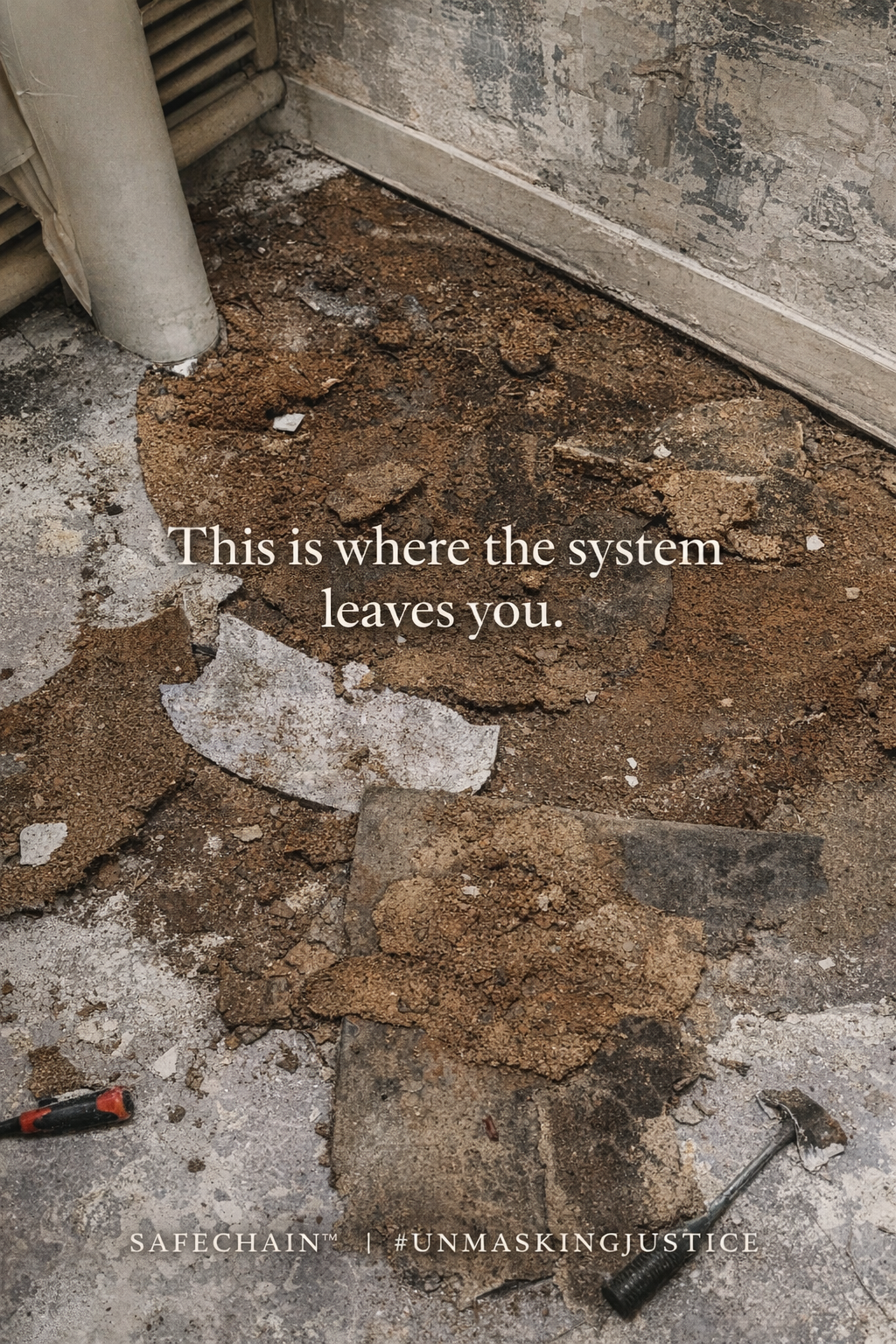
Unmasking Justice: The Human Cost They Never Record
Justice cannot be considered complete if it ends at procedure.
It must extend into impact.
Until legal systems are designed to account for what happens after the decision—
not just during it—
we will continue to see outcomes that are technically lawful, but humanly devastating.
This is not a call for sympathy.
It is a call for structural integrity.

Why justice systems must account for the harm caused by process itself
SAFECHAIN™ argues that many survivors are harmed not only by abuse itself, but by the very processes they enter to seek protection. Repeated retelling, procedural delay, unsafe participation, fragmented systems, and institutional misreading can transform the route to justice into a second site of trauma. When institutions measure only whether procedure occurred, but not what that procedure cost, they risk mistaking compliance for fairness and process for protection.

From Survivor to System Change
Survival is not always the end of the story. Sometimes it becomes the beginning of something greater — the moment pain turns into pattern recognition, silence turns into structure, and lived experience becomes the blueprint for reform. From Survivor to System Change explores the powerful journey of transforming personal harm into public purpose, and asks what becomes possible when those who have lived through systemic failure begin to redesign the systems themselves.

The Hidden Cost of Procedural Trauma
SAFECHAIN™ argues that justice systems must begin reckoning not only with the original harm a survivor has endured, but with the harm caused by process itself. Repeated retelling, delay, intimidation, fragmented procedure, and unsafe participation conditions can turn the route to justice into a second site of trauma. If institutions measure only whether procedure occurred, but not what that procedure cost, they risk mistaking compliance for fairness and process for protection.

Justice Behind the Veil
Justice is often described as blind.
But for many, it is not blind — it is obscured.
Hidden behind layers of procedure, language, and expectation, individuals are required to present themselves with clarity, composure, and precision at the very moment their capacity to do so may have been compromised.
This is the quiet contradiction at the heart of modern systems:
Participation is permitted, but not properly supported.
Trauma does not present neatly. It disrupts memory, sequencing, and communication. Yet these very disruptions are too often interpreted as inconsistency or lack of credibility. What is, in reality, the impact of harm becomes misread as unreliability.
This is where justice begins to fracture.
Because when a system cannot accurately interpret the person before it, it cannot deliver outcomes that are truly fair.
The issue is not whether individuals are allowed to speak.
The issue is whether they are understood.

Why Survivors Are Forced to Become Their Own Case Managers
Many survivors of domestic abuse are forced to do far more than disclose harm. They are made to coordinate the institutions responding to it. SAFECHAIN™ argues that when police, courts, housing bodies, healthcare services, and support systems operate in silos, the survivor becomes the messenger, the evidence courier, and the case manager of their own trauma. That is not support. It is structural failure.