AIFU-001™
AIFU-001™ — The SAFECHAIN™ Accountability Integrity Follow-Up & Implementation Framework™ establishes the governance standard for ensuring that recommendations, remedies, consequences, remediation actions and institutional commitments are actually implemented, evidenced, verified and sustained.
The framework closes the gap between accepting an accountability action and proving that meaningful change occurred. It covers action ownership, implementation deadlines, milestones, evidence of completion, overdue actions, implementation drift, recommendation dilution, failed implementation, verification, effectiveness, sustainability and closure.
Through mechanisms including the SAFECHAIN™ Accountability Follow-Up Architecture™, Action Commitment Register™, Implementation Owner™, Implementation Deadline Standard™, Evidence-of-Completion Requirement™, Overdue Action Trigger™, Implementation Drift Alert™, Recommendation Closure Gate™, Failed Implementation Escalation™, Implementation Effectiveness Test™, Post-Implementation Verification Review™, Executive Implementation Dashboard™, Implementation Sustainability Gate™ and AIFU-001™ Follow-Up & Implementation Integrity Test™, institutions can ensure that accountability does not end when a recommendation is merely recorded.
AIFU-001™ is built on a central principle:
A recommendation, remedy, consequence or corrective action has accountability value only where responsibility is assigned, implementation is evidenced, effectiveness is verified and unresolved failure remains visible until the required outcome has genuinely been achieved.
AIIND-001™
AIIND-001™ — The SAFECHAIN™ Accountability Integrity Independence & Conflict Framework™ establishes the governance standard for identifying, assessing and managing conflicts capable of compromising—or reasonably appearing to compromise—the independence of accountability processes.
The framework examines actual, potential and perceived conflicts, decision-maker independence, investigator independence, structural conflicts, self-review, prior involvement, recusal, replacement, external scrutiny, evidence access, assurance independence and institutional interference.
Through mechanisms including the SAFECHAIN™ Accountability Independence Architecture™, Independence Threshold Test™, Conflict-of-Interest Assessment™, Actual Conflict Test™, Potential Conflict Test™, Perceived Conflict Test™, Decision-Maker Independence Standard™, Investigator Independence Standard™, Structural Independence Test™, Recusal & Replacement Protocol™, Independence Compromise Alert™, External Independence Trigger™, Independence Declaration Record™, Independence Reality Test™ and AIIND-001™ Independence & Conflict Integrity Test™, institutions can determine whether accountability is independent in substance rather than merely in name.
AIIND-001™ is built on a central principle:
Accountability integrity requires decision-makers, investigators, reviewers and assurance providers to be sufficiently independent of the matters they examine, with conflicts identified, assessed, managed, disclosed and escalated where they cannot be adequately controlled.
AICHAL-001™
AICHAL-001™ — The SAFECHAIN™ Accountability Integrity Challenge & Speak-Up Framework™ establishes the governance standard for ensuring people can question decisions, raise concerns, challenge authority and escalate accountability failures safely, effectively and without improper retaliation.
The framework examines whether institutional challenge is genuinely accessible and capable of influencing outcomes. It covers protected challenge, speak-up routes, evidence-based review, escalation, power imbalance, seniority, retaliation risk, challenge suppression, safeguarding, independent review, repeated challenge, board visibility and challenge culture.
Through mechanisms including the SAFECHAIN™ Institutional Challenge Architecture™, Protected Challenge Standard™, Speak-Up Route™, Evidence-Based Challenge Protocol™, Challenge Escalation Ladder™, Power Imbalance Safeguard™, Retaliation Detection Trigger™, Challenge Suppression Alert™, Seniority Override Safeguard™, Independent Challenge Route™, Challenge Outcome Record™, Board Challenge Visibility Standard™, Challenge Reality Test™ and AICHAL-001™ Challenge & Speak-Up Integrity Test™, institutions can determine whether challenge exists merely in policy or functions effectively in practice.
AICHAL-001™ is built on a central principle:
An accountability system is credible only where challenge can be raised safely, supported by evidence, escalated beyond conflicted authority, considered on its merits and capable of changing an outcome.
AIOWN-001™
AIOWN-001™ — The SAFECHAIN™ Accountability Integrity Ownership & Responsibility Framework™ establishes the governance standard for ensuring that material accountability responsibilities are assigned to identifiable owners with sufficient authority, information, capacity and answerability to act.
The framework addresses one of the most common institutional accountability failures: responsibility becoming fragmented across departments, committees, executives, contractors or decision-making structures until no one remains clearly responsible for the outcome.
Through mechanisms including the SAFECHAIN™ Accountability Ownership Architecture™, Accountability Responsibility Map™, Named Accountability Owner™, Executive Accountability Owner™, Decision Ownership Test™, Shared Responsibility Protocol™, Responsibility Transfer Rule™, Accountability Handover Record™, Ownership Gap Alert™, Diffused Responsibility Test™, Leadership Ownership Escalation™, Accountability Continuity Standard™, Ownership Verification Gate™ and AIOWN-001™ Ownership & Responsibility Integrity Test™, institutions can ensure that shared responsibility does not become shared avoidance.
AIOWN-001™ is built on a central principle:
Responsibility without identifiable ownership creates accountability gaps; ownership without sufficient authority creates accountability in name only.
AIRESP-001™
AIRESP-001™ — The SAFECHAIN™ Accountability Integrity Response, Redress & Remedy Framework™ establishes the governance standard for determining how institutions should respond to the people affected by substantiated accountability failure and how meaningful remedy should be identified, delivered, verified and sustained.
The framework distinguishes consequence, remedy and remediation, ensuring that internal accountability action does not replace consideration of the actual harm, disadvantage or continuing consequences experienced by affected people. It covers impact assessment, continuing harm, safeguarding, corrective and restorative remedy, record correction, decision reconsideration, institutional acknowledgement, remedy delay, remedy avoidance, accessibility, participation and outcome verification.
Through mechanisms including the SAFECHAIN™ Response & Remedy Architecture™, Affected-Person Impact Assessment™, Remedy Eligibility Test™, Harm & Continuing Impact Map™, Remedy Proportionality Matrix™, Affected-Person Participation Standard™, Safeguarding Remedy Override™, Continuing Harm Intervention Trigger™, Corrective Remedy Standard™, Restorative Remedy Standard™, Record Correction & Decision Reconsideration Protocol™, Institutional Acknowledgement Standard™, Remedy Delay Alert™, Remedy Avoidance Alert™, Remedy Adequacy Test™, Affected-Person Outcome Verification Gate™, Remedy Sustainability Review™, Response & Remedy Record™ and AIRESP-001™ Response, Redress & Remedy Integrity Test™, institutions can demonstrate that accountability changes something meaningful for the person who experienced the failure.
AIRESP-001™ is built on a central principle:
Institutional accountability is incomplete where an organisation identifies and responds to its own failure but does not adequately consider the harm, disadvantage or continuing consequences experienced by the people affected by that failure.
SAFECHAIN Response Redress Remedy Framework, AIRESP-001, Accountability Remedy Framework, Institutional Redress, Affected Person Remedy, Governance Response Framework, Corrective Remedy, Restorative Remedy, Safeguarding Remedy, Continuing Harm Intervention, Remedy Adequacy, Outcome Verification, Institutional Accountability, Redress and Remedy, SAFECHAIN Accountability Integrity Series
SAFECHAIN™
AIRESP-001™
Response Redress and Remedy
Accountability Remedy
Institutional Redress
Affected-Person Outcomes
Corrective Remedy
Restorative Remedy
Safeguarding Remedy
Continuing Harm
Remedy Proportionality
Remedy Adequacy
Outcome Verification
Record Correction
Decision Reconsideration
Institutional Acknowledgement
Remedy Accessibility
Governance Accountability
Institutional Accountability
SAFECHAIN™ Accountability Integrity Series
AICONS-001™
AICONS-001™ — The SAFECHAIN™ Accountability Integrity Consequence & Enforcement Framework™ establishes the governance standard for determining what should follow when accountability failure has been substantiated and how institutions ensure that consequence is fair, proportionate, enforceable and actually implemented.
The framework distinguishes individual consequence, institutional consequence, structural consequence, remediation and protective intervention, while examining leadership responsibility, safeguarding impact, recurrence, aggravating and mitigating factors, enforcement authority, consistency, consequence avoidance, retaliation risk and verification.
Through mechanisms including the SAFECHAIN™ Consequence Architecture™, Consequence Threshold Test™, Proportionality Matrix™, Aggravating & Mitigating Factors Model™, Individual–Institutional Consequence Test™, Leadership Consequence Review™, Safeguarding Consequence Override™, Repeat Failure Escalation Rule™, Enforcement Authority Map™, Consequence Consistency Test™, Consequence Avoidance Alert™, Consequence Verification Gate™, Consequence Review Record™ and AICONS-001™ Consequence & Enforcement Integrity Test™, institutions can ensure that substantiated failure leads to a meaningful and accountable response.
AICONS-001™ is built on a central principle:
Accountability requires proportionate and evidence-based consequence where consequence is warranted; a system that can identify serious failure but cannot act upon it risks converting accountability into documentation without effect.
Focus SEO Keywords
SAFECHAIN Accountability Consequence Framework, AICONS-001, Accountability Enforcement Framework, Governance Consequence, Leadership Accountability, Safeguarding Consequence, Institutional Consequence, Proportionate Enforcement, Repeat Failure Escalation, Consequence Verification, Enforcement Authority, Consequence Consistency, Accountability Response, Governance Enforcement, SAFECHAIN Accountability Integrity Series
Website Tags
SAFECHAIN™
AICONS-001™
Accountability Consequence
Accountability Enforcement
Governance Consequence
Leadership Accountability
Institutional Accountability
Safeguarding Consequence
Proportionate Enforcement
Structural Consequence
Repeat Failure Escalation
Consequence Verification
Enforcement Authority
Consequence Consistency
Consequence Avoidance
Retaliatory Enforcement
Procedural Integrity
Governance Accountability
Institutional Learning
SAFECHAIN™ Accountability Integrity Series
AICONS-001™ — The SAFECHAIN™ Accountability Integrity Consequence & Enforcement Framework™ for proportionate consequence, leadership accountability, safeguarding response and enforcement following substantiated failure.
AIROOT-001™
AIROOT-001™ — The SAFECHAIN™ Accountability Integrity Root Cause & Systemic Failure Analysis Framework™ establishes the governance methodology for determining why accountability failure occurred, what institutional conditions enabled it, why controls or oversight failed, and what must change to prevent recurrence.
The framework moves beyond surface-level explanations such as individual error and examines immediate causes, contributory conditions, governance failures, systemic causes, enabling conditions, control weakness, leadership and oversight, organisational culture, safeguarding, evidence systems, incentives, technology and institutional design.
Through mechanisms including the SAFECHAIN™ Root Cause Analysis Architecture™, Four-Layer Causation Model™, Immediate Cause Test™, Contributory Cause Matrix™, Governance Cause Test™, Systemic Cause Threshold™, Individual-Blame Safeguard™, Enabling Conditions Map™, Control Failure Analysis™, Leadership & Oversight Cause Review™, Cultural Cause Analysis™, Root Cause Confidence Scale™, Root Cause Verification Gate™ and AIROOT-001™ Root Cause & Systemic Failure Integrity Test™, institutions can connect failure to its true causes and design remediation that addresses the conditions capable of producing the same problem again.
AIROOT-001™ is built on a central principle:
Root-cause analysis is credible only where it moves beyond the visible event and tests the decisions, controls, incentives, culture, authority, evidence, leadership and governance conditions that enabled the failure to occur or recur.
AIREC-001™
AIREC-001™ — The SAFECHAIN™ Accountability Integrity Recurrence & Repeat Failure Framework™ establishes the governance standard for identifying, connecting and escalating repeated accountability failures so that recurring events are not continually treated as isolated incidents.
The framework examines recurrence across complaints, safeguarding, evidence integrity, decision-making, challenge, leadership response, remediation, assurance, closure and institutional learning. It enables organisations to determine when repeated failure demonstrates a material pattern, ineffective remediation, failed learning or systemic accountability weakness.
Through mechanisms including the SAFECHAIN™ Recurrence Detection Architecture™, Repeat Failure Threshold™, Accountability Pattern Map™, Recurrence Severity Scale™, Prior Warning Multiplier™, Common Cause Test™, Cross-Domain Recurrence Test™, Failed Remediation Recurrence Trigger™, Failed Learning Alert™, Repeat Safeguarding Failure Override™, Recurrence Escalation Matrix™, Systemic Pattern Threshold™, Recurrence Review Record™ and AIREC-001™ Recurrence & Repeat Failure Integrity Test™, institutions can recognise when recurrence changes the meaning of an accountability event.
AIREC-001™ is built on a central principle:
Repeated accountability failure must be assessed cumulatively, because recurrence after warning, remediation, assurance or closure provides evidence not only about the new incident, but about the effectiveness of the institution’s previous response.
AICL-001™
AICL-001™ — The SAFECHAIN™ Accountability Integrity Closure & Learning Framework™ establishes the governance standard for determining when an accountability matter can legitimately be closed and what evidence must exist before an institution can represent the matter as substantively resolved.
The framework distinguishes administrative closure from genuine Accountability Integrity Closure™ and requires institutions to consider closure evidence, unresolved matters, residual risk, affected-person outcomes, safeguarding, remediation, consequence, evidence preservation, institutional learning, recurrence prevention and post-closure monitoring.
Through mechanisms including the SAFECHAIN™ Accountability Closure Architecture™, Closure Criteria Standard™, Closure Evidence Pack™, Residual Accountability Risk™, Affected-Person Outcome Standard™, Safeguarding Closure Gate™, Critical Domain Closure Gate™, Accountability Learning Cycle™, Recurrence Prevention Standard™, Post-Closure Review™, Closure Reopening Trigger™, Closure Decision Record™, Closure Integrity Opinion™ and AICL-001™ Closure & Learning Integrity Test™, organisations can prevent the end of an administrative process from being mistaken for genuine accountability resolution.
AICL-001™ is built on a central principle:
An accountability matter should be closed only when the institution can evidence what happened, what was decided, what remains unresolved, what consequence or remediation followed, what was learned, how recurrence risk has been addressed and why closure is now justified.
AIGR-001™
AIGR-001™ — The SAFECHAIN™ Accountability Integrity Governance Review Framework™ establishes the formal governance process through which institutions periodically review and revalidate whether their current Accountability Integrity classification continues to reflect present evidence, risk and institutional reality.
The framework brings together assessment evidence, monitoring intelligence, safeguarding conditions, critical-domain performance, remediation sustainability, assurance findings, governance oversight and classification history to determine whether an existing AI1™–AI5™ position remains current, requires enhanced monitoring or should trigger formal reassessment.
Through mechanisms including the SAFECHAIN™ Governance Review Architecture™, Classification Revalidation Standard™, Review Evidence Pack™, Accountability Change Analysis™, Critical Domain Review™, Safeguarding Revalidation Gate™, Remediation Sustainability Review™, Assurance Currency Review™, Classification Currency Test™, Governance Review Decision Matrix™, Reassessment Trigger™ and AIGR-001™ Governance Review Integrity Test™, institutions can prevent historic accountability conclusions from remaining in place after the underlying governance reality has changed.
AIGR-001™ is built on a central principle:
Accountability classifications, assurances and restoration findings should be periodically revalidated against current evidence so that historic conclusions do not outlive the governance reality they were intended to describe.
AIMON-001™
AIMON-001™ — The SAFECHAIN™ Accountability Integrity Monitoring & Early Warning Framework™ establishes the continuous monitoring and early-warning architecture for identifying when institutional accountability begins to weaken before deterioration becomes material, serious or systemic.
The framework monitors leading and lagging indicators, safeguarding risk, complaints, challenge, evidence integrity, remediation ageing, assurance deterioration, leadership response, recurrence, critical-domain weakness and classification instability across the SAFECHAIN™ AI1™–AI5™ architecture.
Through mechanisms including the SAFECHAIN™ Accountability Monitoring Architecture™, Early Warning Indicator Set™, Accountability Deterioration Signal™, Recurrence Alert™, Safeguarding Alert™, Critical Domain Alert™, Remediation Ageing Trigger™, Assurance Deterioration Trigger™, Classification Review Trigger™, Monitoring Escalation Ladder™, Post-Restoration Surveillance Period™ and AIMON-001™ Monitoring & Early Warning Integrity Test™, institutions can detect emerging accountability failure earlier and trigger proportionate intervention before harm becomes embedded.
AIR-001™
AIR-001™ — The SAFECHAIN™ Accountability Integrity Reporting & Disclosure Framework™ establishes the governance standard for reporting institutional accountability conditions accurately, proportionately and without creating a materially misleading impression.
The framework governs how organisations disclose AI1™–AI5™ classifications, material findings, adverse evidence, safeguarding risk, assurance opinions, remediation status, uncertainty, residual risk and historical accountability conditions across operational, executive, board, external and public reporting environments.
Through mechanisms including the SAFECHAIN™ Accountability Disclosure Architecture™, Material Disclosure Threshold™, Adverse Findings Disclosure Rule™, Classification Reporting Standard™, Historical Classification Record™, Assurance Disclosure Standard™, Remediation Status Disclosure™, Safeguarding Transparency Rule™, Reporting Integrity Test™, Correction & Restatement Protocol™ and AIR-001™ Reporting & Disclosure Integrity Test™, institutions can strengthen transparency while protecting legitimate confidentiality and avoiding selective or misleading reporting.
AIR-001™ is built on a central principle:
Accountability reporting is credible only where material strengths, weaknesses, uncertainty, adverse findings and unresolved risks are disclosed with sufficient context to prevent a misleading impression.
AIO-001™
AIO-001™ — The SAFECHAIN™ Accountability Integrity Oversight & Governance Framework™ establishes the governance architecture through which boards, executives, committees and independent oversight functions maintain meaningful visibility, challenge and control over institutional accountability.
The framework defines how governing bodies should oversee AI1™–AI5™ classifications, safeguarding risk, critical-domain failures, assurance findings, complaints, leadership accountability, overdue remediation, escalation, restoration and residual accountability risk.
Through mechanisms including the SAFECHAIN™ Accountability Oversight Architecture™, Board Accountability Integrity Standard™, Executive Accountability Owner™, Reserved Accountability Matters™, Oversight Information Rights™, Board Visibility Test™, Oversight Independence Test™, Critical Escalation Route™, Accountability Reporting Pack™, AI1™–AI5™ Governance Review Cycle™ and AIO-001™ Oversight Integrity Test™, institutions can strengthen governance visibility and ensure serious accountability failure reaches the level of authority capable of acting upon it.
AIO-001™ is built on a central principle:
Oversight is effective only where those charged with governance receive sufficiently complete and reliable information, possess authority to challenge and intervene, and remain accountable for what they knew, what they should have known and what action followed.
AIA-001™
AIA-001™ — The SAFECHAIN™ Accountability Integrity Assurance Framework™ establishes how institutions independently assure the integrity, reliability and continuing effectiveness of their accountability systems after assessment, remediation or reclassification.
The framework provides a structured approach to assurance scope, independence, evidence testing, risk-based sampling, critical-domain assurance, safeguarding, remediation verification, sustainability testing, assurance opinions, evidence confidence, limitations and escalation.
Through mechanisms including the SAFECHAIN™ Eight-Domain Accountability Assurance Model™, Assurance Independence Scale™, Accountability Assurance Sampling Model™, Critical Domain Assurance Rule™, Safeguarding Assurance Override™, Assurance Opinions™, Assurance Confidence Levels™, Assurance Quality Gate™, Accountability Assurance Map™, Assurance Withdrawal Protocol™ and AIA-001™ Accountability Integrity Assurance Test™, organisations can move beyond self-certification and demonstrate whether accountability operates as represented in practice.
AIA-001™ is built on a central principle:
Accountability should not be treated as assured merely because the institution responsible for delivering it says that it is effective. Assurance requires evidence, appropriate independence, meaningful testing and the ability to identify and escalate failure.
AIP-001™
AIP-001™ — The SAFECHAIN™ Accountability Integrity Improvement & Restoration Programme™ establishes the structured governance programme for moving institutions from AI2™ Effective with Improvement, AI3™ Material Accountability Gap, AI4™ Serious Accountability Failure or AI5™ Systemic Accountability Breakdown toward AI1™ Effective Accountability.
The framework converts accountability findings into a disciplined restoration pathway covering immediate protection, evidence preservation, executive ownership, root-cause analysis, remediation, governance redesign, verification, sustainability, reassessment and reclassification.
Through mechanisms including the SAFECHAIN™ Accountability Restoration Pathway™, Classification-Specific Improvement Plans™, Executive Accountability Owner™, Restoration Milestone Architecture™, Remediation Verification Gate™, Sustainability Gate™, Accountability Restoration Dashboard™, Restoration Traceability Chain™, AI1™ Restoration Readiness Test™ and AIP-001™ Improvement & Restoration Test™, organisations can demonstrate that improvement has changed the underlying accountability condition rather than merely completed an action plan.
AIP-001™ is built on a central principle:
Accountability improvement is not demonstrated by the existence of a remediation plan; it is demonstrated when the underlying governance condition changes, that change is i
AIT-001™
AIT-001™ — The SAFECHAIN™ Accountability Integrity Transition & Escalation Framework™ establishes the governance rules for moving between AI1™ Effective Accountability, AI2™ Effective with Improvement, AI3™ Material Accountability Gap, AI4™ Serious Accountability Failure and AI5™ Systemic Accountability Breakdown.
The framework defines how accountability classifications should respond when governance conditions deteriorate, material failures recur, safeguarding risk increases, leadership fails to act, remediation proves ineffective or systemic patterns emerge. It also establishes the evidential requirements for stabilisation, restoration and reclassification toward stronger accountability.
Through mechanisms including the SAFECHAIN™ Accountability Integrity Transition Cycle™, Transition Trigger Architecture™, Material Gap Threshold™, Serious Failure Threshold™, Systemic Breakdown Threshold™, Critical Domain Transition Override™, Interim Accountability Integrity Classification™, Emergency Accountability Escalation Protocol™, Classification Delta Statement™, Deterioration Early Warning System™ and AIT-001 Transition Integrity Test™, organisations can ensure that classifications move when governance reality changes.
AIT-001™ is built on a central principle:
Classification must move when governance reality moves; neither deterioration nor restoration should be hidden behind historic ratings, planned remediation or institutional preference.
AISC-001™
AISC-001™ — The SAFECHAIN™ Accountability Integrity Scorecard™ establishes a structured scoring and diagnostic system for measuring institutional accountability across the SAFECHAIN™ AI1™–AI5™ Accountability Integrity Architecture.
The framework assesses thirteen core domains including authority, responsibility, answerability, evidence integrity, independence, challenge, safeguarding, consequence, remediation, verification, oversight, learning and accountability culture.
Through mechanisms including the SAFECHAIN™ Thirteen-Domain Accountability Integrity Model™, Accountability Integrity Domain Scale™, Critical Accountability Domain Set™, Critical Domain Override Rule™, Accountability Integrity Red Flag Register™, Score Materiality Matrix™, Recurrence Modifier™, Leadership Accountability Modifier™, Nine-Layer Accountability Integrity Model™ and AISC-001 Accountability Integrity Scorecard Test™, organisations can identify strengths, expose material weaknesses and support evidence-based AI1™–AI5™ classification.
AISC-001™ is built on a central principle:
Accountability scoring should make governance weakness more visible, not average serious failure into apparent adequacy.
AIE-001™
AIE-001™ — The SAFECHAIN™ Accountability Integrity Evidence Standard™ establishes the evidential standard for supporting, challenging, verifying, maintaining and reclassifying accountability integrity across the SAFECHAIN™ AI1™–AI5™ architecture.
The framework governs how evidence is identified, preserved, authenticated, contextualised, tested, corroborated, weighted and traced into accountability findings. It addresses primary and secondary evidence, contemporaneous records, decision trails, lived evidence, digital records, missing evidence, contradictory evidence, selective disclosure, evidence confidence, AI-generated material and remediation verification.
Through mechanisms including the SAFECHAIN™ Evidence Architecture™, Evidence Provenance Standard™, Missing Evidence Classification™, Contradictory Evidence Matrix™, Evidence Weighting Scale™, Governance Evidence Thresholds™, Accountability Evidence Index™, Evidence-to-Finding Traceability Chain™, Evidence Escalation Ladder™ and AIE-001 Evidence Integrity Test™, organisations can strengthen the evidential reliability of AI1™–AI5™ classification and governance decision-making.
AIE-001™ is built on a central principle:
The reliability of an accountability conclusion cannot exceed the reliability of the evidence upon which it depends.
AIM-001™
AIM-001™ — The SAFECHAIN™ Accountability Integrity Assessment Methodology™ establishes the formal methodology for assessing institutional accountability and determining the appropriate classification across the AI1™–AI5™ Accountability Integrity Architecture.
The methodology provides a structured process for defining assessment scope, preserving evidence, gathering and testing records, examining authority, responsibility, answerability, independence, challenge, safeguarding, consequence, remediation, oversight and institutional learning, and then determining the classification most accurately supported by the evidence.
Through mechanisms including the SAFECHAIN™ Accountability Integrity Assessment Domains™, Assessment Scope Statement™, Evidence Triangulation Principle™, Policy-to-Practice Test™, Adverse Case Sampling™, Domain Integrity Rating™, Accountability Materiality Assessment™, Critical Domain Override™, Assessment Confidence Scale™, Four-Layer Assessment Model™ and AIM-001 Assessment Integrity Test™, organisations can move from subjective assurance to a consistent and evidence-led accountability assessment process.
AIM-001™ is built on a central principle:
Accountability integrity should be assessed through evidence of institutional behaviour, decision-making, answerability, challenge, consequence, remediation and learning — not through the existence of governance structures alone.
AI5™
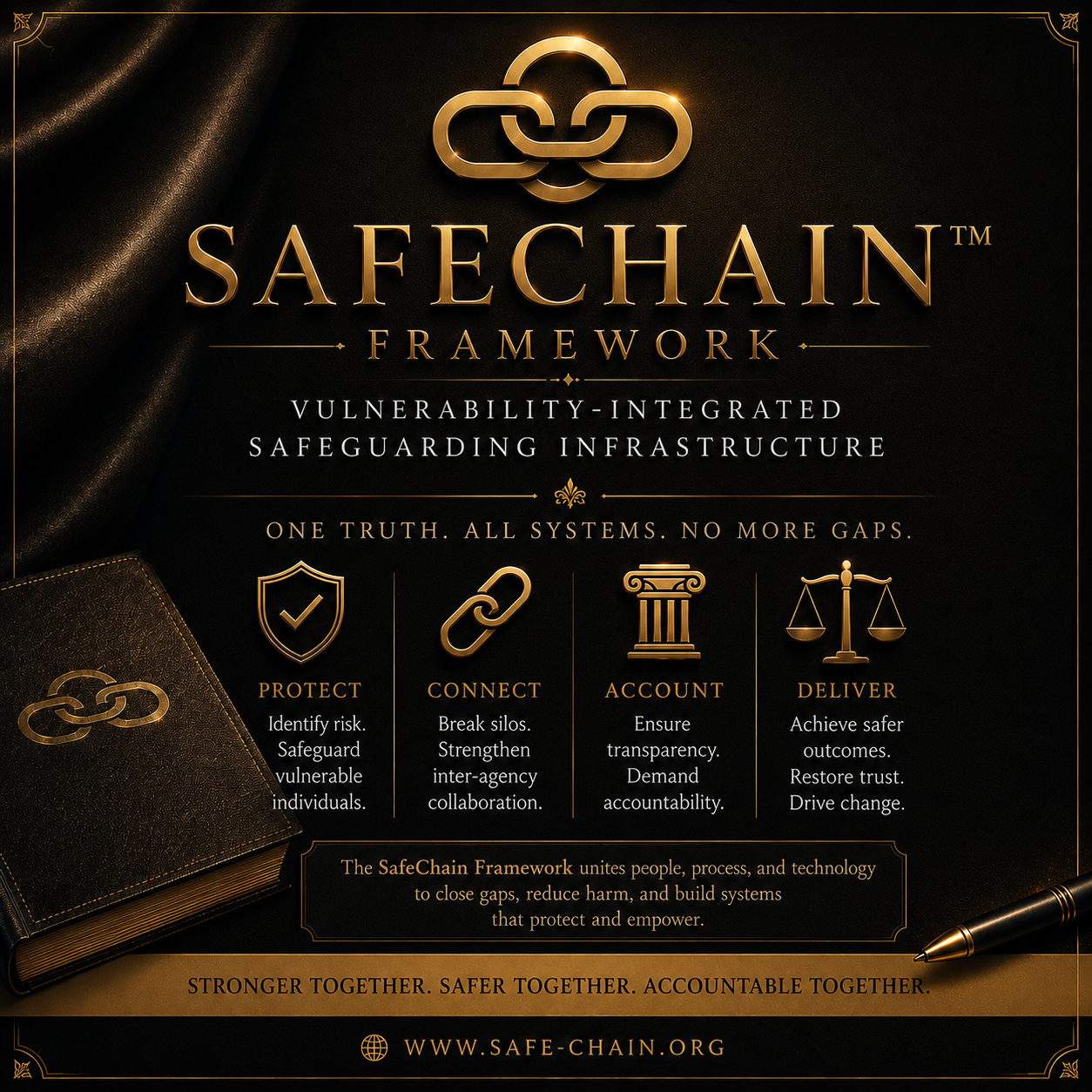
AI5™ — The SAFECHAIN™ Systemic Accountability Breakdown Framework™ establishes the highest-severity governance classification within the SAFECHAIN™ Accountability Integrity Series, applying where accountability failure has become structural, repeated or institutionally embedded.
The framework addresses situations in which ordinary internal mechanisms can no longer be relied upon to identify responsibility, establish truth, protect challenge, impose proportionate consequence, correct serious failure or prevent recurrence.
Through mechanisms including the SAFECHAIN™ AI5 Systemic Breakdown Architecture™, Internal Independence Exhaustion™, Challenge Dead-Zone™, Evidence Infrastructure Breakdown™, Systemic Accountability Pattern Map™, Accountability Breakdown Chronology™, Accountability Reconstruction Authority™, Governance Truth Recovery™, Accountability Reconstruction Model™, Systemic Accountability Reconstruction Plan™ and AI5 Systemic Accountability Breakdown Test™, organisations can identify when ordinary remediation is no longer enough and structural reconstruction is required.
AI5™ is built on a central principle:
Systemic accountability breakdown exists where institutional accountability mechanisms are structurally, culturally or operationally incapable of reliably identifying responsibility, establishing truth, protecting challenge, imposing appropriate consequence, correcting serious failure or preventing recurrence across the affected system.