AILEAD-001™
AILEAD-001™ — The SAFECHAIN™ Accountability Integrity Leadership, Executive & Board Accountability Framework™ establishes the governance standard for ensuring serious institutional accountability reaches the level where authority, knowledge, decision-making power and capacity to intervene actually existed.
The framework examines leadership authority, actual and constructive knowledge, warnings, executive decisions, omissions, safeguarding, affected-person impact, challenge, conflicts, board oversight, senior-level investigation, consequences, remediation, leadership culture and accountability continuity through leadership transition.
Through mechanisms including the SAFECHAIN™ Leadership Accountability Architecture™, Leadership Authority Map™, Authority–Accountability Alignment Test™, Leadership Knowledge Standard™, Leadership Warning Architecture™, Executive Decision Ownership Standard™, Leadership Omission Test™, Leadership Safeguarding Standard™, Board Accountability Architecture™, Board Assurance Reality Test™, Leadership Accountability Escalation Ladder™, Accountability Gradient™, Power–Accountability Symmetry Test™, Leadership Accountability Verification Gate™ and AILEAD-001™ Leadership, Executive & Board Accountability Integrity Test™, institutions can determine whether accountability genuinely follows authority or becomes progressively weaker as scrutiny moves upward.
AILEAD-001™ is built on a central principle:
Accountability should follow authority. The greater an individual’s institutional authority, decision-making power, access to information and capacity to prevent or correct harm, the greater the expectation that they can demonstrate responsible governance when serious failure occurs.
AICRIS-001™
AICRIS-001™ — The SAFECHAIN™ Accountability Integrity Crisis, Emergency & Exceptional Decision-Making Framework™ establishes the governance standard for preserving accountability when institutions operate under crisis, emergency, major incident or exceptional operational pressure.
The framework addresses emergency authority, exceptional decision thresholds, safeguarding, temporary control relaxation, evidence under pressure, proportionality, challenge, executive escalation, affected-person impact, decision recording, emergency power expiry, retrospective review, remedy and restoration of ordinary governance.
Through mechanisms including the SAFECHAIN™ Crisis Accountability Architecture™, Emergency Authority Test™, Exceptional Decision Threshold™, Crisis Safeguarding Assessment™, Temporary Control Relaxation Standard™, Evidence-in-Emergency Standard™, Crisis Decision Record™, Emergency Proportionality Test™, Crisis Challenge Standard™, Executive Emergency Escalation Route™, Emergency Power Expiry Gate™, Retrospective Accountability Review™, Crisis Remedy Review™, Emergency Governance Restoration Gate™, Crisis Accountability Verification Gate™ and AICRIS-001™ Crisis & Emergency Accountability Integrity Test™, institutions can determine whether emergency governance remained controlled, proportionate and accountable — or whether exceptional circumstances became an excuse for exceptional power without sufficient oversight.
AICRIS-001™ is built on a central principle:
Urgency may justify changing how governance operates, but it does not eliminate the need for accountability. Exceptional authority should remain necessary, proportionate, time-limited, evidence-based, safeguarding-aware, traceable and subject to review.
AITHIRD-001™
AITHIRD-001™ — The SAFECHAIN™ Accountability Integrity Third-Party, Contractor & Partnership Accountability Framework™ establishes the governance standard for preserving accountability when institutions deliver services, manage risk or exercise responsibility through contractors, suppliers, commissioned providers, delivery partners, professional advisers, subcontractors and other third parties.
The framework addresses delegated responsibility, retained institutional accountability, due diligence, safeguarding, contractual governance, evidence access, subcontracting, third-party monitoring, investigation authority, escalation, remedy, recurrence, renewal, termination and accountability continuity.
Through mechanisms including the SAFECHAIN™ Third-Party Accountability Architecture™, Delegated Responsibility Map™, Retained Accountability Principle™, Third-Party Due Diligence Standard™, Safeguarding Contract Gate™, Accountability Information Rights™, Subcontractor Visibility Test™, Third-Party Failure Escalation Route™, Institutional Responsibility Override™, No-Wrong-Door Accountability Standard™, Contractual Remedy Standard™, Renewal Integrity Test™, Exit & Termination Integrity Standard™, Third-Party Accountability Verification Gate™ and AITHIRD-001™ Third-Party Accountability Integrity Test™, institutions can determine whether accountability remains visible and enforceable across organisational and contractual boundaries.
AITHIRD-001™ is built on a central principle:
Delegation of performance does not automatically constitute delegation of institutional accountability.
AIINV-001™
AIINV-001™ — The SAFECHAIN™ Accountability Integrity Investigation & Fact-Finding Framework™ establishes the governance standard for conducting serious institutional investigations through independent, evidence-led, procedurally fair and safeguarding-aware fact-finding.
The framework addresses investigation thresholds, scope, investigator competence and independence, evidence preservation, evidential standards, witness and affected-person participation, contradictory and exculpatory evidence, credibility assessment, safeguarding, disclosure, investigation delay, institutional interference, findings, limitations, quality assurance and record integrity.
Through mechanisms including the SAFECHAIN™ Accountability Investigation Architecture™, Investigation Threshold Test™, Investigation Scope Standard™, Investigator Competence Standard™, Investigator Independence Gate™, Evidence Collection Protocol™, Contradictory Evidence Test™, Credibility Assessment Matrix™, Safeguarding Investigation Override™, Investigation Delay Alert™, Investigative Interference Alert™, Investigation Finding Architecture™, Finding Confidence Standard™, Investigation Quality Assurance Gate™, Investigation Closure Gate™ and AIINV-001™ Investigation & Fact-Finding Integrity Test™, institutions can determine whether findings were genuinely reached through impartial inquiry or shaped around a preferred institutional conclusion.
AIINV-001™ is built on a central principle:
An accountability finding is only as reliable as the investigation through which it was reached. Institutional fact-finding must seek, preserve, test and evaluate relevant evidence impartially, including evidence capable of contradicting the institution’s initial assumptions or preferred account.
AISYS-001™
AISYS-001™ — The SAFECHAIN™ Accountability Integrity Systemic Failure & Institutional Breakdown Framework™ establishes the governance standard for determining when repeated accountability failures are no longer isolated incidents but evidence of a wider structural, cultural, operational or governance breakdown.
The framework examines cross-case patterns, recurrence, systemic causation, cumulative harm, safeguarding risk, leadership knowledge, board visibility, data integrity, fragmentation, normalisation of deviance, structural reform, independent verification and systemic closure.
Through mechanisms including the SAFECHAIN™ Systemic Failure Architecture™, Systemic Signal Register™, Cross-Case Connection Test™, Recurrence Threshold Test™, Systemic Cause Test™, Systemic Failure Threshold™, Institutional Breakdown Threshold™, Systemic Individual-Blame Safeguard™, Normalisation of Deviance Test™, Accountability Fragmentation Alert™, Systemic Cumulative Harm Assessment™, Leadership Knowledge Test™, Systemic Governance Failure Test™, Systemic Evidence Matrix™, Systemic Failure Verification Gate™, Systemic Intervention Standard™, Systemic Remediation Verification Gate™ and AISYS-001™ Systemic Failure & Institutional Breakdown Integrity Test™, institutions can determine when the problem is no longer a series of separate cases but evidence that the accountability system itself is failing.
AISYS-001™ is built on a central principle:
Accountability failure becomes systemic when the evidence demonstrates that harmful outcomes are materially connected to recurring institutional conditions, structures, behaviours, controls, incentives, omissions or governance weaknesses rather than being adequately explained as isolated events.
AIPUB-001™
AIPUB-001™ — The SAFECHAIN™ Accountability Integrity Public Interest & Disclosure Framework™ establishes the governance standard for determining when accountability information has legitimate wider public significance and how disclosure should be managed when transparency, privacy, safeguarding, confidentiality and institutional reputation are all engaged.
The framework addresses public-interest thresholds, proportional disclosure, affected-person protection, identification risk, safeguarding overrides, institutional reputation conflicts, material omission, selective disclosure, correction duties, public-record integrity and disclosure reassessment.
Through mechanisms including the SAFECHAIN™ Public Interest Disclosure Architecture™, Public Interest Threshold Test™, Public Curiosity vs Public Interest Test™, Public Interest Decision Matrix™, Affected-Person Public Disclosure Protection Standard™, Institutional Reputation Conflict Test™, Material Omission Test™, Public Interest Disclosure Verification Gate™, Public Interest Correction Duty™, Public Record Integrity Standard™, Public Interest Escalation Ladder™, Public Interest Closure Gate™ and AIPUB-001™ Public Interest & Disclosure Integrity Test™, institutions can determine when wider disclosure genuinely serves public accountability and how to protect those who should not bear the cost of institutional transparency.
AIPUB-001™ is built on a central principle:
Public-interest disclosure should be governed by materiality, evidence, proportionality, lawful authority, safeguarding, affected-person protection and legitimate public accountability rather than institutional reputation or public curiosity alone.
AIREP-001™
AIREP-001™ — The SAFECHAIN™ Accountability Integrity Reparation & Institutional Repair Framework™ establishes the governance standard for determining what must be repaired after serious or systemic accountability failure where apology, compensation, correction or individual remedy alone is insufficient.
The framework examines continuing harm, record correction, service restoration, safeguarding repair, structural reform, cultural change, leadership accountability, affected-person participation, community impact, reparation milestones, verification and sustainability.
Through mechanisms including the SAFECHAIN™ Institutional Repair Architecture™, Reparation Eligibility Test™, Institutional Harm & Damage Map™, Institutional Acknowledgement Standard™, Affected-Person Repair Standard™, Corrective Reparation Standard™, Safeguarding Repair Standard™, Structural Repair Standard™, Cultural Repair Standard™, Collective & Community Reparation Standard™, Institutional Repair Plan™, Reparation Milestone Architecture™, Reparation Adequacy Test™, Affected-Person Outcome Verification Gate™, Independent Repair Verification™, Reparation Sustainability Gate™ and AIREP-001™ Reparation & Institutional Repair Integrity Test™, institutions can determine whether they have repaired what their failure damaged or merely completed the administrative actions attached to the case.
AIREP-001™ is built on a central principle:
Reparation requires institutions to address the continuing effects of serious accountability failure through proportionate acknowledgement, correction, remedy, structural change, affected-person participation and evidence-based institutional repair rather than treating procedural completion as equivalent to restoration.
SAFECHAIN Reparation Framework, AIREP-001, Institutional Repair, Accountability Reparation, Structural Repair, Cultural Repair, Affected-Person Repair, Safeguarding Repair, Institutional Restoration, Community Reparation, Corrective Reparation, Reparation Governance, Post-Failure Repair, Accountability Remedy, SAFECHAIN Accountability Integrity Series
Website Tags
SAFECHAIN™
AIREP-001™
Reparation
Institutional Repair
Accountability Reparation
Structural Repair
Cultural Repair
Affected-Person Repair
Safeguarding Repair
Corrective Reparation
Community Reparation
Institutional Acknowledgement
Service Restoration
Leadership Accountability
Repair Verification
Reparation Sustainability
Governance Accountability
Institutional Accountability
Post-Failure Governance
SAFECHAIN™ Accountability Integrity Series
AIWHISTLE-001™
AIWHISTLE-001™ — The SAFECHAIN™ Accountability Integrity Whistleblowing & Protected Disclosure Framework™ establishes the governance standard for receiving, protecting, investigating and escalating serious institutional concerns raised by employees, workers, contractors, professionals and other persons with legitimate access to accountability information.
The framework addresses protected disclosure routes, confidentiality, anonymity, anti-retaliation, power imbalance, evidence preservation, investigator independence, seniority bypass, safeguarding overrides, regulatory escalation, board visibility, post-disclosure monitoring and institutional learning.
Through mechanisms including the SAFECHAIN™ Protected Disclosure Architecture™, Protected Disclosure Route Standard™, Speak-Up Route™, Seniority Bypass Safeguard™, Disclosure Classification Architecture™, Confidentiality Protection Standard™, Anti-Retaliation Architecture™, Retaliation Detection Trigger™, Whistleblower Power Imbalance Safeguard™, Whistleblowing Investigator Independence Standard™, Protected Disclosure Investigation Protocol™, Safeguarding Disclosure Override™, Whistleblowing Escalation Ladder™, Board Whistleblowing Visibility Standard™, Post-Disclosure Protection Monitoring Standard™, Protected Disclosure Closure Gate™ and AIWHISTLE-001™ Whistleblowing & Protected Disclosure Integrity Test™, institutions can determine whether people can expose serious failure without being silenced, isolated or punished for doing so.
AIWHISTLE-001™ is built on a central principle:
A mature accountability institution does not measure the integrity of its speak-up system by whether people are permitted to raise concerns. It measures integrity by whether concerns can be raised safely, independently assessed, properly investigated, escalated where necessary and resolved without retaliation, suppression or institutional interference.
Focus SEO Keywords
SAFECHAIN Whistleblowing Framework, AIWHISTLE-001, Protected Disclosure Framework, Whistleblower Protection, Anti-Retaliation Governance, Speak-Up Framework, Confidential Reporting, Independent Investigation, Seniority Bypass, Protected Disclosure, Whistleblowing Governance, Institutional Speak-Up, Retaliation Detection, Board Whistleblowing Oversight, SAFECHAIN Accountability Integrity Series
SAFECHAIN™
AIWHISTLE-001™
Whistleblowing
Protected Disclosure
Whistleblower Protection
Anti-Retaliation
Speak-Up Culture
Confidential Reporting
Anonymous Disclosure
Independent Investigation
Seniority Bypass
Power Imbalance
Retaliation Detection
Evidence Preservation
Safeguarding Disclosure
Regulatory Escalation
Board Oversight
Institutional Accountability
Governance Accountability
SAFECHAIN™ Accountability Integrity Series
Primary Image:
AIWHISTLE-001™ — The SAFECHAIN™ Accountability Integrity Whistleblowing & Protected Disclosure Framework™ for safe reporting, anti-retaliation, independent investigation and protected institutional challenge.
SAFECHAIN™ AIWHISTLE-001 Whistleblowing & Protected Disclosure Framework™ connecting protected reporting, confidentiality, retaliation detection, evidence preservation, independent investigation, escalation and board oversight.
AIWHISTLE-001™ establishes the SAFECHAIN™ standard for ensuring people can expose serious institutional failure safely, with protection from retaliation, independent investigation and meaningful accountability action.
AIREG-001™
AIREG-001™ — The SAFECHAIN™ Accountability Integrity Regulatory Referral & Oversight Framework™ establishes the governance standard for determining when serious accountability failure must move beyond internal institutional control and be referred to a regulator, statutory body, professional authority or other competent oversight body.
The framework addresses referral thresholds, jurisdiction mapping, mandatory versus discretionary referral, safeguarding overrides, evidence preservation, referral ownership, institutional non-interference, parallel proceedings, regulator-response tracking, external findings and post-referral governance.
Through mechanisms including the SAFECHAIN™ Regulatory Referral Architecture™, Regulatory Referral Threshold Test™, Jurisdiction Mapping Architecture™, Regulatory Jurisdiction Map™, Mandatory vs Discretionary Referral Standard™, Safeguarding Referral Override™, Regulatory Evidence Preservation Standard™, Regulatory Referral Ownership Standard™, Regulatory Non-Interference Standard™, Parallel Proceedings Architecture™, Regulator Response Tracking Architecture™, External Finding Integration Standard™, Post-Referral Governance Architecture™, Regulatory Action Verification Gate™, Regulatory Closure Gate™ and AIREG-001™ Regulatory Referral & Oversight Integrity Test™, institutions can determine when accountability has become too serious, conflicted or externally significant to remain solely within internal control.
AIREG-001™ is built on a central principle:
Where an accountability matter falls within the jurisdiction of a competent external authority, meets an applicable mandatory reporting requirement, presents serious safeguarding or public-interest concerns, or cannot credibly be addressed through sufficiently independent internal processes, the institution should determine promptly and transparently whether external referral is required.
SAFECHAIN Regulatory Referral Framework, AIREG-001, Regulatory Oversight, Statutory Referral, Mandatory Reporting Governance, Jurisdiction Mapping, Safeguarding Referral, Professional Oversight, Regulatory Accountability, Evidence Preservation, External Referral, Post-Referral Governance, Regulatory Compliance Governance, Institutional Accountability, SAFECHAIN Accountability Integrity Series
SAFECHAIN™
AIREG-001™
Regulatory Referral
Regulatory Oversight
Statutory Referral
Mandatory Reporting
Jurisdiction Mapping
Safeguarding Referral
Professional Oversight
External Accountability
Evidence Preservation
Regulatory Governance
Parallel Proceedings
Regulator Response Tracking
Post-Referral Governance
External Findings
Institutional Accountability
Governance Accountability
Public Interest
SAFECHAIN™ Accountability Integrity Series
AIEXT-001™
AIEXT-001™ — The SAFECHAIN™ Accountability Integrity External Scrutiny & Independent Accountability Framework™ establishes the governance standard for determining when accountability must move beyond ordinary internal processes and be subjected to sufficiently independent external scrutiny.
The framework addresses reviewer independence, terms of reference, evidence access, institutional non-interference, protected participation, safeguarding, external findings, recommendation tracking, board oversight, publication integrity and closure verification.
Through mechanisms including the SAFECHAIN™ External Accountability Architecture™, External Scrutiny Threshold Test™, Independent Reviewer Appointment Standard™, Terms of Reference Integrity Test™, Evidence Access Guarantee™, Institutional Non-Interference Standard™, External Findings Standard™, External Finding Response Protocol™, Mandatory Action Tracking™, External Recommendation Closure Gate™, External Accountability Transparency Standard™, Independent Scrutiny Record™ and AIEXT-001™ External Scrutiny Integrity Test™, institutions can determine whether external review provides genuine accountability or merely symbolic reassurance.
AIEXT-001™ is built on a central principle:
External scrutiny should be sufficiently independent, evidence-enabled, properly scoped, protected from institutional interference and capable of producing findings, recommendations and follow-up actions that materially affect governance where the evidence requires it.
AILEG-001™
AILEG-001™ — The SAFECHAIN™ Accountability Integrity Legacy Risk & Historical Failure Framework™ establishes the governance standard for identifying and addressing historical accountability failures whose consequences remain materially relevant in the present.
The framework examines continuing harm, inaccurate historical records, failed remediation, safeguarding legacy, successor responsibility, unresolved remedy, recurrence, institutional memory loss and structural causes that remain embedded long after the original failure occurred.
Through mechanisms including the SAFECHAIN™ Legacy Accountability Architecture™, Historical Failure Identification Test™, Legacy Risk Map™, Historical Harm Review™, Continuing Consequence Test™, Historical Record Reassessment™, Successor Responsibility Standard™, Legacy Safeguarding Trigger™, Historical Correction Route™, Legacy Remedy Review™, Historical Cause Persistence Test™, Legacy Closure Gate™, Legacy Accountability Record™ and AILEG-001™ Legacy Risk & Historical Failure Integrity Test™, institutions can determine what obligations remain when the original people, structures or leadership have already moved on.
AILEG-001™ is built on a central principle:
The passage of time, change of personnel or organisational restructuring does not by itself extinguish the governance significance of historical accountability failure where material consequences, risks, records, learning obligations or affected-person impacts remain unresolved.
AICOMP-001™
AICOMP-001™ — The SAFECHAIN™ Accountability Integrity Compensation & Financial Redress Governance Framework™ establishes the governance standard for assessing and delivering financial redress where institutional accountability failure has caused or materially contributed to financial loss, hardship, additional expenditure or continuing economic harm.
The framework governs eligibility, evidence, causation, quantification, proportionality, hardship, interim relief, non-financial remedy, consistency, independent review, payment verification and closure, while distinguishing legal entitlement from governance redress and discretionary compensation.
Through mechanisms including the SAFECHAIN™ Financial Redress Architecture™, Compensation Eligibility Assessment™, Loss & Impact Schedule™, Causation Review Standard™, Financial Remedy Proportionality Matrix™, Vulnerability & Hardship Override™, Compensation Avoidance Alert™, Redress Consistency Test™, Approval & Authority Record™, Financial Redress Reassessment Trigger™, Payment Verification Gate™, Financial Redress Reality Test™ and AICOMP-001™ Compensation & Financial Redress Integrity Test™, institutions can determine whether financial harm is being assessed fairly or defensively minimised.
AICOMP-001™ is built on a central principle:
Financial redress should be governed through evidence, causation, proportionality, consistency, lawful authority and affected-person impact, with neither institutional convenience nor reputational concern determining whether an established loss is properly considered.
AITRANS-001™
AITRANS-001™ — The SAFECHAIN™ Accountability Integrity Transparency & Public Accountability Framework™ establishes the governance standard for ensuring that material accountability information is communicated accurately, proportionately, contextually and without misleading stakeholders through selective disclosure, omission or unsupported institutional narrative.
The framework covers material transparency thresholds, adverse findings, public-interest disclosure, correction, remediation status, unresolved risk, safeguarding confidentiality, affected-person privacy, stakeholder reporting, board visibility, transparency delay, narrative drift and independent verification.
Through mechanisms including the SAFECHAIN™ Accountability Transparency Architecture™, Material Transparency Threshold™, Public Interest Disclosure Test™, Adverse Finding Transparency Rule™, Correction Disclosure Standard™, Remediation Transparency Record™, Unresolved Risk Disclosure Rule™, Safeguarding Transparency Rule™, Stakeholder Transparency Standard™, Selective Disclosure Alert™, Accountability Narrative Integrity Test™, Public Accountability Record™, Transparency Verification Gate™ and AITRANS-001™ Transparency Integrity Test™, institutions can determine whether transparency reveals accountability reality or simply manages perception.
A central principle of AITRANS-001™ is:
Truth can be materially distorted through selective accuracy as well as direct falsehood.
AIMEM-001™
AIMEM-001™ — The SAFECHAIN™ Accountability Integrity Institutional Memory & Knowledge Preservation Framework™ establishes the governance standard for preserving the lessons, evidence, decisions, historical context and critical knowledge arising from serious accountability failure.
The framework addresses a major institutional risk: lessons being lost when staff leave, leadership changes, organisations restructure, systems migrate or historical records become fragmented and inaccessible. It ensures that accountability learning survives beyond the people who originally experienced the failure and remains available to inform future governance, safeguarding, risk and decision-making.
Through mechanisms including the SAFECHAIN™ Institutional Memory Architecture™, Accountability Knowledge Record™, Critical Learning Preservation Standard™, Decision Memory Map™, Evidence Retention Link™, Leadership Transition Handover™, Historical Risk Register™, Institutional Amnesia Alert™, Learning Loss Trigger™, Knowledge Continuity Test™, Legacy Accountability Record™, Institutional Memory Reporting Pack™ and AIMEM-001™ Institutional Memory Integrity Test™, institutions can preserve not only what happened, but why it happened, what changed and what must not be repeated.
AIMEM-001™ is built on a central principle:
A lesson is not institutional learning until the institution can retain it beyond the individuals who learned it, retrieve it when the risk returns and apply it to future decisions.
AIREV-001™
AIREV-001™ — The SAFECHAIN™ Accountability Integrity Review & Appeal Framework™ establishes the governance standard for ensuring accountability decisions can be meaningfully challenged, independently reviewed and corrected where material error, procedural unfairness, new evidence, safeguarding concerns or independence failures are established.
The framework examines whether review and appeal mechanisms are genuinely capable of changing an outcome rather than simply confirming the institution’s original position. It covers review eligibility, appeal thresholds, grounds of review, new evidence, procedural fairness, material error, reviewer independence, evidence access, affected-person participation, safeguarding, interim protection, decision substitution, remittal, delay, finality and reopening.
Through mechanisms including the SAFECHAIN™ Review & Appeal Architecture™, Review Eligibility Test™, Appeal Threshold Test™, Grounds of Review Matrix™, New Evidence Admission Standard™, Procedural Fairness Review™, Material Error Review™, Reviewer Independence Standard™, Evidence Access Standard™, Affected-Person Participation Standard™, Safeguarding Review Override™, Interim Protection Trigger™, Review Outcome Matrix™, Decision Substitution Standard™, Remittal Standard™, Review Delay Alert™, Finality & Reopening Rule™, External Review Trigger™, Review & Appeal Record™ and AIREV-001™ Review & Appeal Integrity Test™, institutions can determine whether challenge is meaningful in substance and whether defective accountability decisions can actually be corrected.
AIREV-001™ is built on a central principle:
A credible review or appeal mechanism must be capable of identifying material error, testing contested evidence, examining procedural fairness, operating with sufficient independence and changing the original outcome where the evidence or governance integrity requires it.
AICORR-001™
AICORR-001™ — The SAFECHAIN™ Accountability Integrity Correction & Reconsideration Framework™ establishes the governance standard for determining what institutions must do when reliable evidence demonstrates that a previous record, finding, decision, classification or institutional position is materially wrong, incomplete or no longer defensible.
The framework moves beyond simple acknowledgement of error and requires institutions to examine what must actually be corrected, which decisions depended upon the error, what consequences flowed from it, who must be notified, whether safeguarding or continuing harm is affected, and whether correction has genuinely taken effect across institutional systems.
Through mechanisms including the SAFECHAIN™ Accountability Correction Architecture™, Material Error Threshold Test™, Correction Eligibility Standard™, Record Correction Protocol™, Decision Reconsideration Standard™, Consequential Decision Review™, Historical Integrity Preservation Rule™, Affected-Person Correction Notice™, Safeguarding Correction Override™, Correction Delay Alert™, Institutional Resistance to Correction Alert™, Independent Correction Review™, Correction Ownership Record™, Correction Verification Gate™ and AICORR-001™ Correction & Reconsideration Integrity Test™, institutions can ensure that error is not merely recognised but operationally corrected.
AICORR-001™ is built on a central principle:
Accountability integrity requires institutions not only to identify error, but to correct the records, decisions, consequences and continuing effects that flow from that error where lawful authority and evidence permit.
AIESC-001™
AIESC-001™ — The SAFECHAIN™ Accountability Integrity Escalation & Intervention Framework™ establishes the governance standard for determining when ordinary accountability processes are no longer sufficient and serious, continuing, repeated or systemic failure must be escalated to a higher level of institutional authority.
The framework addresses failed ordinary processes, continuing harm, safeguarding risk, repeated non-response, implementation failure, recurrence, independence failure, leadership obstruction, executive intervention, board escalation and external scrutiny.
Through mechanisms including the SAFECHAIN™ Accountability Escalation Architecture™, Escalation Threshold Test™, Ordinary Process Failure Trigger™, Critical Accountability Intervention Trigger™, Safeguarding Escalation Override™, Continuing Harm Escalation Rule™, Executive Intervention Standard™, Board Escalation Standard™, Independence Failure Escalation Trigger™, Repeated Non-Response Alert™, Escalation Ownership Record™, External Escalation Threshold™, Intervention Verification Gate™ and AIESC-001™ Escalation & Intervention Integrity Test™, institutions can ensure that serious accountability failure becomes progressively more visible and subject to stronger intervention where ordinary processes are unable or unwilling to resolve it.
AIESC-001™ is built on a central principle:
Serious or continuing accountability failure should become progressively more visible and subject to progressively stronger intervention where ordinary processes are unable, unwilling or insufficiently independent to resolve it.
AIEVAL-001™
AIEVAL-001™ — The SAFECHAIN™ Accountability Integrity Evaluation & Reassessment Framework™ establishes the governance standard for determining when previous accountability findings, decisions, classifications and institutional conclusions should be formally reconsidered.
The framework addresses situations where new evidence emerges, contradictory evidence becomes available, assumptions fail, circumstances materially change, implementation proves ineffective, impact does not occur, recurrence develops, safeguarding risk continues or independence concerns undermine the original process.
Through mechanisms including the SAFECHAIN™ Accountability Evaluation & Reassessment Architecture™, Reassessment Trigger Architecture™, New Evidence Standard™, Reassessment Threshold Test™, Reassessment Evidence Preservation Gate™, Failed Assumption Review™, Safeguarding Reassessment Gate™, Independent Reassessment Standard™, Reassessment Evidence Pack™, Evidence Comparison Matrix™, Classification Reassessment Standard™, Reassessment Decision Matrix™, External Reassessment Trigger™, Reassessment Outcome Record™ and AIEVAL-001™ Evaluation & Reassessment Integrity Test™, institutions can determine whether an original accountability conclusion remains defensible in light of the evidence now available.
AIEVAL-001™ is built on a central principle:
Institutional accountability requires conclusions to remain open to proportionate reassessment where material new evidence, changed circumstances, failed assumptions, implementation outcomes, safeguarding developments or recurrence materially affect the reliability of the original determination.
AIIMPACT-001™
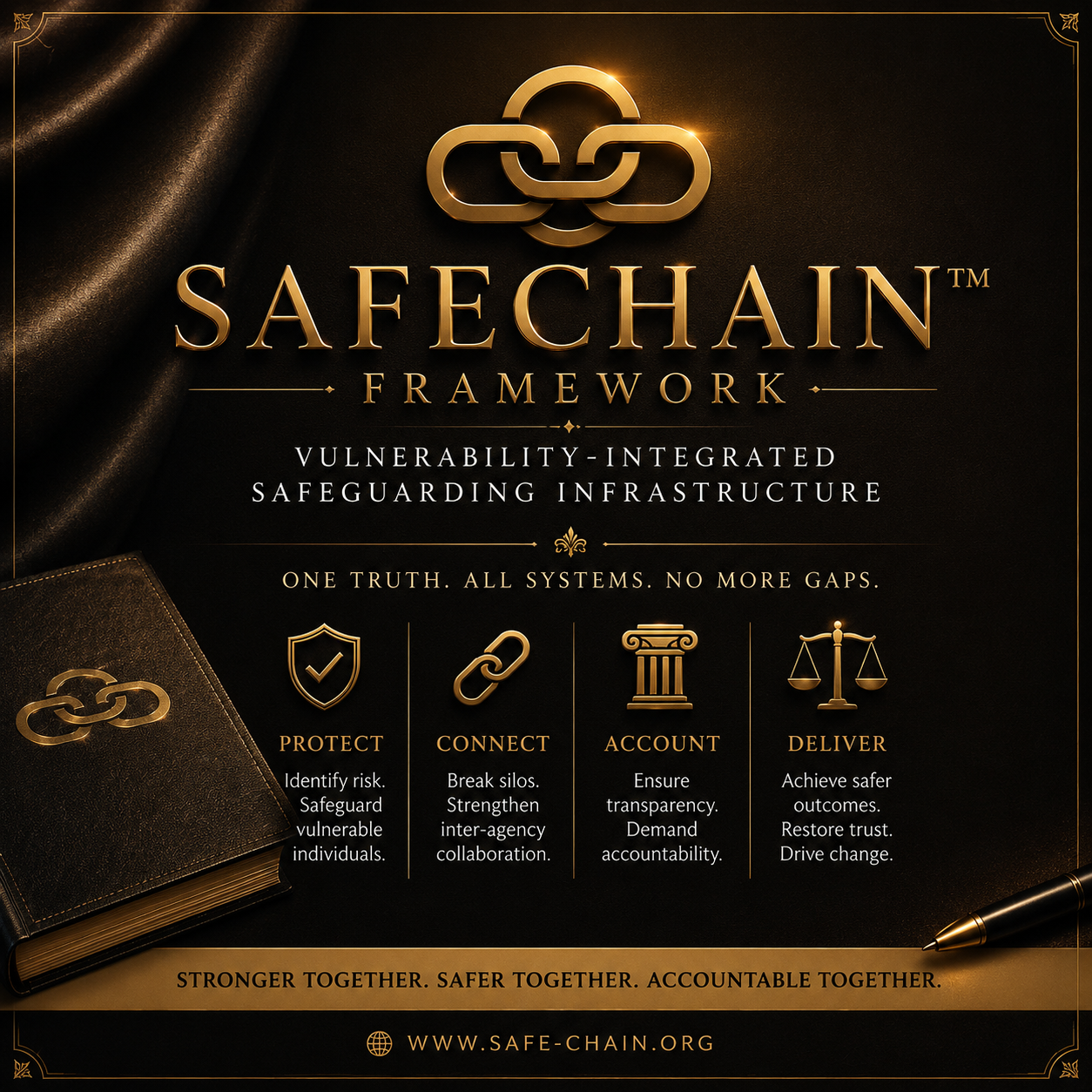
AIIMPACT-001™ — The SAFECHAIN™ Accountability Integrity Impact & Effectiveness Framework™ establishes the governance standard for determining whether accountability activity produces meaningful, measurable and sustainable institutional change.
The framework moves beyond counting investigations, recommendations, policies, training and completed actions to assess whether accountability actually improves behaviour, governance integrity, safeguarding, decision quality, affected-person outcomes, recurrence risk, independence, challenge, leadership accountability and institutional learning.
Through mechanisms including the SAFECHAIN™ Accountability Impact Architecture™, Accountability Effectiveness Baseline™, Intended Impact Map™, Outcome Indicator Set™, Behavioural Change Test™, Governance Change Test™, Safeguarding Impact Test™, Affected-Person Impact Test™, Recurrence Reduction Measure™, Institutional Learning Effectiveness Test™, Unintended Consequence Review™, Accountability Impact Score™, Longitudinal Effectiveness Review™ and AIIMPACT-001™ Impact & Effectiveness Integrity Test™, institutions can determine whether accountability has produced demonstrable improvement rather than merely administrative activity.
AIIMPACT-001™ is built on a central principle:
Accountability should ultimately be judged by the measurable and sustainable difference it produces in institutional behaviour, governance integrity, safeguarding, affected-person outcomes and recurrence risk—not merely by the volume of accountability activity undertaken.