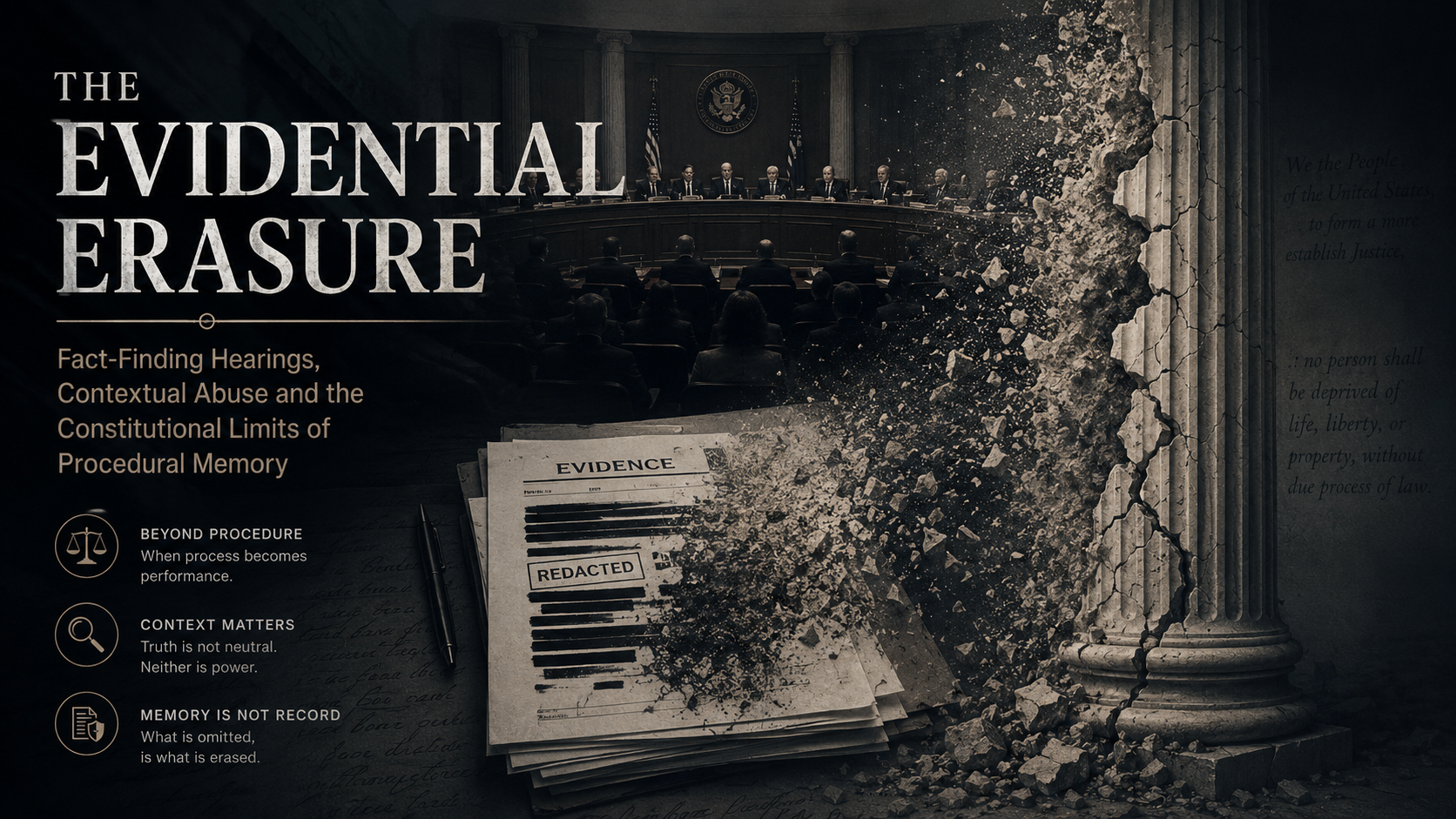
THE EVIDENTIAL ERASURE
Fact-finding hearings determine far more than disputed allegations. They determine what institutional systems will officially remember — and what will disappear from safeguarding architecture altogether. The Evidential Erasure examines coercive control, contextual abuse, Article 6 rights, PD12J, participation impairment and the constitutional limits of procedural memory within modern family justice systems.
THE FRACTURED STATE
This report examines how fragmented governments, unstable institutions, economic insecurity, and global political tensions affect domestic abuse, child wellbeing, public trust, and collective healing. It positions SAFECHAIN™ as a framework for institutional coherence, safeguarding continuity, and trauma-informed systems reform.
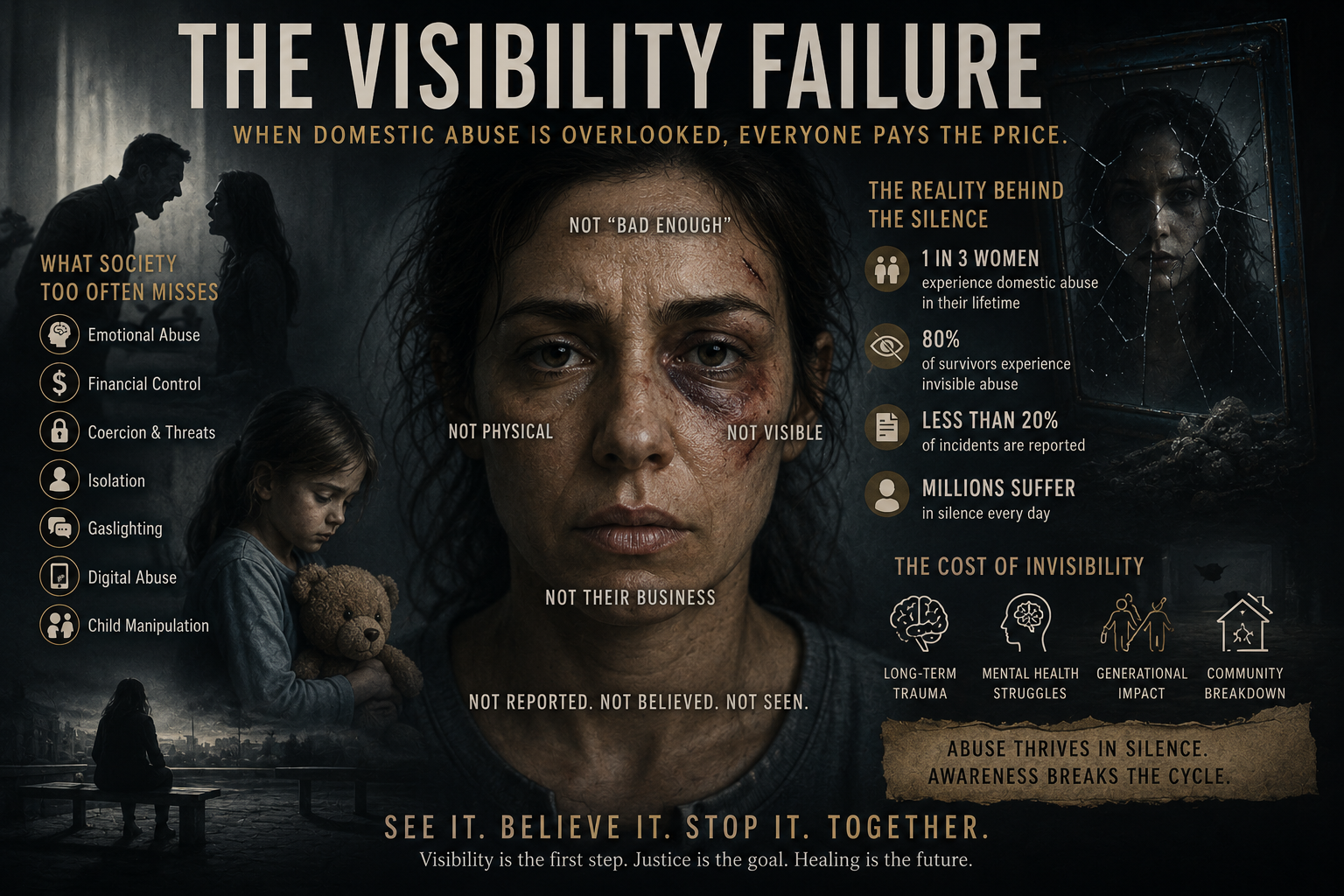
THE VISIBILITY FAILURE
Modern family justice systems increasingly recognise vulnerability, coercive control and trauma-informed safeguarding in principle. Yet operationally, many procedural environments continue rewarding compliance, composure and procedural fluency while misinterpreting trauma responses as unreliability, hostility or non-compliance. The Compliance Trap examines the growing constitutional gap between vulnerability recognition and meaningful participation, analysing Article 6 rights, PD3AA, the Equal Treatment Bench Book, equality of arms and the operational realities of trauma within adversarial systems. The report argues that safeguarding cannot remain procedural symbolism alone — it must become operationally capable of recognising cumulative trauma without converting vulnerability into procedural disadvantage.

THE COMPLIANCE TRAP
Modern family justice systems increasingly recognise vulnerability, coercive control and trauma-informed safeguarding in principle. Yet operationally, many procedural environments continue rewarding compliance, composure and procedural fluency while misinterpreting trauma responses as unreliability, hostility or non-compliance. The Compliance Trap examines the growing constitutional gap between vulnerability recognition and meaningful participation, analysing Article 6 rights, PD3AA, the Equal Treatment Bench Book, equality of arms and the operational realities of trauma within adversarial systems. The report argues that safeguarding cannot remain procedural symbolism alone — it must become operationally capable of recognising cumulative trauma without converting vulnerability into procedural disadvantage.

Comparative Domestic Abuse Frameworks
This comparative report examines how domestic abuse laws differ across global jurisdictions and why fragmented legal systems often fail to protect survivors consistently. From Scotland’s integrated coercive control framework to state-based models in the US and Australia, the article explores the urgent need for connected safeguarding systems, institutional continuity, and survivor-centred reform.

THE FRACTURED STATE
This report examines how fragmented governments, unstable institutions, economic insecurity, and global political tensions affect domestic abuse, child wellbeing, public trust, and collective healing. It positions SAFECHAIN™ as a framework for institutional coherence, safeguarding continuity, and trauma-informed systems reform.
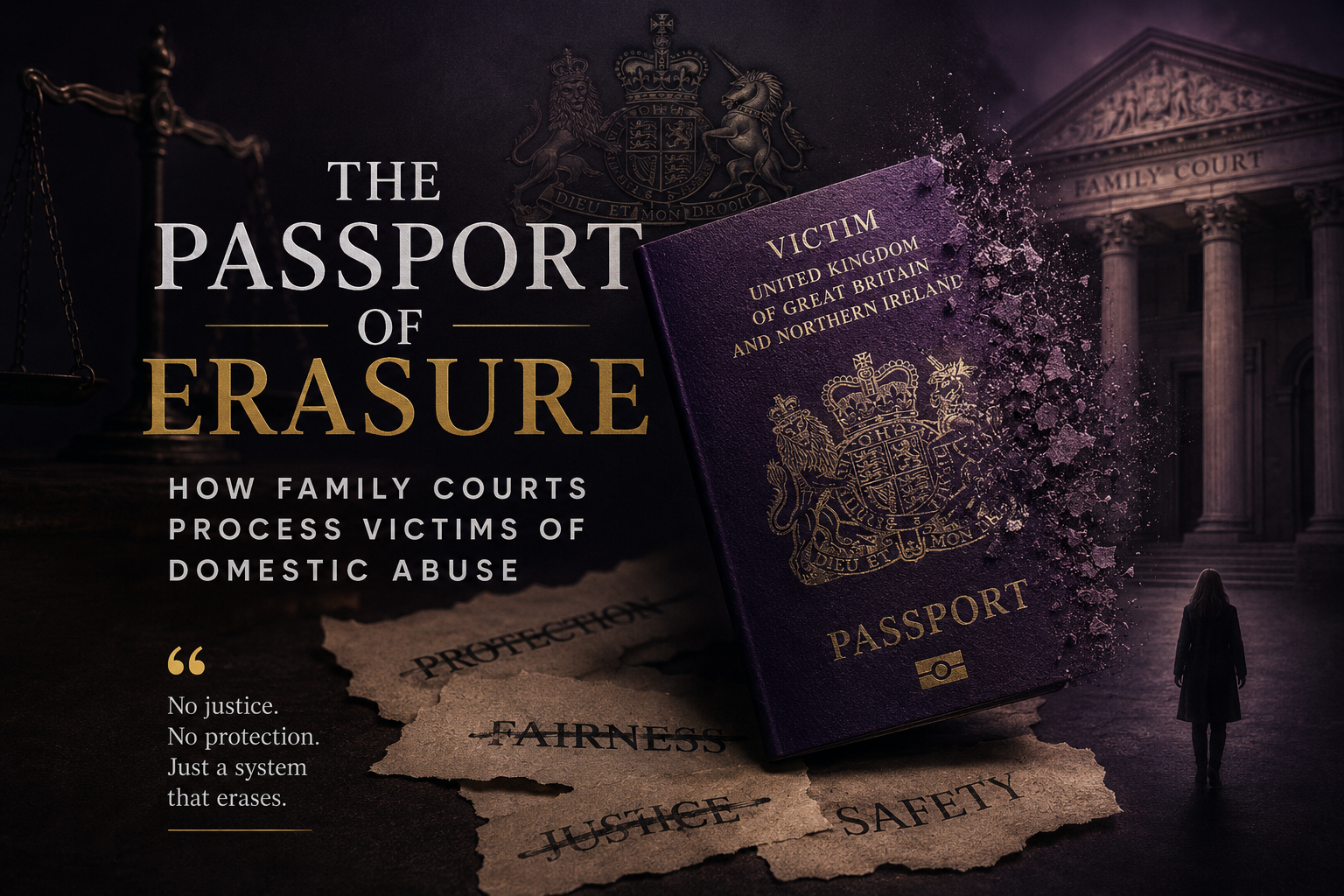
THE PASSPORT OF ERASURE — HOW FAMILY COURTS PROCESS VICTIMS OF DOMESTIC ABUSE
The Passport of Erasure examines how victims of domestic abuse can be processed through Family Court systems in ways that compound trauma rather than resolve it. Grounded in the Domestic Abuse Act 2021, Human Rights Act 1998, Family Procedure Rules, and Matrimonial Causes Act 1973, this article exposes the legal and structural gaps that allow coercive control, non-disclosure, financial erosion, and participation impairment to continue under the appearance of procedure.

THE MISSING BILL - King’s Speech
The King’s Speech 2026 promised national renewal, fairness and safer communities, yet failed to place family justice reform at the centre of the legislative agenda. This article examines the missing bill: a dedicated reform framework addressing coercive litigation, economic abuse, participation impairment, safeguarding failures and the structural realities of domestic abuse within family proceedings.

STRATEGIC OBFUSCATION
Strategic Obfuscation, Economic Abuse and Family Justice Reform | King’s Speech 2026 & Brighter Britain
Economic abuse within family proceedings is increasingly operating through strategic obfuscation: procedural delay, disclosure asymmetry, financial fragmentation and coerced economic destabilisation. This article examines how coercive control evolves through legally structured opacity, why institutional silos continue failing survivors, and why the King’s Speech 2026 omitted one of the most significant safeguarding gaps within modern Britain.

FACT-FINDING HEARINGS: THE PROCEDURAL PIVOT POINT
Fact-finding hearings are not merely procedural stages in family court. They determine what becomes legally recognised, what enters institutional memory, and what disappears from protection. This article examines why the King’s Speech 2026 and “Brighter Britain” agenda remain incomplete without structural reform of fact-finding hearings, coercive control recognition and trauma-informed safeguarding.

Legal Aid, Inequality of Arms and the Procedural Economy of Family Proceedings
The modern family justice system increasingly operates within a procedural economy in which access to justice is shaped not merely by legal principle or evidential merit, but by financial endurance, procedural stamina and psychological survivability. This article examines how reductions in legal aid and structurally unequal litigation environments risk undermining Article 6 fairness, participation integrity and safeguarding outcomes within family proceedings.
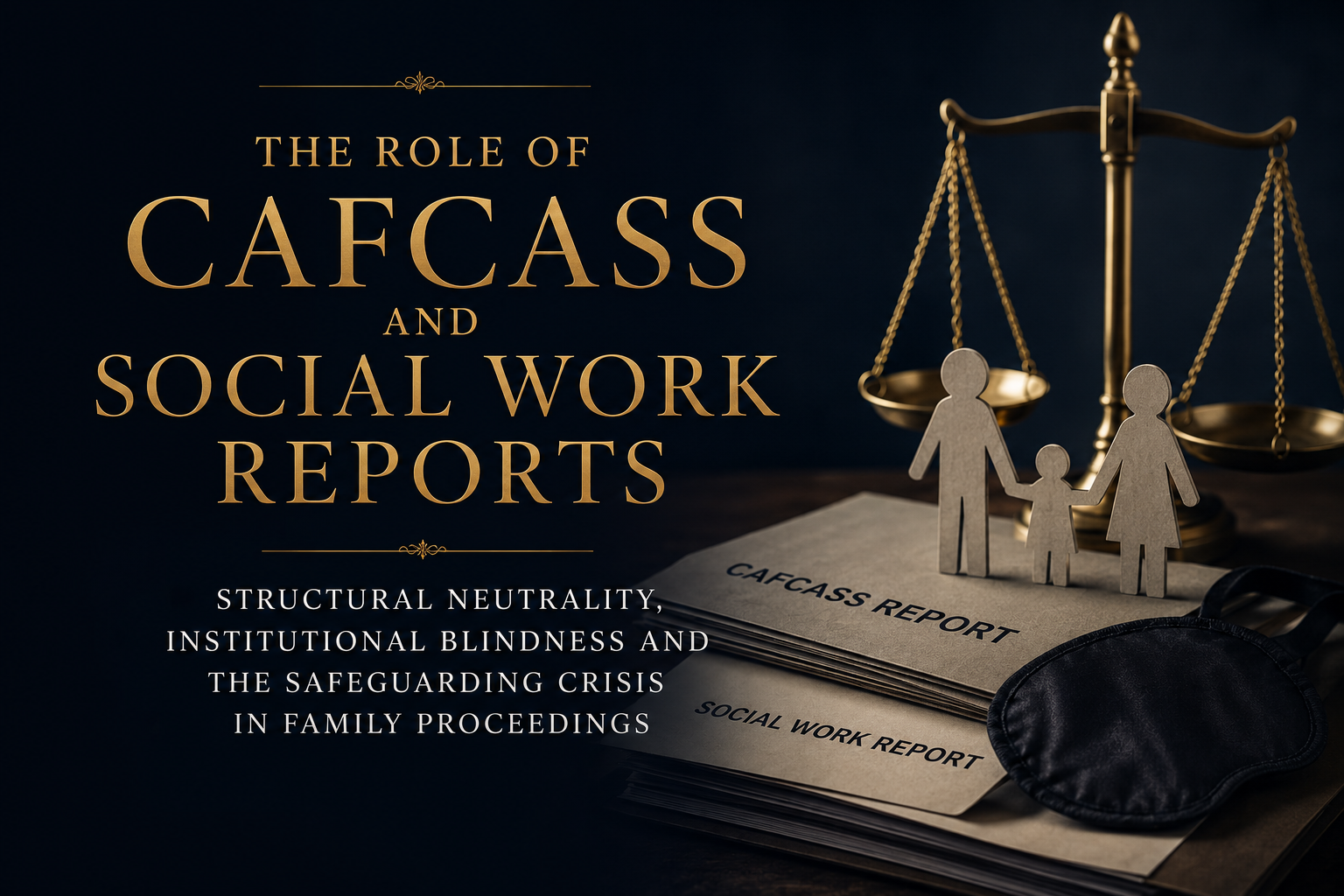
The Role of CAFCASS and Social Work Reports: Structural Neutrality, Institutional Blindness and the Safeguarding Crisis in Family Proceedings
The contemporary family justice system increasingly recognises coercive control doctrinally while remaining structurally configured around outdated assumptions of conflict, mutuality and episodic abuse. This article examines why current safeguarding frameworks — particularly CAFCASS and social work reporting structures — remain operationally ill-equipped to identify coercive control accurately within procedurally compressed family proceedings.

UNMASKING JUSTICE
Unmasking Justice is a powerful new book exploring survival, systemic failure, coercive control and the rebuilding of dignity through truth, reform and resilience. Launching at the SAFECHAIN™ Masquerade Gala at Lainston House Hotel on 30 October 2026, the evening marks not only the release of a book, but the beginning of a wider movement for safeguarding, accountability and change.

UNMASKING JUSTICE - The Masquerade Gala™A Night of Truth, Reclamation and New History
A powerful evening of truth, reclamation and reform at Lainston House Hotel, Hampshire. The UNMASKING JUSTICE Masquerade Gala marks the launch of Unmasking Justice, the burial of shame, and the rise of SAFECHAIN™ as a movement for justice, dignity and systemic change.

The “Parental Alienation” Counter-Strategy, Participation Integrity and the Structural Limits of Safeguarding in Family Proceedings
The family justice system increasingly recognises coercive control doctrinally while continuing to struggle operationally with the distinction between genuine emotional harm and protective parenting shaped by trauma and abuse. The issue is no longer whether emotional manipulation of children can occur. The issue is whether safeguarding systems possess sufficient structural sophistication to distinguish coercive dynamics from trauma-informed protective behaviour within adversarial proceedings.

Structural Silence, Coercive Personality Structures and the “Alter Ego” Problem in Family Proceedings
Corporate structures can be lawful, but in coercive control litigation they may also become vehicles for financial obfuscation, disclosure imbalance and procedural domination. This article examines the “alter ego” problem in family proceedings, the institutional integrity concerns raised by aggressive litigation conduct, and why safeguarding must move beyond discretion toward operational accountability.
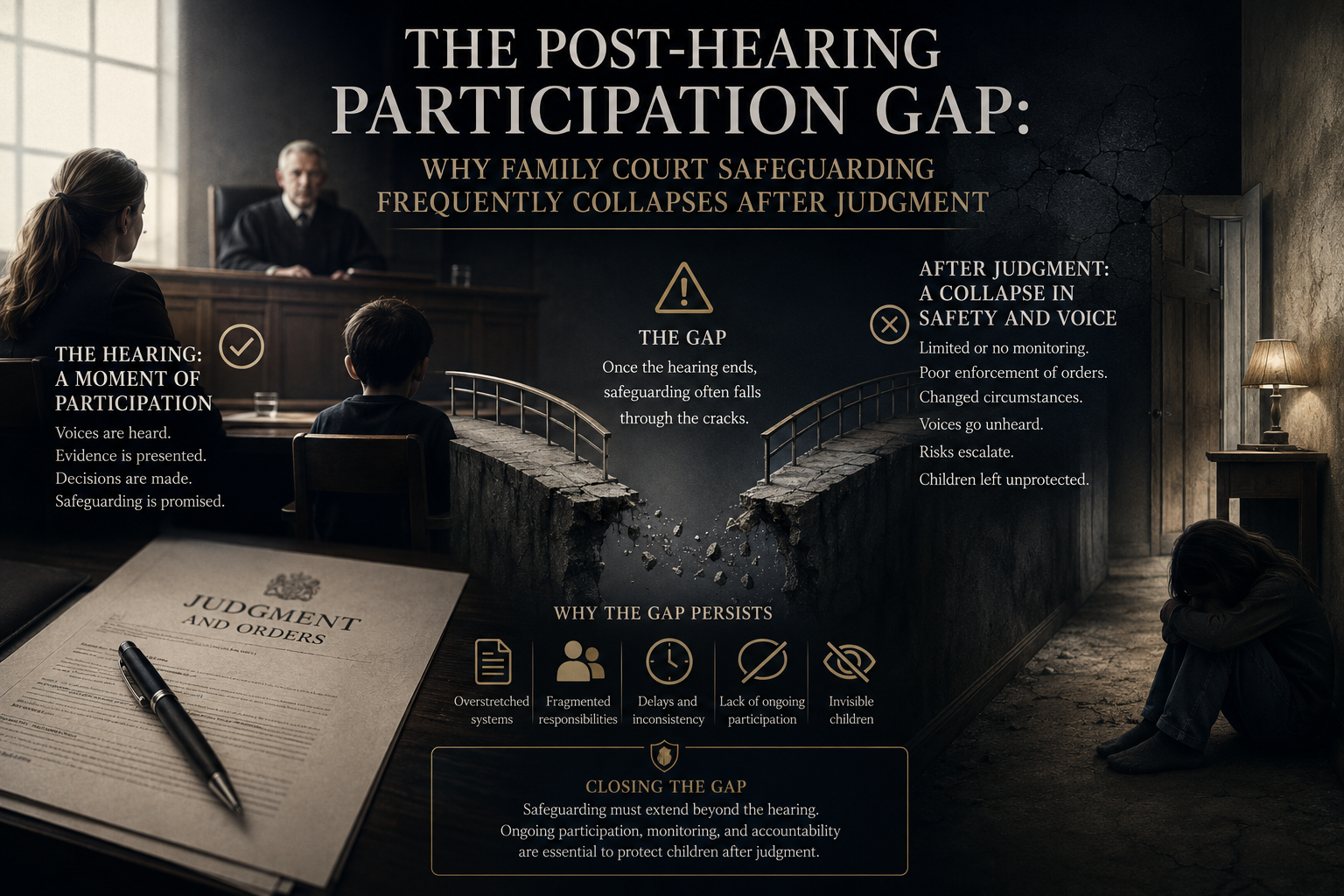
The Post-Hearing Participation Gap: Why Family Court Safeguarding Frequently Collapses After Judgment
Many survivors believe a family court order will bring closure, but for those facing coercive control, the post-hearing phase can become a new site of manipulation. This article examines vague drafting, enforcement barriers, implementation abuse and the safeguarding gap that emerges after judgment.
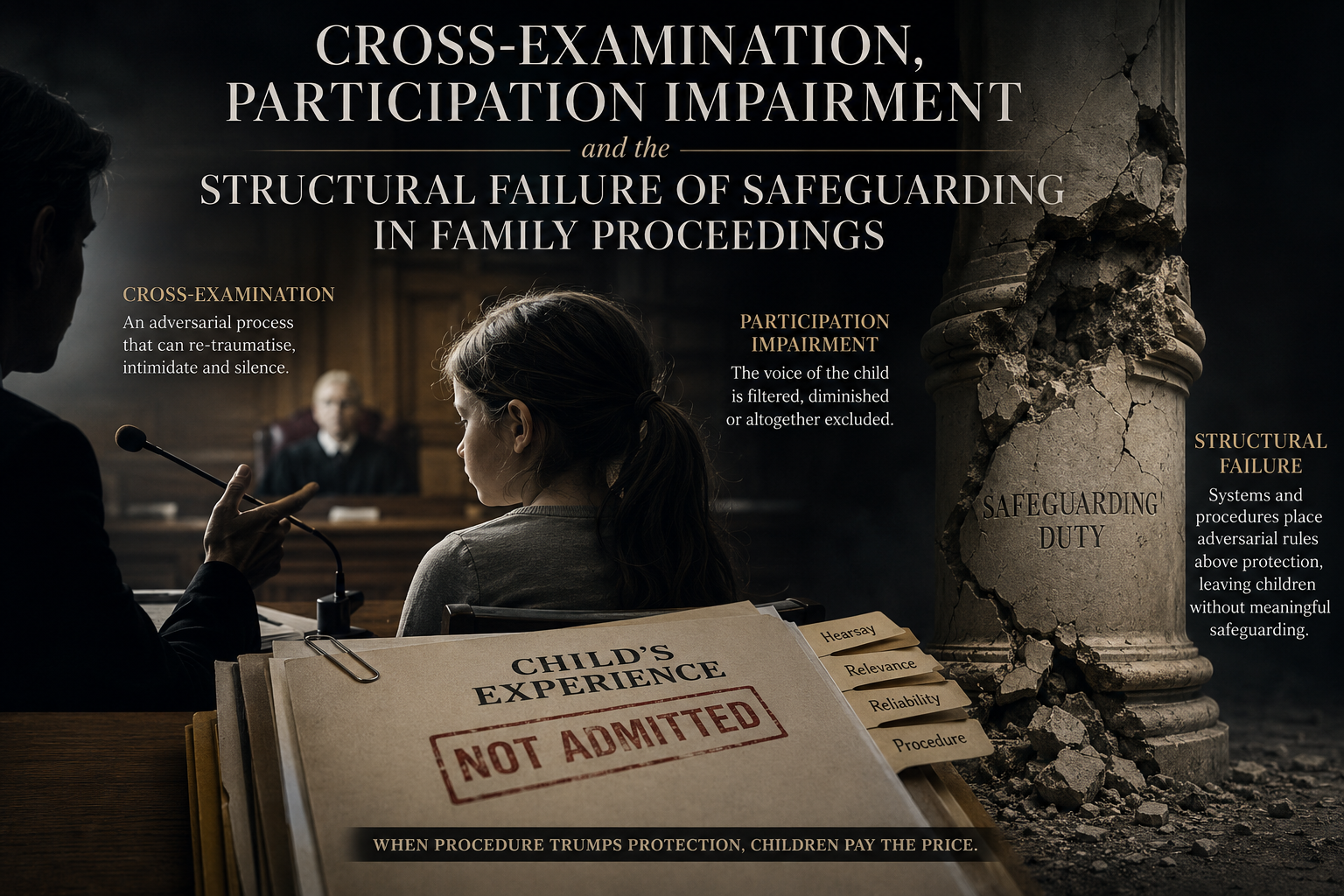
Cross-Examination, Participation Impairment and the Structural Failure of Safeguarding in Family Proceedings
The family justice system increasingly recognises vulnerability doctrinally while failing to operationalise it structurally. This contradiction is most visible during cross-examination, where trauma responses are routinely misinterpreted as credibility failures. The issue is no longer whether safeguarding exists in principle, but whether the system is capable of delivering meaningful participation in practice.

The Illusion of Participation: Why Being Present in Family Court Is Not the Same as Being Heard
Many survivors are physically present in family court but psychologically unable to participate effectively. This article examines the gap between attendance and meaningful engagement, exploring trauma, coercive control, Article 6 fairness, participation directions and why courts must move beyond procedural checklists toward trauma-informed justice.
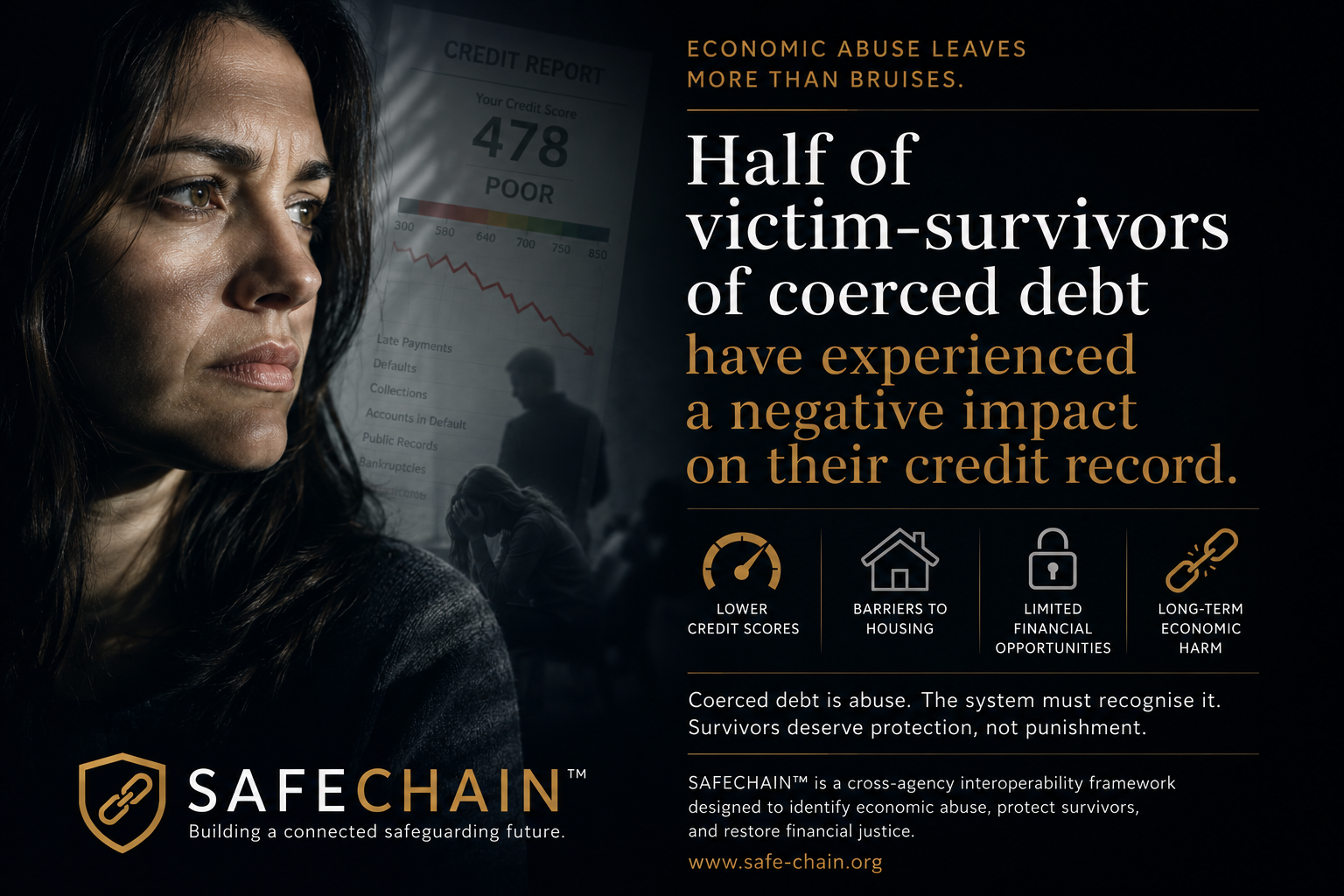
Coerced Debt Negative Impact on Their Credit Record
Coerced debt does not end when the abuse ends. For many survivors, damaged credit records, mortgage barriers and financial exclusion become a continuation of coercive control. This article explores why SAFECHAIN™ is proposing a connected safeguarding framework to protect survivors from credit destruction and economic erasure.