
APPLIED INSTITUTE ANALYSIS SERIES — AIAS-012
AAS-012, Institutional Capture™: Applying Paper 32 — The Power Paradox™, examines how institutions created to protect the public may become increasingly focused on managing exposure, reputation, procedure, and organisational risk. The paper explores institutional self-protection as a governance condition, not a claim of bad faith, and connects AAS-010 and AAS-011 to the next phase of preventable harm analysis.
APPLIED INSTITUTE ANALYSIS SERIES —AIAS-011
AAS-011, The Accountability Gap™: When Harm Exists But Accountability Does Not, examines how accountability becomes difficult to identify in complex systems. Building on AAS-001 to AAS-010, the paper distinguishes accountability from blame and explores why institutions may recognise harm, publish recommendations, and identify lessons while still failing to establish clear accountability pathways.
APPLIED INSTITUTE ANALYSIS SERIES —AIAS-010
AAS-010, The Implementation Paradox™: When Knowing Is Not the Same as Doing, examines the gap between institutional awareness and operational change. The paper asks why systems continue producing harmful or ineffective outcomes even after training, guidance, research, legislation, and recommendations already exist.

APPLIED ANALYSIS SERIES — AAS-009
Website Excerpt
AAS-009, The Administrative Weaponisation of Procedure, examines how individually reasonable procedural requirements can become collectively overwhelming for vulnerable individuals, litigants in person, and domestic abuse survivors. Through the SAFECHAIN™ lens, the paper explores cumulative procedural burden, participation impairment, equality of arms, and institutional fairness.

AIAS-008: Economic Abuse, Coercive Debt & Financial Remedy Reform
AAS-008, Economic Abuse, Coercive Debt, and the Financial Remedy Blind Spot, examines how economic abuse can continue after separation through debt, mortgage arrears, credit damage, asset concealment, litigation pressure, and financial remedy proceedings. The paper applies SAFECHAIN™ architecture to argue that financial justice requires disclosure integrity, safeguarding continuity, equality of arms, and governance systems capable of recognising coercive financial control.

APPLIED INSTITUTE ANALYSIS SERIES —AIAS-007
AAS-007, Non-Fatal Strangulation and the Failure of Risk Transmission, examines how one of the clearest high-risk domestic abuse indicators can become diluted, delayed, or lost as it moves between institutions. Through the SAFECHAIN™ lens, the paper analyses risk transmission, Disclosure Integrity™, the Implementation Paradox™, the Coordination Deficit™, the Continuity Deficit™, and institutional responsibility.

APPLIED INSTITUTE ANALYSIS SERIES —AIAS-006
AAS-006, The Pro-Contact Culture Problem, examines how family justice systems balance parental involvement with safeguarding duties where domestic abuse, coercive control, stalking, intimidation, or unresolved risk factors are present. Through the SAFECHAIN™ lens, the paper explores how assumptions, participation barriers, fragmented safeguarding information, and disclosure gaps may affect child contact decision-making.

APPLIED INSTITUTE ANALYSIS SERIES —AIAS-005
AAS-005, Financial Remedies and Disclosure Integrity™, examines why financial justice depends on reliable, verified disclosure. The paper argues that Form E compliance alone is not enough where non-disclosure, business assets, coercive control, economic abuse, unequal resources, or litigants in person are involved. Through the SAFECHAIN™ lens, it positions Disclosure Integrity™ as a governance requirement for fair financial remedy outcomes.

APPLIED INSTITUTE ANALYSIS SERIES —AIAS-004
AAS-004, Participation Integrity™ and FPR Part 3A: From Accommodation to Capability, examines whether current vulnerability protections in family justice go far enough. The paper argues that adjustments under FPR Part 3A and PD3AA are important, but justice systems must also measure whether vulnerable participants can meaningfully understand, engage, challenge evidence, and exercise procedural rights in practice.

APPLIED INSTITUTE ANALYSIS SERIES — AIAS-002
AAS-002, Beyond Awareness, analyses the Magistrates’ Association Domestic Abuse and Stalking Conference through the SAFECHAIN™ governance lens. The paper examines how professional awareness of domestic abuse, stalking, coercive control, and non-fatal strangulation must be supported by operational standards, safeguarding continuity, participation integrity, and institutional accountability.

APPLIED INSTITUTE ANALYSIS SERIES —AIAS-003
AAS-003, AI in the Courts: Speed Without Safeguards Is Not Reform, examines the governance risks of artificial intelligence in justice systems. The paper argues that AI may support court efficiency and backlog reduction, but only if implemented with safeguards for Disclosure Integrity™, Participation Integrity™, accountability, transparency, and safeguarding continuity.

APPLIED INSTITUTE ANALYSIS SERIES —AIAS-001
AAS-001, Two Reports, One Chain, is the first paper in The Directive™ Applied Analysis Series. It reads the Domestic Abuse Commissioner’s Everyday Business report alongside Right to Equality’s Scratching the Surface, examining how domestic abuse evidence is captured, validated, filtered, and carried into family court decision-making. The paper applies SAFECHAIN™ architecture through Disclosure Integrity™, The Coordination Deficit™, and The Continuity Deficit™.
Publication Framework v1.1
The Directive™ Publication Framework v1.1 sets out the publication governance system for SAFECHAIN™. It defines how the Foundational Architecture Index™, The Directive™, The Source™, Implementation Guides, Professional Standards, the Seal of Integrity™, Diagnostic & Audit tools, and the Knowledge Series™ relate to one another. Supported by the Master Publication Register and Architecture Application Index, it creates a structured, auditable system for tracking SAFECHAIN™ outputs and framework application.

Domestic Abuse Commissioner's Findings Alongside Scratching the Surface
Two major reports now expose connected failures within the family justice system. Everyday Business examines how domestic abuse is identified, recorded, and carried through the system, while Scratching the Surface reveals patterns of victim-blaming and bias in published family court judgments. This SAFECHAIN™ analysis argues that the next stage of reform must move beyond training alone toward governance: disclosure integrity, coordination, continuity, auditability, and evidence-based decision-making.

From Scratching the Surface to Everyday Business: Why SAFECHAIN™ Is the Missing Governance Architecture
Two major reports now expose different layers of the same family justice crisis. Scratching the Surface reveals victim-blaming and bias in judgments, while Everyday Business exposes the structural failures beneath them: pro-contact culture, adversarialism, silo working, weak oversight, and poor data. This SAFECHAIN™ analysis argues that awareness and training are not enough. Family justice now needs governance architecture: verified disclosure, safeguarding continuity, participation integrity, financial abuse safeguards, audit trails, and institutional accountability.
Scratching the Surface — and the Governance Questions Beneath It
The report Scratching the Surface exposes troubling evidence of victim-blaming and bias in family court judgments. This SAFECHAIN™ commentary argues that awareness alone is not enough: family justice reform must now move toward transparent disclosure, auditable safeguarding records, participation integrity, and governance systems capable of supporting fair, evidence-based decision-making.
AI IN THE COURTS: SPEED WITHOUT SAFEGUARDS IS NOT REFORM
The Ministry of Justice AI pilot raises a critical question: can technology make courts fairer, or merely faster? This SAFECHAIN™ Intelligence Hub article argues that AI in justice must be governed by safeguarding principles, Participation Integrity™, Documentation Continuity™, transparency, and Accountability Architecture™. Faster injustice is still injustice.
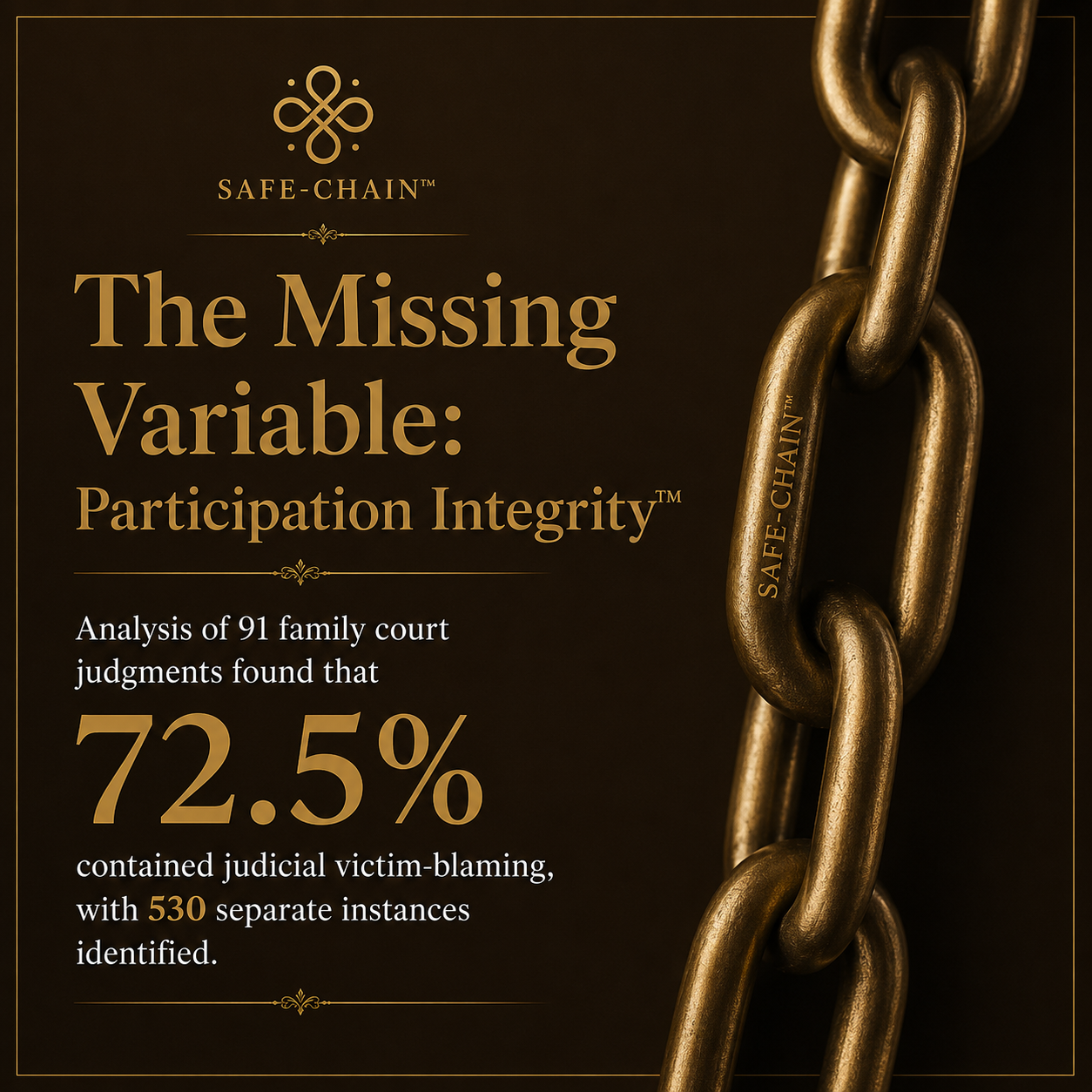
The Missing Variable: Participation Integrity™
The Right to Equality report identified judicial victim-blaming in 72.5% of reviewed family court judgments. The Domestic Abuse Commissioner's Everyday Business report found domestic abuse present in 87% of reviewed case files and 73% of observed hearings. SAFECHAIN™ argues that both reports expose the same missing variable: Participation Integrity™. Before courts can deliver justice, they must establish whether vulnerable survivors can participate effectively—not merely whether they are present

10 Things the Everyday Business Report Tells Us — And Why Safeguarding Must Become Infrastructure
Domestic abuse is not an exceptional feature of family justice—it is the operating environment. In this SAFECHAIN™ Intelligence Hub article, Samantha Avril-Andreassen examines 10 critical findings from the Domestic Abuse Commissioner's Everyday Business report and presents practical governance solutions through the Participation Gap™, Passport of Erasure™, Institutional Coordination™, Accountability Architecture™, and the SAFECHAIN™ Index.

Domestic abuse is not sitting at the edge of family justice.
Domestic abuse was found in 87% of reviewed family court case files and 73% of observed hearings. These 10 SAFECHAIN™ Intelligence Hub insights examine the report's most significant findings, including coercive control, economic abuse, the Participation Gap™, the Passport of Erasure™, institutional fragmentation, and the future of safeguarding reform.