
Abuse of Process, Alter Ego Assets, and the “Impecunious” Litigant
This paper examines how corporate structures, alleged impecuniosity, selective disclosure, forum-shopping, litigation abuse, and procedural manipulation can distort financial remedy proceedings. It explores alter ego assets, fraud, non-disclosure, economic abuse, and why family justice requires stronger disclosure integrity and governance safeguards.

When Domestic Abuse Is Everywhere but Treated as Nowhere
The Everyday Business report found evidence of domestic abuse in 87% of reviewed private family law cases, yet abuse was frequently not treated as an active safeguarding issue. This article explores the distinction between awareness and recognition, institutional capability, and why family justice reform must move beyond acknowledging domestic abuse to consistently acting upon it.

Domestic Abuse and Family Court Failures Around the World
family justice, domestic abuse, coercive control, family courts, child welfare, safeguarding, family court reform, post-separation abuse, parental conflict, participation rights, trauma-informed justice, governance, systems reform, vulnerability recognition, Canada family courts, Australia family courts, Brazil domestic abuse, Africa justice systems, SAFECHAIN, The Directive, Samantha Avril-Andreassen

Domestic Abuse Remains “Far Too High” — But What Does That Actually Mean?
Domestic abuse remains far too high — but the deeper question is why. This article examines the gap between reporting and protection, the limits of incident-based systems, and why safeguarding must focus on recognising coercive control, vulnerability, escalation, and preventable harm before crisis occurs.

Can a Tick Box Recognise Fear?
Domestic abuse risk cannot always be captured by “yes”, “no”, or “don’t know”. This article examines the DASH assessment debate, why high-risk victims may be wrongly assessed, and why safeguarding must move beyond form-filling towards vulnerability recognition, pattern analysis, and protection.

More Than 1,000 Domestic Abuse Reports Per Week — Why Volume Is Not the Real Story
More than 1,000 domestic abuse reports per week is not only a statistic — it is a safeguarding warning. This article examines what happens after disclosure, why institutions must recognise patterns rather than isolated incidents, and why information must be converted into protection before harm escalates.

Raneem's Law and the Recognition Failure That Cost Two Lives
Raneem’s Law is a vital step forward, placing domestic abuse specialists inside 999 control rooms across England and Wales. But the deeper question remains: why did the system fail to recognise danger when the warning signs already existed? This article examines recognition failure, coercive control, safeguarding, police response, and why protection must begin before crisis.

SAFECHAIN™ Is Entering Its Most Important Phase Yet
This LinkedIn article explains the current direction of SAFECHAIN™ and its latest framework development, including the Specialist Safeguarding Architecture Portfolio™, Migrant Vulnerability Architecture™, Intersectional Recognition Architecture™, Institutional Disbelief Risk™, Housing Recognition Architecture™ and Domestic Abuse Suicide Architecture™.

The Next Frontier of Safeguarding
The latest SAFECHAIN™ publications reveal a common pattern across migration, housing, domestic abuse and safeguarding: vulnerability becomes fragmented, visibility deteriorates and recognition fails. This Directive article explains why safeguarding must evolve from information collection toward vulnerability intelligence.

Why Vulnerability Is Not a Sector™
What if vulnerability itself is not a sector? This Directive article challenges one of the central assumptions of modern public services and introduces Vulnerability Convergence™ as a foundational SAFECHAIN™ concept explaining why fragmented systems struggle to support complex human realities.

Why the Future of Safeguarding Is Continuity, Not Data Collection
Is SAFECHAIN™ simply another database? This Directive article explains why the architecture focuses on continuity, verification and accountability rather than data accumulation, positioning SAFECHAIN™ as governance infrastructure rather than a technology platform.

The Governance Problem Nobody Owns
Why do people continue to fall through systems designed to protect them? This Directive article introduces The Continuity Crisis™ and examines how fragmented institutions create hidden burdens for vulnerable individuals. SAFECHAIN™ argues that the future challenge is not simply improving services but improving continuity between them.

From Family Court Research to National Infrastructure
How did SAFECHAIN™ evolve from participation and family justice research into a national infrastructure proposition? This Directive article traces the journey from governance analysis to implementation architecture, revealing the development of one of the most ambitious continuity and vulnerability verification frameworks currently under development.

Mapping the Growth of a National Safeguarding Infrastructure
How large has SAFECHAIN™ become? This Directive article maps the development of the architecture across 60+ published papers, tracing its evolution from governance analysis to a proposed national safeguarding and vulnerability verification infrastructure.

How a Governance Framework Became a National Infrastructure Programme
This Directive article traces the current trajectory of SAFECHAIN™, showing how the architecture has evolved from governance critique into a national infrastructure programme. It explains the development of the NVI, NOM and EERS research papers and why SAFECHAIN™ now represents a serious implementation framework for vulnerability verification, safeguarding continuity and institutional accountability.

THE FORESEEABILITY QUESTION™
Coercive financial control and economic abuse do not end with the abusive act. They can create debt, procedural inequality, housing insecurity, loss of participation and long-term disadvantage. This SAFECHAIN™ paper examines the causal chain from economic abuse to institutional responsibility.

How the Research, Methodology, Frameworks, and Standards Connect
SAFECHAIN™ is more than a collection of papers, frameworks, or training programmes. It is an integrated governance architecture designed to identify, analyse, measure, and reform institutional failure. This presentation explains how the Foundational Papers, Methodology, Applied Analysis Series, Framework Series, SAFECHAIN™ Index, Seal of Integrity™, Training Ecosystem, and Public Intelligence Layer connect to form one coherent safeguarding and accountability ecosystem. It provides the first complete map of the SAFECHAIN™ Architecture and demonstrates how research becomes standards, standards become capability, and capability becomes systemic reform.
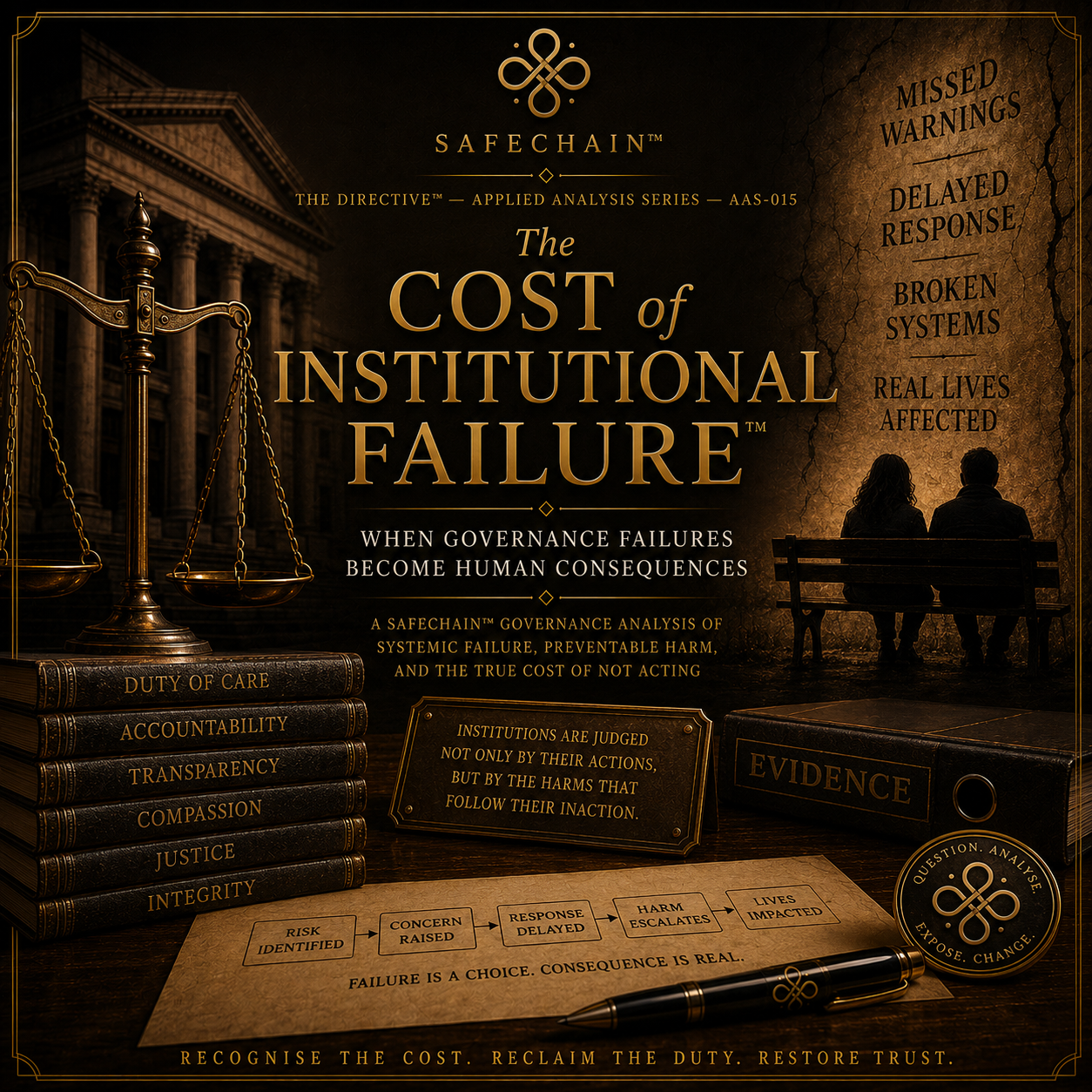
APPLIED INSTITUTE ANALYSIS SERIES — AAS-015
AAS-015, The Cost of Institutional Failure™: When Governance Failures Become Human Consequences, concludes the Consequence Tier of The Directive™. The paper examines how institutional failures generate lasting human, economic, social, and institutional costs, often extending far beyond the original event. Through the SAFECHAIN™ lens, it explores legacy harm, recovery burdens, and the long-term consequences of systems that fail to protect, intervene, or learn.
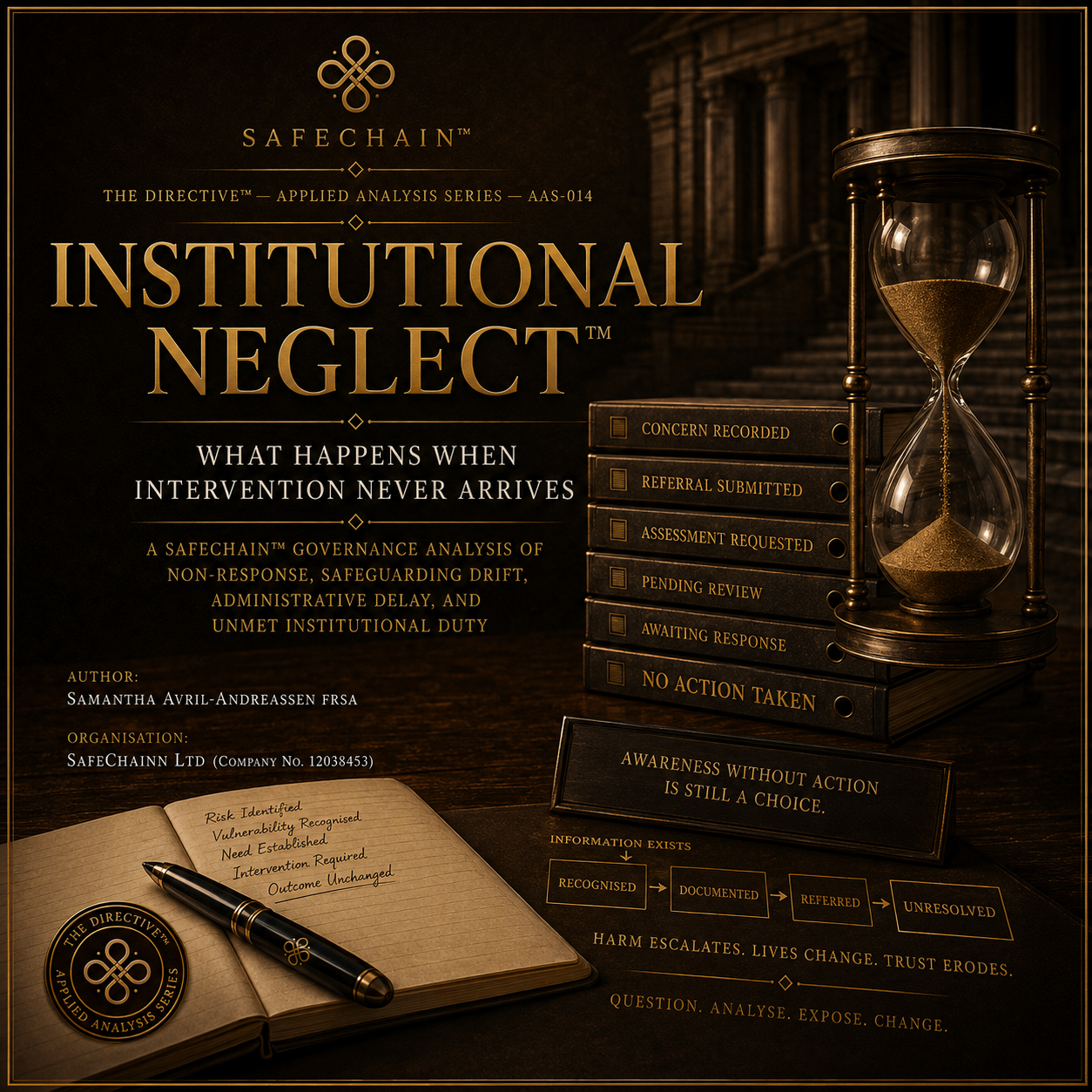
APPLIED INSTITUTE ANALYSIS SERIES — AIAS-014
AAS-014, Institutional Neglect™: What Happens When Intervention Never Arrives, continues The Directive™ Consequence Tier by examining non-response after risk has been identified. The paper argues that awareness is not protection, referral is not intervention, and recognition is not response. It explores how delay, drift, administrative silence, and unmet institutional duty may allow foreseeable harm to continue.
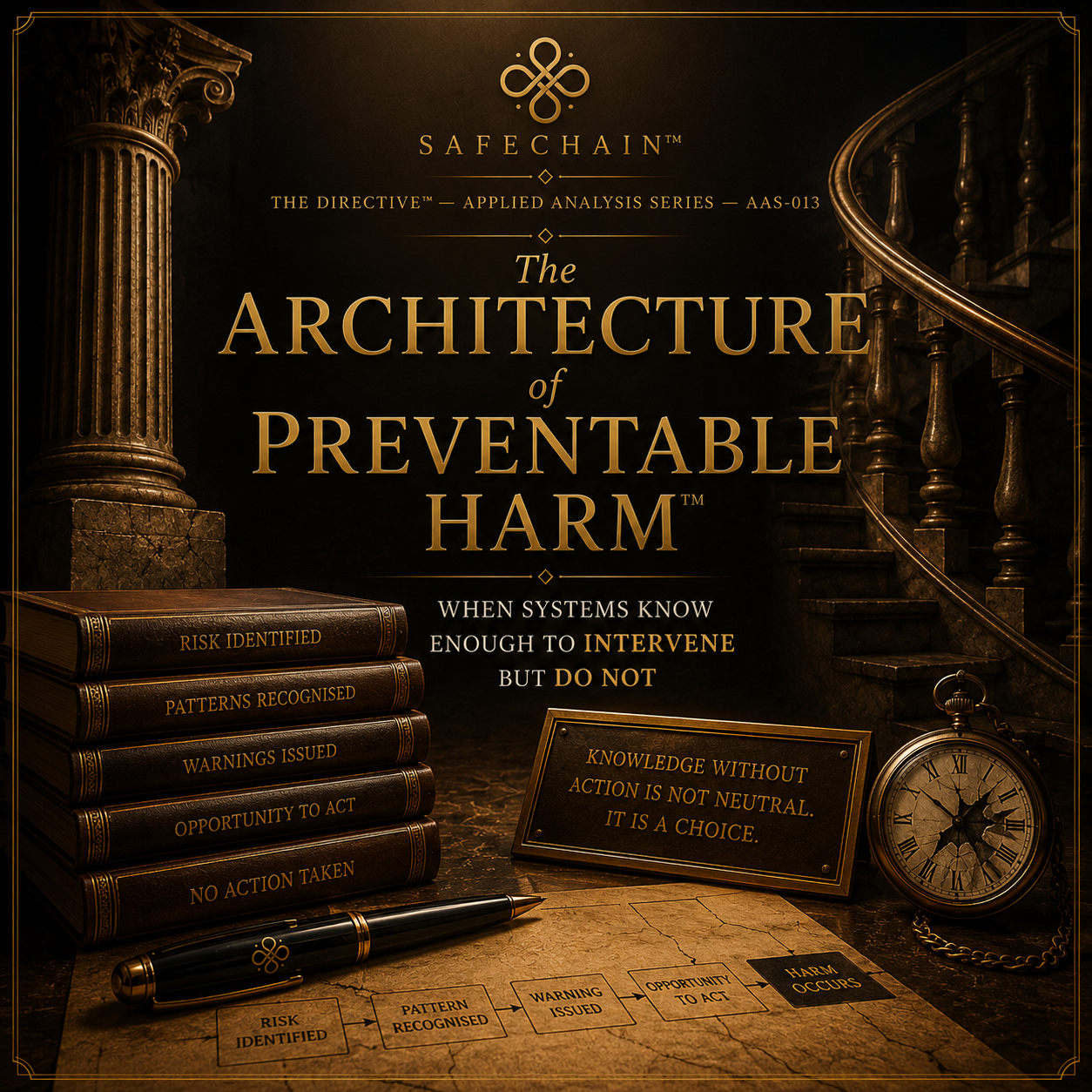
APPLIED INSTITUTE ANALYSIS SERIES — AIAS-013
AAS-013, The Architecture of Preventable Harm™: When Systems Know Enough to Intervene but Do Not, marks the beginning of The Directive™ Consequence Tier. Building on AAS-010 to AAS-012, the paper examines how implementation failure, accountability gaps, and institutional self-protection can contribute to foreseeable harm when risk is visible but intervention does not follow.