Safeguarding Infrastructure. Professional Capability. Institutional Integrity.
Building vulnerability-aware systems that protect participation, preserve dignity, and strengthen procedural fairness.
SAFECHAIN™ is a safeguarding infrastructure and professional capability ecosystem designed to strengthen how individuals, professionals, institutions, and public systems respond to vulnerability within complex legal, healthcare, housing, safeguarding, education, and public-sector environments.
SAFECHAIN™ operates as a compliance-aligned safeguarding overlay. It does not replace existing statutory systems. It strengthens them by improving procedural integrity, participation capability, safeguarding visibility, vulnerability recognition, and institutional accountability.
What SAFECHAIN™ Does
SAFECHAIN™ brings together professional training, institutional frameworks, research, policy development, survivor-informed education, and public engagement into one integrated safeguarding ecosystem.
Our work sits at the intersection of:
Safeguarding
Human Rights
Institutional Governance
Procedural Justice
Trauma-Informed Practice
Professional Standards
Vulnerability Recognition
System Navigation
SAFECHAIN™ exists to address a critical systems problem:
vulnerability is often present, but not recognised; disclosed, but not connected; documented, but not acted upon; visible, but procedurally misunderstood.
The SAFECHAIN™ Ecosystem
SAFECHAIN™ is structured around three integrated pillars:
1. Institutional Capability & Professional Standards
Professional education and safeguarding frameworks for those working within legal, healthcare, housing, policing, safeguarding, regulatory, and public-sector environments.
This includes:
MØPIT™ — Mandatory Øversight & Procedural Integrity Training™
CPIT™ — Certified Professional in Institutional Trauma Compliance™
These frameworks help professionals strengthen:
procedural integrity;
documentation accuracy;
trauma-informed decision-making;
credibility interpretation;
safeguarding escalation;
vulnerability recognition;
human rights alignment.
Outcome: stronger safeguarding decisions, reduced procedural harm, and improved institutional accountability.
2. Individual Navigation & Recovery Frameworks
Structured education for individuals navigating complex systems after domestic abuse, trauma, homelessness, institutional harm, or significant life disruption.
This includes:
The Threshold™ — Navigating Systems Without Retraumatization™
R.I.S.E.™ — Reintegration, Identity, Safeguarding & Empowerment™
The Embodiment Programme™ — Body-First Language™ in Practice
These programmes support:
nervous system awareness;
communication under stress;
institutional literacy;
documentation preparation;
decision-making clarity;
emotional regulation;
practical system navigation.
Outcome: helping individuals engage with systems from a position of stability, clarity, and informed participation.
3. Research, Policy & Public Education
SAFECHAIN™ is built upon research, policy analysis, systems thinking, lived experience, governance theory, and human rights principles.
The public education arm includes:
policy papers and institutional briefings;
safeguarding governance frameworks;
the Silent Screams, Loud Strength™ podcast;
authored works by Samantha Avril-Andreassen, including Silent Screams, Loud Strength, Homeless, Not Defeated, Healing From Within, and The Little Voice That Roared.
Outcome: transforming lived experience, research, and legal-policy analysis into structured safeguarding knowledge.
Why SAFECHAIN™ Matters
Many safeguarding failures do not occur because no one was involved.
They occur because systems become fragmented.
Information is missed.
Documentation becomes disconnected.
Trauma is misinterpreted.
Procedural compliance is mistaken for protection.
Vulnerability is treated as instability rather than risk.
Participation is assumed rather than preserved.
SAFECHAIN™ responds to these structural weaknesses by creating frameworks that help institutions recognise vulnerability earlier, respond more coherently, and preserve human dignity within high-stakes processes.
SAFECHAIN™ Is Not
SAFECHAIN™ is not therapy.
SAFECHAIN™ is not legal advice.
SAFECHAIN™ is not crisis intervention.
SAFECHAIN™ does not replace statutory safeguarding duties.
SAFECHAIN™ provides structured education, policy frameworks, institutional training, research, and safeguarding infrastructure designed to strengthen lawful, ethical, trauma-informed, and accountable practice.
Who SAFECHAIN™ Is For
SAFECHAIN™ is designed for:
legal professionals;
safeguarding leads;
public-sector leaders;
NHS and healthcare professionals;
housing providers;
police and community safety teams;
social workers;
regulators;
universities and researchers;
policymakers;
domestic abuse organisations;
survivors navigating complex systems;
individuals rebuilding after trauma or institutional harm.
Our Core Aim
To ensure that vulnerability is recognised, participation is preserved, safeguarding information remains connected, and institutions are equipped to respond with integrity.
SAFECHAIN™ exists because safeguarding should not depend on chance, personality, persistence, or procedural endurance.
It should be structured.
It should be accountable.
It should be capable of protecting human dignity.
Build Safer Systems. Strengthen Professional Practice. Protect Human Dignity.
Request an Institutional Briefing
Explore Professional Training
Access the Research Repository
Join the SAFECHAIN™ Pilot Programme
Book a Discovery Call
Intellectual Property & Research Protection
SAFECHAIN™ is an original safeguarding infrastructure and policy framework developed by Samantha Avril-Andreassen.
All SAFECHAIN™ policy papers, frameworks, training methodologies, governance models, research materials, course architecture, and institutional documents constitute protected intellectual property.
© 2026 Samantha Avril-Andreassen. All rights reserved.
SAFECHAINN Ltd is a conceptual safeguarding infrastructure and policy framework authored by Samantha Avril-Andreassen. Reproduction or implementation of this framework without permission is prohibited.
Version: SAFECHAIN™ Homepage Copy | Version 1.0

SAFECHAIN™ — Closing the Safeguarding Gap Across Institutions
A governance framework designed to connect the systems that protect survivors of domestic abuse — so no one falls through the gaps between them.


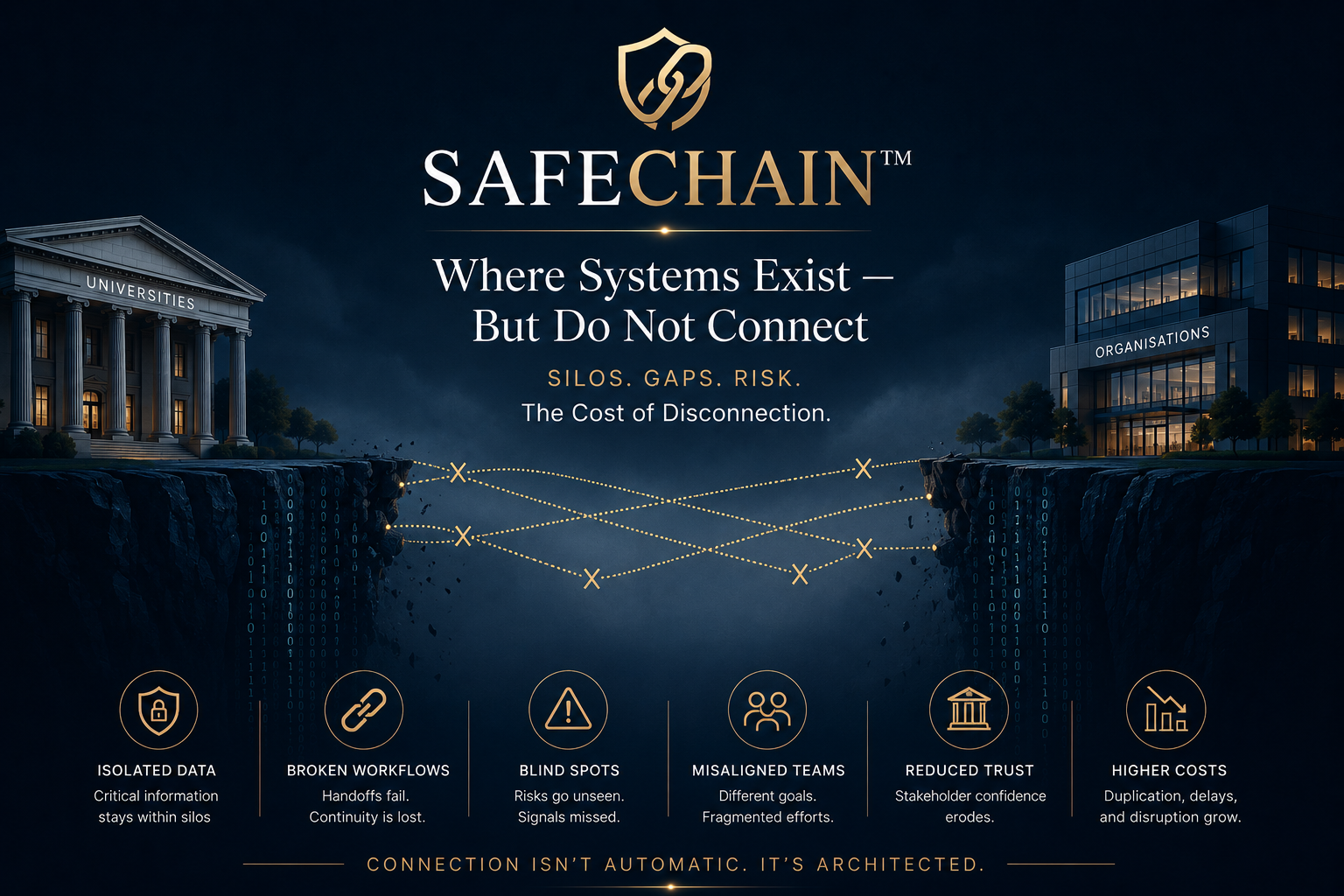
Where Systems Exist — But Do Not Connect
Domestic abuse does not happen inside one institution. Survivors move between police, courts, housing, healthcare, and social care — and each holds a different piece of the same story. When those systems do not communicate, the safeguarding chain breaks, and the gap becomes the harm.
SAFECHAIN™ — The Infrastructure That Connects Them
SAFECHAIN™ introduces a governance framework that sits across institutions — not inside any single one. It creates continuity where there is currently fragmentation: ensuring that safeguarding information travels with the survivor, that trauma is recognised rather than misread, and that no institution can claim ignorance of what another already knows.
This is not advocacy. It is accountability architecture.
What SAFECHAIN™ Delivers
Four points:
Evidential continuity across legal, housing, health, and enforcement systems
Trauma-informed compliance embedded into institutional process
Cross-agency visibility so risk is identified before it escalates
Structured safeguarding checkpoints at every stage of the journey
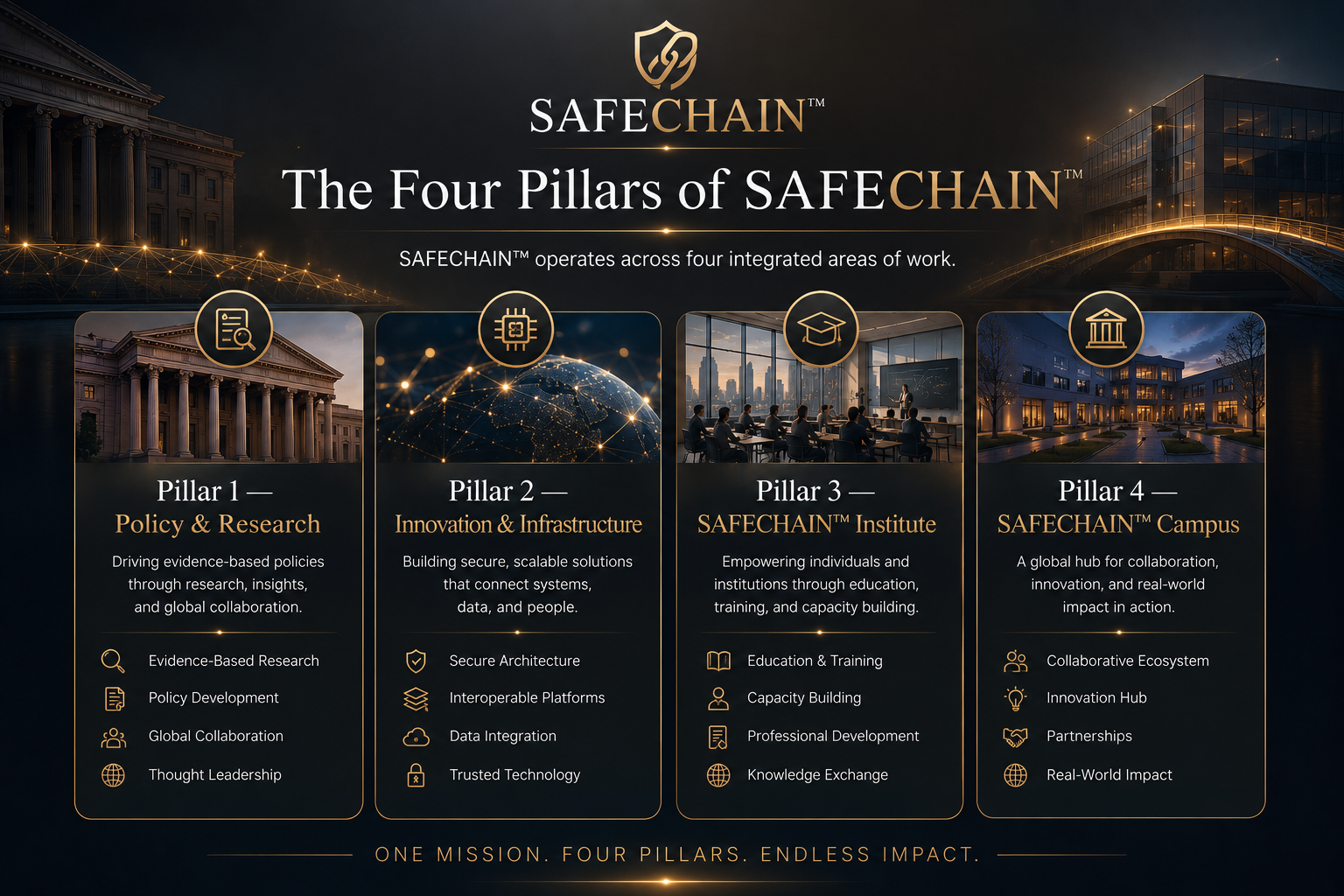
The Four Pillars of SAFECHAIN™
SAFECHAIN™ operates across four integrated areas of work.
Pillar 1 — Policy & Research Rigorous analysis of safeguarding failure, institutional fragmentation, and procedural trauma. White papers, reform proposals, and evidence-based recommendations for policymakers and commissioners.
Pillar 2 — Innovation & Infrastructure The SAFECHAIN™ governance framework — including the Biopsychosocial Bridge™ and Participation Capacity Variability™ mapping — provides the structural spine that connects institutions and protects evidential continuity.
Pillar 3 — SAFECHAIN™ Institute Postgraduate-level professional training for police, legal practitioners, healthcare providers, housing authorities, and safeguarding leads. Designed to embed trauma literacy into institutional practice — not as awareness, but as compliance.
Pillar 4 — SAFECHAIN™ Campus Practical tools and structured pathways for survivors navigating complex systems — including the Evidence Binder System, the Rebuild Compass™, and self-advocacy resources designed to restore clarity and confidence.
Closing line: Together, these four pillars form a complete safeguarding ecosystem — from structural reform at policy level to direct support at individual level.

.
Institutions & Professionals
Local Authorities
Legal Professionals
NHS & Healthcare
Safeguarding Leads
AUTHORITY
From Lived Experience to System Design
SAFECHAIN™ was developed through direct engagement with systemic failure across legal, housing, and safeguarding structures.
It reflects a shift from:
isolated processes
tointegrated infrastructure
This is not commentary.
It is system design.
Public & Individuals
Understanding safeguarding systems
Accessing structured insight
Safeguarding Requires Structure
Systems do not fail because they are absent.
They fail when they are not designed to connect.
SAFECHAIN™ provides the framework to change that.
SAFECHAIN™
Building safeguarding systems that connect, protect, and hold institutions accountable
SAFECHAIN™ works to close the gaps between institutions so survivors of domestic abuse are heard, protected, and believed.
When systems fail survivors, SAFECHAIN™ works to reconnect the chain.
SAFECHAIN™ is a policy, innovation, and training initiative designed to strengthen safeguarding through institutional coordination, trauma-informed practice, and survivor empowerment.
Book Launch | SAFECHAIN™ Gala | 30 October — Winchester
Safeguarding failures often happen because systems do not talk to each other.
Police may hold one part of the story.
Courts another.
Healthcare providers another.
Housing teams another.
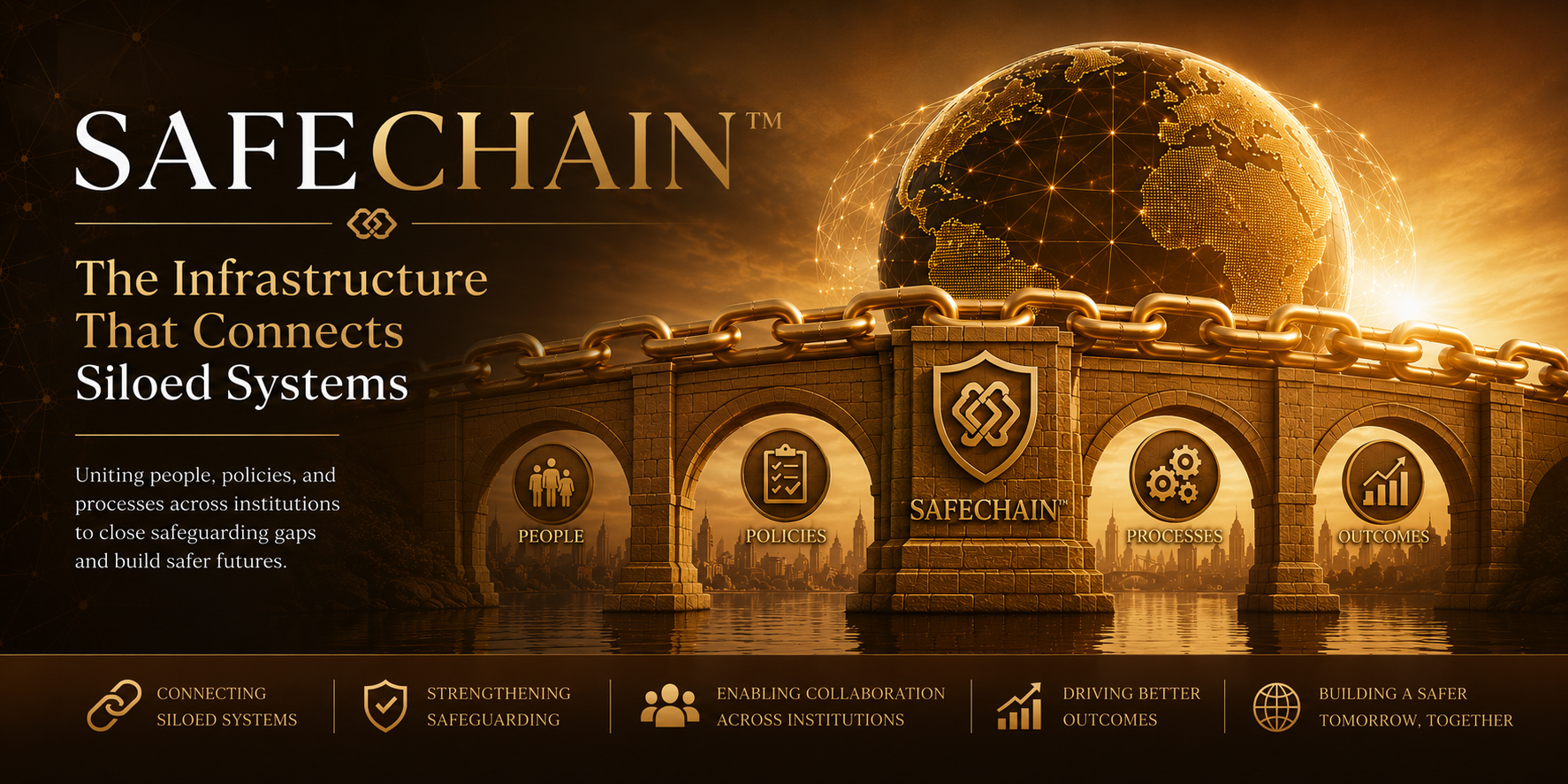
SAFECHAIN™ exists to close that gap through policy reform, institutional innovation, postgraduate-level training, and survivor-focused tools that strengthen protection pathways and improve accountability.
What is SAFECHAIN™?
SAFECHAIN™ is a safeguarding think tank, systems innovation initiative, and training platform.
It was created to address institutional fragmentation — the structural problem that arises when courts, police, healthcare providers, councils, charities, and other agencies hold critical information in isolation, without a coordinated framework for recognising risk or responding effectively.
SAFECHAIN™ brings together:
policy and systems reform
safeguarding infrastructure design
professional training
survivor empowerment tools
to help build safer, more connected responses across institutions.
Statement of Integrity & Formal Intent
This platform stands at the intersection of innovation, truth, and the consistent application of the law.
I do not claim perfection.
I do claim integrity.
In prior proceedings, my intelligence was referenced in a manner intended to diminish. That same intelligence is now applied with clarity, structure, and purpose.
The position is simple:
The law must remain constant.
It must not become flexible in the hands of those with access, influence, or technical advantage.
This is not a request for special treatment.
It is a demand for equal application.
This platform therefore serves as a formal notice of intent:
To pursue accountability through transparency
To present verifiable, structured information
To challenge systemic gaps where they exist
To support outcomes grounded in accuracy, not narrative
This work is not directed at individuals.
It is directed at standards.
The objective is to ensure that the law operates as it was intended—
as a consistent and impartial foundation for all.
Ethical Foundation
My work is grounded in a clear and consistent set of values.
I believe in honesty.
I accept responsibility for my own actions.
And I do not act in a way that causes harm to others.
I do not claim perfection.
I do claim accountability.
This foundation informs everything I do.
It is why my approach is not to bend the law to personal advantage, but to ensure that the law is applied consistently, transparently, and without distortion.
This is not about retaliation.
It is about standard.
Where systems fall short of that standard, they must be examined, and where necessary, corrected.

Work With SAFECHAIN™
SAFECHAIN™ welcomes dialogue with institutions, universities, policymakers, charities, and aligned partners who are committed to strengthening safeguarding systems and improving accountability.
SAFECHAIN™
The Silence Ends Here
Survivors deserve to be seen, believed, and protected.
The law has begun to recognise abuse — our culture must now catch up.
No voice should disappear between institutions.
Justice begins when truth is finally heard.
The silence ends here.
Rebuilding Safeguarding Systems
Across the United Kingdom and beyond, victims of domestic abuse continue to navigate complex institutional systems while seeking safety, dignity, and justice.
Police services, housing authorities, healthcare providers, courts, and social services each play a vital role in safeguarding individuals experiencing harm.
Yet too often, these systems operate in isolation.
Survivors may find themselves repeating their stories again and again — moving from one institution to another while critical information becomes fragmented or lost.
This is not simply an individual failure.
It is a structural problem within safeguarding systems.
SAFECHAIN™ was created to address that gap.

Behind Every Mask Is a Story
On 30 October 2026 we gather to honour survivors, confront injustice, and build stronger safeguarding systems.
SAFECHAIN™ Masquerade Gala
SAFECHAIN™ Masquerade Gala
Unmasking Silence.
Honouring Survivors.
Rebuilding Safeguarding Systems.
30 October 2026 | Winchester
SAFECHAIN™ Masquerade Gala
Unmasking Silence. Reclaiming Power.
Date: 30 October 2026
Location: Winchester / Hampshire
Venue: UNMASKING JUSTICE — Masquerade Gala 📍 Lainston House Hotel, Hampshire 📅 30 October 2026
An Evening to Stand for Change
On 30 October 2026, guests will gather for the SAFECHAIN™ Masquerade Gala, a unique evening dedicated to raising awareness, strengthening safeguarding systems, and honouring those whose voices have too often gone unheard.
This event brings together professionals, policymakers, advocates, artists, and members of the public who believe that victims of domestic abuse and injustice deserve to be seen, heard, and protected.
The Masquerade Gala symbolises the hidden nature of abuse and the collective responsibility we share in bringing truth into the light.
Behind every mask is a story.
Together, we create a space where those stories are acknowledged with dignity and respect.
Event Highlights
Guests attending the SAFECHAIN™ Masquerade Gala will experience an evening designed to inspire reflection, connection, and meaningful change.
The evening will include:
Welcome Reception
An elegant drinks reception where guests can connect with professionals and supporters of safeguarding reform.
Acknowledgement of Survivors
A candle moment honouring victims of domestic abuse and injustice.
Keynote Address
A distinguished speaker reflecting on the future of safeguarding and institutional accountability.
SAFECHAIN™ Vision Presentation
Founder Samantha Avril-Andreassen will present the vision for SAFECHAIN™ and the importance of coordinated safeguarding systems.
Charity Art Auction
A special auction featuring works donated by artists and supporters.
Book Signing
Guests will have the opportunity to meet Samantha Avril-Andreassen and receive signed copies of her books.
Music and Networking
The evening concludes with music, conversation, and an opportunity to build connections around a shared commitment to safeguarding reform.
Dress Code
Black Tie & Mask
Guests are encouraged to wear elegant masquerade masks as part of the evening’s symbolic theme — revealing the truths that too often remain hidden.
Sponsorship Opportunities
We are honoured to welcome organisations that wish to support safeguarding innovation and social justice.
Sponsorship packages are available from £250 to £25,000, offering recognition during the event and opportunities to demonstrate commitment to safeguarding reform.
If your organisation would like to partner with SAFECHAIN™, we would be delighted to hear from you.
Tickets
Tickets for the SAFECHAIN™ Masquerade Gala will be available through Eventbrite.
Further details regarding ticket options, venue announcement, and keynote speakers will be released soon.
A Message from the Founder
The SAFECHAIN™ Masquerade Gala is not simply an event.
It is a moment to stand together and recognise that victims of abuse and injustice deserve more than awareness — they deserve systems that listen, respond, and protect.
When voices are heard, change becomes possible.
And when institutions work together, safeguarding becomes stronger for everyone.
Samantha Avril-Andreassen
Founder, SAFECHAIN™
© 2026 Samantha Avril-Andreassen. All rights reserved.

A New Approach to Safeguarding
SAFECHAIN™ explores how institutions can work together more effectively to support victims of domestic abuse and other forms of vulnerability.
The initiative focuses on strengthening safeguarding systems through:
• improved coordination between institutions
• preservation of safeguarding records
• trauma-informed professional practice
• stronger accountability across agencies.
Legal reforms such as the Domestic Abuse Act 2021 have strengthened recognition of coercive and controlling behaviour.
But legislation alone cannot solve systemic fragmentation.
Safeguarding systems require infrastructure, cooperation, and cultural change.
SAFECHAIN™ represents a vision where institutions work together to ensure that survivors are heard, protected, and supported with dignity.
Why This Matters
Domestic abuse is not always visible.
It may take the form of coercive control, psychological manipulation, financial restriction, or intimidation. These patterns of harm often unfold gradually and can be difficult to capture within traditional institutional frameworks.
For survivors, the journey to safety can involve navigating multiple systems simultaneously.
When institutions fail to communicate effectively, the burden of connecting those systems often falls on the victim.
SAFECHAIN™ seeks to change that.
By exploring new frameworks for safeguarding coordination, SAFECHAIN™ aims to ensure that no person’s story is lost between the institutions meant to protect them.
Our Vision
A future where:
• survivors are believed
• safeguarding systems recognise patterns of abuse
• institutions collaborate instead of operating in isolation
• dignity and justice are placed at the centre of every response.
This work is not only about addressing harm.
It is about restoring trust in the systems designed to protect society’s most vulnerable members.
Join the Movement
Change happens when individuals, communities, and institutions stand together.
SAFECHAIN™ welcomes dialogue with:
• policymakers
• safeguarding professionals
• legal practitioners
• charities and advocacy organisations
• researchers and academics
• members of the public committed to justice.
Together, we can build safeguarding systems that listen, respond, and protect with integrity.


SAFECHAIN™
SAFECHAIN™ is a structural safeguarding initiative focused on the gap between what the law says and what institutions actually do. It addresses the fragmentation that occurs when police, healthcare, housing, social care, regulators, and courts hold pieces of the same story, but no one system carries the full safeguarding picture forward. The Domestic Abuse Act 2021 expressly recognises domestic abuse as including emotional, controlling, coercive, and economic abuse, and the statutory guidance places emphasis on a cross-agency response. Yet in practice, evidence, trauma indicators, and risk information often remain siloed across institutions.
SAFECHAIN™ Core Positioning Statement
Core Positioning Statement
SAFECHAIN™ exists because law without operational continuity is not enough. Family and civil proceedings already sit within legal frameworks that require fairness, truthful disclosure, proper participation, and protection against abuse; however, implementation failures still leave vulnerable parties exposed to document fragmentation, trauma-blind decision-making, and unequal procedural power. The Family Procedure Rules require the court to consider vulnerability and participation directions, while the Equal Treatment Bench Book is expressly used by the judiciary and referred to in judicial training.
What SAFECHAIN™ Addresses
SAFECHAIN™ addresses five systemic failures:
Institutional fragmentation. Police reports, GP records, housing assessments, safeguarding referrals, financial disclosure, and court materials are rarely held within a single accountable chain of information, despite the policy need for coordinated domestic abuse responses across agencies.
Trauma-blind process. Where vulnerability is not recognised in time, a party’s distress may be misread as non-engagement, unreliability, hostility, or procedural obstruction rather than as a trauma response requiring adjustments. Part 3A FPR and PD3AA require the court to consider whether vulnerability diminishes participation or the quality of evidence and to consider appropriate directions.
Disclosure asymmetry. Financial remedy proceedings rely heavily on Form E disclosure, yet accurate disclosure depends on candour, scrutiny, and proper testing against available records. Form E is the official financial statement for financial remedy proceedings, and false information in family proceedings can engage contempt consequences under the rules framework.
Professional ethics risk. Solicitors and barristers are already bound not to mislead the court, not to abuse their role, and to act with honesty, integrity, independence, and public trust in mind. SAFECHAIN™ argues that these standards must be applied with greater forensic discipline wherever coercive control, asset opacity, or participation vulnerability is in issue.
Property and housing disconnect. Domestic abuse survivors can become effectively homeless even where property ownership exists on paper, because economic abuse can deprive them of real access, safety, liquidity, or occupation. Government guidance recognises economic abuse and provides homelessness guidance specifically for domestic abuse cases, while HM Land Registry itself provides anti-fraud tools including Property Alert and restrictions.
Mission Statement
SAFECHAIN™ advances one clear principle: justice requires a reliable chain of safeguarding information, ethical participation, and accountable decision-making from first disclosure to final outcome.
Its mission is to strengthen institutional integrity across legal, housing, health, and safeguarding environments so that no victim’s evidence, vulnerability, or rights are lost between agencies, and no professional actor is treated as beyond scrutiny. This mission aligns with the rule-of-law values reflected in Article 6 and Article 8 of the Human Rights Act 1998, the vulnerability duties in family procedure, and the broader public-law expectation that institutions must operate fairly, consistently, and without systemic blindness
SAFECHAIN™
safeguarding chain of custody
SAFECHAIN™ is building a safeguarding chain of custody for human dignity.
Where systems fragment, abuse hides.
Where records do not travel, truth becomes unstable.
Where trauma is misread, fairness collapses.
SAFECHAIN™ exists to change that.
SAFECHAIN™ Mission and Public-Interest Disclaimer
SAFECHAIN™ is a policy, training, and systems-reform initiative. It provides public-interest analysis, structural critique, educational materials, and self-advocacy resources. It is not a law firm and does not provide legal advice or legal representation. Nothing on this website should be read as an allegation against any unnamed individual or organisation as a matter of fact unless expressly supported by public findings, court records, or official sources. SAFECHAIN™ critiques systems, procedures, governance failures, and risk patterns in the public interest. Regulatory concerns, disclosure concerns, and safeguarding concerns should be understood as matters potentially requiring professional or judicial scrutiny within the proper legal process.
Restoring the Chain of Safeguarding in Justice Systems
SAFECHAIN™ is an institutional safeguarding framework dedicated to strengthening accountability across legal, governmental, and safeguarding institutions.
Modern safeguarding systems rely on multiple agencies working together to protect individuals experiencing harm. However, institutional fragmentation frequently prevents safeguarding information from moving effectively between those agencies.
When documentation becomes siloed between institutions, victims may face repeated procedural barriers while perpetrators benefit from gaps between systems.
SAFECHAIN™ addresses this structural problem by introducing a Chain-of-Custody Safeguarding Model, ensuring that safeguarding documentation and institutional accountability remain continuous throughout the justice process.
Our work focuses on three core priorities.
Institutional Accountability
SAFECHAIN™ examines how safeguarding obligations are implemented across policing bodies, courts, housing authorities, medical institutions, and regulatory organisations.
Trauma-Informed Justice
Effective safeguarding requires recognition of the neurobiological impact of trauma and the need for procedural fairness for vulnerable participants in legal processes.
Structural Reform
SAFECHAIN™ proposes institutional reforms designed to strengthen safeguarding architecture, improve cross-agency coordination, and restore public confidence in the justice system.
The law exists to protect.
SAFECHAIN™ exists to ensure the systems responsible for enforcing that law remain accountable, coordinated, and aligned with the principles of justice.
© 2026 Samantha Avril-Andreassen. All rights reserved.
SAFECHAIN™
Restoring Integrity to Safeguarding Systems
SAFECHAIN™ is a safeguarding systems initiative examining how institutional fragmentation across policing, healthcare, housing, financial systems, and the courts can undermine protection for individuals experiencing domestic abuse and vulnerability.
Our work focuses on strengthening the continuity of safeguarding information, improving trauma-informed institutional practice, and developing practical tools that help individuals and professionals navigate complex systems more effectively.
SAFECHAIN™ brings together policy research, documentation frameworks, professional education, and systems analysis to help ensure that safeguarding responsibilities do not disappear at the boundaries between institutions.
When systems fail to communicate, protection fails.
SAFECHAIN™ exists to rebuild that chain.
The Structural Problem
Domestic abuse cases rarely involve a single institution.
Survivors often navigate multiple systems simultaneously:
• police services
• healthcare providers
• housing authorities
• family and civil courts
• financial disclosure processes
• regulatory bodies
While each institution plays an important role, these systems frequently operate in parallel rather than in coordination.
This fragmentation can lead to:
• incomplete safeguarding information
• repeated retelling of trauma across agencies
• decisions made without full context
• individuals falling through institutional gaps
SAFECHAIN™ examines how these structural disconnects arise and proposes models for improving safeguarding coordination.
What SAFECHAIN™ Does
SAFECHAIN™ operates at the intersection of safeguarding practice, systems research, and professional education.
Our work currently focuses on four areas.
Safeguarding Systems Research
SAFECHAIN™ develops policy analysis examining institutional fragmentation and the structural challenges affecting safeguarding responses across agencies.
Survivor Documentation Tools
We design practical frameworks that help individuals organise safeguarding evidence and maintain documentation continuity when navigating multiple institutions.
Examples include:
• the SAFECHAIN™ Evidence Binder System
• the Agency Communication Log
• self-advocacy documentation tools
Institutional Training and Education
SAFECHAIN™ provides professional learning resources focused on:
• trauma-informed institutional practice
• economic abuse awareness
• safeguarding documentation continuity
• participation integrity in legal and safeguarding processes
Contact
SAFECHAIN™
Founder: Samantha Avril-Andreassen
safe-chain.org
samantha@safe-chain.org
SAFECHAIN™
What SAFECHAIN™ actually is:
SAFECHAIN™ is a safeguarding interoperability framework designed to strengthen operational coherence across the systems responsible for protecting individuals experiencing abuse, coercive control, and vulnerability.
Safeguarding responsibilities in the United Kingdom are distributed across multiple institutions, including police, courts, healthcare services, housing authorities, legal professionals, and social care providers. While statutory duties exist, operational fragmentation between agencies can undermine safeguarding outcomes.
SAFECHAIN™ introduces a governance spine that supports structured cooperation between institutions through:
• documentation continuity standards
• trauma-informed participation protocols
• cross-agency safeguarding communication
• institutional accountability alignment
• procedural safeguarding integrity within legal and administrative systems
The framework integrates lived experience insight, policy research, and professional training to support the evolution of safeguarding systems across the United Kingdom.
SAFECHAIN™ operates as a policy initiative, safeguarding research platform, and professional training environment aimed at strengthening institutional safeguarding capacity.
SAFECHAIN™ is a safeguarding interoperability framework designed to strengthen operational coherence across the multi-agency systems responsible for protecting vulnerable individuals.
The framework addresses structural fragmentation between institutions including police, housing authorities, courts, legal professionals, healthcare services, and social care.
SAFECHAIN™ introduces a governance spine that supports:
• inter-agency documentation continuity
• trauma-informed participation protocols
• structured institutional hand-off procedures
• safeguarding accountability alignment
• procedural integrity within legal and safeguarding processes
The framework aligns with existing statutory duties and regulatory standards, including:
• Human Rights Act 1998
• Domestic Abuse Act 2021
• Solicitors Regulation Authority Principles
• Bar Standards Board Core Duties
• Equality Act 2010
SAFECHAIN™ operates as a policy innovation initiative, research platform, and professional training environment designed to support the evolution of safeguarding systems in the United Kingdom.
SAFECHAIN™ Institutional Overview
SAFECHAIN™ is a safeguarding interoperability framework developed to address fragmentation within the systems responsible for protecting individuals experiencing abuse, coercive control, and vulnerability.
The initiative integrates lived experience research, safeguarding policy analysis, and professional training to strengthen operational integrity across multi-agency safeguarding environments.
SAFECHAIN™ focuses on improving:
• documentation continuity between agencies
• trauma-informed participation practices
• safeguarding governance structures
• institutional accountability pathways
• cross-agency safeguarding communication
The initiative includes:
• safeguarding policy research
• professional training programmes
• institutional consultation
• framework development
• safeguarding governance modelling
SAFECHAIN™ engages with universities, regulators, policymakers, and safeguarding organisations seeking to strengthen safeguarding systems and improve outcomes for vulnerable individuals.
For institutional engagement or collaboration enquiries:
samantha@safe-chain.org
SAFECHAIN™ is a safeguarding interoperability framework and policy initiative focused on strengthening institutional safeguarding integrity across multi-agency systems.
SAFECHAIN™
Restoring the Chain of Safeguarding
Across the United Kingdom, multiple institutions play critical roles in responding to domestic abuse.
Police, healthcare providers, housing authorities, financial institutions, and courts each hold responsibilities within safeguarding frameworks.
Yet these systems often operate independently.
For many survivors, navigating these institutions can reveal a profound structural problem: the safeguarding chain does not always hold.
SAFECHAIN™ examines how fragmentation across safeguarding systems can affect responses to domestic abuse and institutional protection.
The Structural Challenge
Domestic abuse rarely occurs within a single institutional environment.
A survivor may interact with:
police services
medical professionals
housing authorities
financial institutions
family or civil courts.
Each institution may hold part of the safeguarding picture.
When information does not move effectively between these systems, critical context can be lost.
SAFECHAIN™ explores how strengthening institutional coordination and safeguarding continuity can improve responses to complex abuse dynamics.
A Systems Approach
SAFECHAIN™ focuses on safeguarding systems rather than individual cases.
Through policy analysis, research, and structural frameworks, the initiative examines:
institutional fragmentation
trauma-informed legal participation
financial disclosure transparency
cross-agency safeguarding coordination.
The objective is to strengthen safeguarding responses through structural integrity across institutions.
Why This Work Matters
Legal recognition of coercive control and economic abuse has advanced significantly in recent years.
Ensuring that this recognition is reflected in institutional practice remains an ongoing challenge.
SAFECHAIN™ contributes to this discussion by exploring how safeguarding systems can operate more effectively together.
When institutions coordinate and communicate, the safeguarding chain remains intact.
When the chain breaks, survivors may face instability, uncertainty, and prolonged vulnerability.
SAFECHAIN™
The Chain of Custody for Institutional Integrity.
SAFECHAIN™
Rebuilding Structural Integrity in Safeguarding Systems
A governance framework designed to reduce inter-agency disconnect and institutional re-traumatisation.
THE PROBLEM
Safeguarding systems are legally robust but operationally fragmented.
Individuals navigating police, housing, health, legal, and court systems often encounter:
• Repetition of testimony
• Documentation discontinuity
• Procedural fatigue
• Accountability diffusion
The issue is not absence of law.
It is absence of interoperability.
THE SOLUTION
SAFECHAIN™ introduces a Structural Spine across safeguarding entities.
It provides:
• Inter-agency protocol mapping
• Documentation continuity standards
• Governance overlay architecture
• Institutional accountability integration
Designed for councils, legal professionals, and public bodies.
LEGAL ALIGNMENT
SAFECHAIN™ aligns with:
• Human Rights Act 1998
• SRA Principles
• Bar Standards Board Core Duties
• Institutional accountability standards
This is governance infrastructure, not commentary.
Where there is fiduciary duty, there must be an unbroken chain.
SAFECHAIN™ provides custodial infrastructure that safeguards participation, preserves evidential continuity, and protects institutional duty of care across legal, medical, housing, and public systems.
This is not advocacy.
This is accountability architecture.
SAFECHAIN™ eliminates evidential discontinuity in multi-agency safeguarding by embedding vulnerability-aware compliance into procedural infrastructure.
PILOT MODEL
SAFECHAIN™ offers:
• 90-Day pilot programmes
• Institutional diagnostic audits
• Professional safeguarding training
• Policy advisory retainers
© 2026 Samantha Avril-Andreassen. All rights reserved.
SAFECHAIN™ is a proprietary safeguarding framework.
Why SAFECHAIN™
In law and forensics, when the chain of custody breaks, the evidence collapses.
In institutional systems, when safeguarding logs fragment, when participation variability is misread, when adjustments are undocumented — integrity fractures.
SAFECHAIN™ exists to ensure the chain does not break.
We operationalise trauma-informed principles into measurable, auditable standards — moving from awareness to structural compliance.
Institutional Positioning Statement
SAFECHAIN™ is a governance framework designed to strengthen procedural integrity within domestic abuse and safeguarding systems.
Built from direct system navigation and reinforced through legal study, SAFECHAIN™ addresses structural fragmentation, evidential discontinuity, and re-traumatisation risk through Trauma Literacy and documentation continuity architecture.
SAFECHAIN™ does not replace statutory frameworks.
It strengthens their implementation.
Governance Spine
Governance Spine
Title: The Governance Spine of SAFECHAIN™
Sections:
• Institutional Accountability Principles
• Evidentiary Integrity Standards
• Human Rights Alignment
• Equality, Inclusion & Social Cohesion
• Procedural Continuity Architecture
Closing Line:
SAFECHAIN™ exists to move safeguarding systems from fragmentation to structural cohesion.
The Innovation
The Biopsychosocial Bridge™
The Biopsychosocial Bridge™ is a secure procedural integrity layer connecting housing, police, courts, NHS, and legal counsel within a unified safeguarding architecture.
It:
• Preserves participation integrity
• Logs Equality Act adjustments
• Flags safeguarding triggers
• Reduces retraumatisation through repetition
• Protects evidential continuity
It is not therapy software.
It is procedural integrity infrastructure.
Accreditation & Standards
SAFECHAIN™ Accreditation establishes a measurable standard for fiduciary compliance.
To become accredited, institutions must:
• Complete tiered professional certification
• Integrate custodial compliance protocols
• Implement the Biopsychosocial Bridge™
• Demonstrate annual audit alignment
Accredited organisations may display the:
SAFECHAIN™ Procedural Integrity Mark
A visible commitment to custodial accountability.
The Compass™
Orientation Infrastructure for Structured Participation
Rebuild™
Operational Stabilisation & Participation Readiness
Trauma-Informed Risk Response™
Practitioner Certification
Participation & Decision Integrity™
Senior Evaluation Safeguards
RISE™
Governance & Oversight Architecture
Structural Reform Integration™
Executive & Policy-Level Design
The Principle
Strong institutions do not rely on discretion alone.
They rely on structure.
SAFECHAIN™ ensures:
• Duty of care is demonstrable
• Participation is protected
• Equality obligations are documented
• Safeguarding is auditable
• The chain of custody remains intact
Institutional Collaboration
We are engaging:
• Policy Think Tanks
• Pilot Local Authorities
• Legal Institutions
• NHS Trusts
• Academic Partners
Website: safe-chain.org
Email: samantha@safe-chain.org
Architectural Principle
The Bridge operates on a biopsychosocial logic:
Biological stress presentation affects participation.
Psychological processing may fluctuate under threat.
Social-legal environments influence behavioural interpretation.
The system does not diagnose.
It does not treat.
It documents context.
And in doing so, it protects procedural fairness.
The Innovation
The Biopsychosocial Bridge™
The Biopsychosocial Bridge™ is a secure procedural integrity layer developed under SAFECHAIN™ to protect the chain of custody across institutions carrying fiduciary duties of care.
It connects housing authorities, police services, courts, NHS Trusts, and legal counsel within a unified safeguarding architecture — reducing fragmentation, preventing credibility distortion, and strengthening statutory compliance.

Personal Development
Structured rebuilding pathways for individuals navigating domestic abuse recovery and litigation environments.
Professional Training
Trauma-informed safeguarding education for legal, HR, and institutional professionals.

Innovation
Participation integrity infrastructure in conceptual development to reduce re-traumatisation across systems.
Academy
University partnerships, research collaboration, and micro-certificate integration.
→ Academic Partnerships
Policy & Convening
Annual Justice & Participation Dinner and the Winchester Working Group.
Masquerade & Working Group
SAFECHAIN™ | Trauma-Informed Compliance Framework UK
SAFECHAIN™ delivers structural safeguarding reform through trauma literacy, procedural integrity, and compliance architecture in the UK.
trauma-informed compliance
safeguarding reform UK
procedural integrity framework
domestic abuse system reform
structural safeguarding architecture
SAFECHAIN™
Digital Safeguarding Infrastructure for Trauma-Informed Justice
From Fragmented Response to Structural Integrity
Safeguarding systems across the UK face a common challenge:
Fragmented documentation.
Evidential discontinuity.
Cross-agency incoherence.
Re-traumatisation through process.
SAFECHAIN™ provides a structured compliance overlay designed to strengthen safeguarding architecture through trauma literacy, procedural integrity, and documentation continuity.
This is governance reform — not rhetoric.
What SAFECHAIN™ Delivers
SAFECHAIN™ operates as a compliance and governance framework for institutions working in high-risk environments, including:
Local Authorities
Police Safeguarding Units
NHS Safeguarding Leads
Family & Public Law Practitioners
Domestic Abuse Services
Policy & Compliance Bodies
The framework integrates:
• Participation Capacity Variability (PCV™) mapping
• Safeguarding Trigger Architecture™
• Procedural Integrity Framework™
• Trauma Literacy governance standards
• Documentation continuity architecture
SAFECHAIN™ strengthens systems without replacing statutory responsibility.
Why Structural Reform Is Required
Domestic abuse and safeguarding systems often operate across multiple agencies.
When documentation is inconsistent, safeguarding weakens.
When classification systems differ, risk assessment destabilises.
When continuity breaks, evidence fragments.
Trauma-informed awareness alone cannot correct structural instability.
What is required is compliance architecture.
The Governance Spine
SAFECHAIN™ aligns with established legal and governance standards, including:
• Institutional accountability principles
• Human Rights Act alignment
• Equality Act 2010 obligations
• Procedural integrity in family and public law contexts
• Safeguarding documentation standards
The Governance Spine ensures reform remains legally grounded and structurally coherent.
Institutional Pathways
SAFECHAIN™ offers three structured routes:
Institutional Pathways
SAFECHAIN™ offers three structured routes:
Institutional Licensing
Full implementation of the SAFECHAIN™ compliance framework.
Pilot Programme
Controlled 90-day evaluation licence for structural readiness assessment.
Executive Governance Programmes
Professional development pathways, including SCP designation.