
Justice Behind the Veil
Justice is often described as blind.
But for many, it is not blind — it is obscured.
Hidden behind layers of procedure, language, and expectation, individuals are required to present themselves with clarity, composure, and precision at the very moment their capacity to do so may have been compromised.
This is the quiet contradiction at the heart of modern systems:
Participation is permitted, but not properly supported.
Trauma does not present neatly. It disrupts memory, sequencing, and communication. Yet these very disruptions are too often interpreted as inconsistency or lack of credibility. What is, in reality, the impact of harm becomes misread as unreliability.
This is where justice begins to fracture.
Because when a system cannot accurately interpret the person before it, it cannot deliver outcomes that are truly fair.
The issue is not whether individuals are allowed to speak.
The issue is whether they are understood.

Why Survivors Are Forced to Become Their Own Case Managers
Many survivors of domestic abuse are forced to do far more than disclose harm. They are made to coordinate the institutions responding to it. SAFECHAIN™ argues that when police, courts, housing bodies, healthcare services, and support systems operate in silos, the survivor becomes the messenger, the evidence courier, and the case manager of their own trauma. That is not support. It is structural failure.

The Night the Mask Comes Off: Why Unmasking Justice and the Masquerade Gala Are the Most Important Events You Will Witness This Year
There is a particular kind of silence that follows injustice.
Not the silence of peace. Not the silence of resolution. But the heavy, suffocating silence of a system that has decided — quietly, efficiently, and without apology — that your truth is inconvenient.
I know that silence.
I have lived inside it.
Unmasking Justice is not a victim's account. It is a forensic dismantling of the architecture of institutional failure. It is the documented story of what happens when courts, financial institutions, and regulatory bodies — each operating in its own silo — allow fraud, concealment, and injustice to move freely through the gaps between them.
This is not a niche issue. Every year, thousands of people enter the family court system believing that fairness will protect them. They bring their evidence. They trust the process.
And they are systematically failed.
This is a national crisis wearing the costume of individual misfortune.
On the 30th of October 2025, in London, the mask comes off.
Unmasking Justice — the book, the Masquerade Gala, and the first public unveiling of the SAFECHAIN™ policy framework — marks the moment testimony becomes transformation.
Be in the room.

Why the Law Exists — But the Culture Hasn’t Caught Up
The problem in domestic abuse cases is no longer only whether the law recognises coercive control, vulnerability, and psychological harm. In many respects, it does. The deeper problem is whether institutions have built the culture, procedures, and operational discipline to apply that recognition in practice. SAFECHAIN™ argues that where law evolves faster than implementation culture, survivors are left with rights on paper but inconsistency in reality.

When Giving Evidence Becomes Another Trauma
A justice system cannot claim fairness if it allows a survivor of rape or domestic abuse to give evidence under conditions that reproduce fear, coercion, or psychological harm. Special measures are not optional comforts. They are core justice safeguards. Where vulnerability is clear, procedural protection is not a favour extended by the court. It is a duty. SAFECHAIN™ argues that the real issue is not simply whether survivors are present in court, but whether the system is designed to make meaningful, trauma-informed participation possible at all.

The Accountability Gap: When Safeguarding Systems Lack Structural Responsibility
Safeguarding systems do not fail solely because responsibility is absent.
They fail because responsibility is not connected.
When multiple institutions act within their own mandates without structural coordination, accountability can become fragmented — and protection may not follow.

Manufactured Neutrality: When Equality of Arms Exists Only on Paper
Equality of arms is a foundational principle of justice.
Yet in domestic abuse proceedings, fairness can exist in form while remaining unequal in practice.
When individuals enter the courtroom with fundamentally different capacities to participate, procedural equality alone may not be enough to ensure substantive fairness.

The Missing Link in Safeguarding: Why Continuity of Information Determines Outcomes
Safeguarding systems do not fail solely because information is missing.
They fail because information is not connected.
In many domestic abuse cases, critical insights exist across police, courts, healthcare, and housing systems — yet without continuity, the broader pattern of harm can remain obscured.

The Future of Safeguarding: Building Institutional Systems That Protect Survivors
Safeguarding systems in the United Kingdom have reached a critical point of evolution.
While domestic abuse is now recognised in law as a pattern of coercion, control, and psychological harm, the systems designed to respond to it often remain structured around institutional boundaries rather than lived realities.
The future of safeguarding will not be defined solely by legal recognition, but by whether institutions are capable of working together to recognise patterns of harm that unfold across multiple domains of a person’s life.

Manufactured Neutrality: When Equality of Arms Exists Only on Paper
Equality of arms does not mean equal rules.
It means equal ability to be heard.
Without that—
neutrality is only an appearance.
Manufactured Neutrality: When Equality of Arms Exists Only on Paper
When the same system teaches you how to argue—
and then asks you to judge—
the question is not intention.
It is structure.

The Recorder Paradox: When Advocacy and Adjudication Intersect
When the same system teaches you how to argue—
and then asks you to judge—
the question is not intention.
It is structure.
When Process Becomes Strategy
When process begins to shape outcome,
fairness becomes conditional.
Not on the law—
but on how the process is applied.

The Paradox of Procedure
The law, in its current form, is not silent on domestic abuse, coercive control, or financial manipulation. Statutory frameworks exist. Judicial guidance exists. Safeguarding duties exist.
And yet—outcomes continue to emerge that appear disconnected from those very protections.
This is the paradox.
Not of absence, but of application.
Within family proceedings, particularly at the Financial Dispute Resolution stage, process is intended to facilitate fairness. It is designed to create space for resolution, guided by judicial neutrality and informed discretion. However, where that process becomes displaced—moved across courts, detached from continuity, and presided over without contextual grounding—it begins to shift.
When a hearing is no longer anchored to its procedural origin, and when requests for adjournment are refused despite material context, the structure of fairness itself is placed under strain.
In such moments, procedure does not simply govern the outcome.
It shapes it.
The presence of part-time judicial roles introduces an additional layer of structural complexity. A system that permits dual participation—judicial and professional—must ensure that its safeguards are not only present, but actively functioning. Where perception of neutrality is weakened, even unintentionally, confidence in the system is affected.
This is not a question of individuals.
It is a question of architecture.
Because when evidential inconsistency is not reconciled, when medical vulnerability does not translate into procedural protection, and when financial narratives diverge without scrutiny—the system is no longer operating as a unified whole.
It is operating in fragments.
And within those fragments, the burden shifts.
From system to individual.
From structure to survival.
The result is not simply legal imbalance—it is lived consequence.
Loss of home.
Ongoing financial exposure.
Psychological and physical strain.
The law exists.
But where culture, structure, and application fail to move with it—
the protection it promises remains, in practice, just out of reach.

Why the Law Exists — But the Culture Hasn’t Caught Up
Domestic abuse law UK, coercive control legal framework, family court failures UK, trauma-informed justice, SAFECHAIN framework, evidential continuity, cultural lag legal system, human rights domestic abuse

Acknowledgement Is Not Accountability
Acknowledgement is not accountability.
Domestic abuse is now widely recognised in law and policy.
But recognition alone does not guarantee protection.
When systems evolve in language but not in structure,
harm may be understood in principle —
but not effectively addressed in practice.

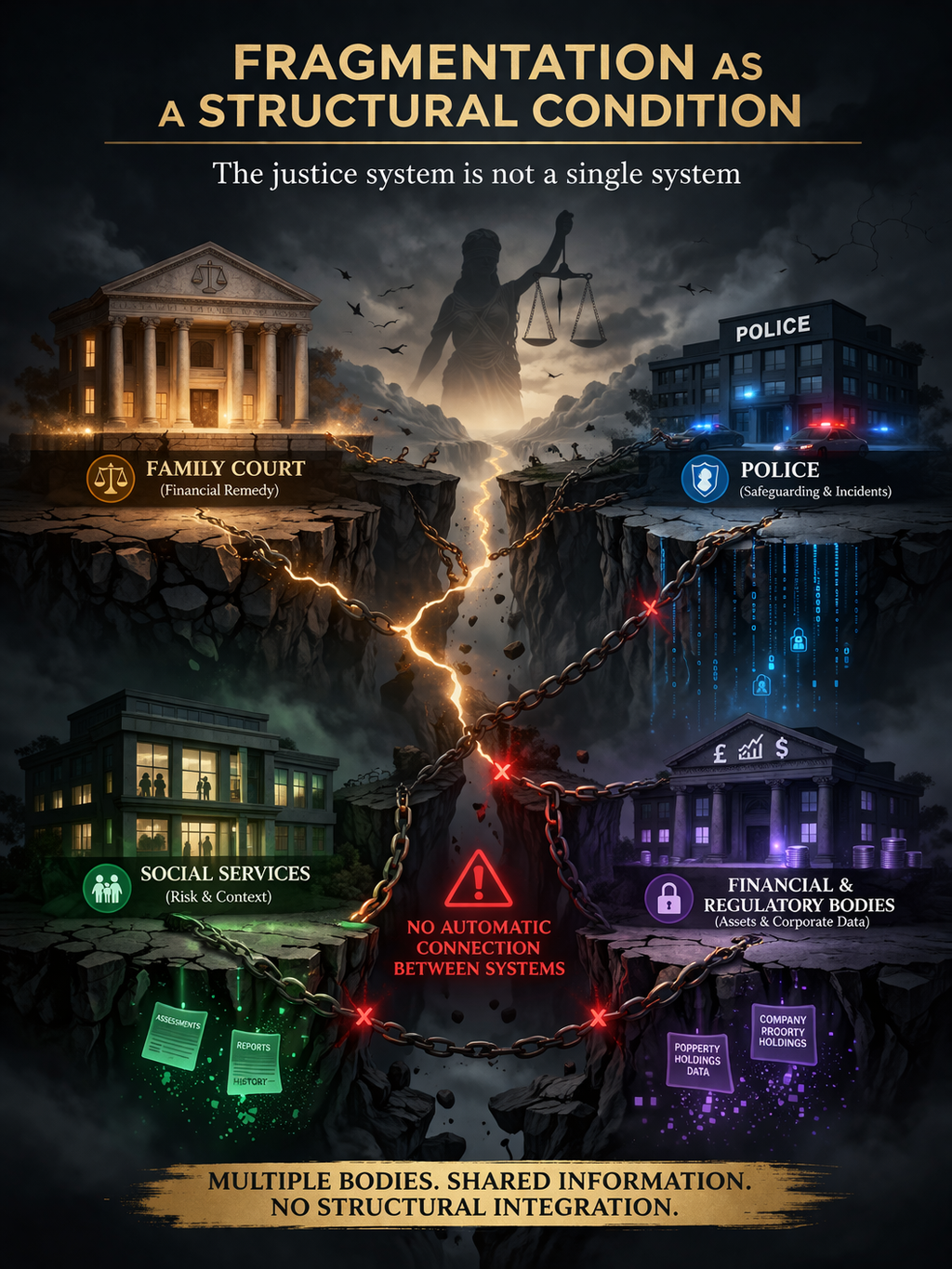
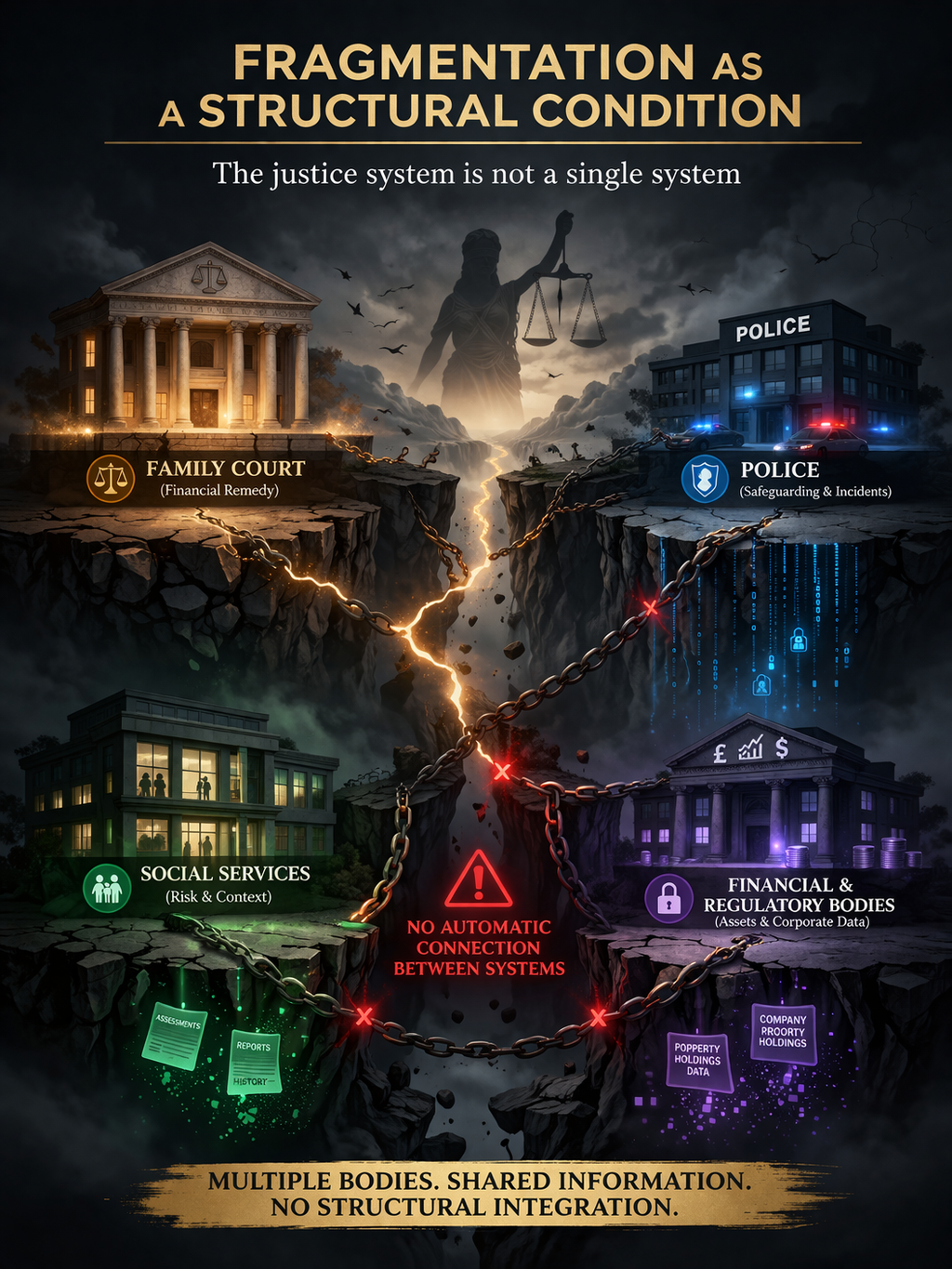
The System Isn’t Broken — It’s Fragmented
The system isn’t failing because it doesn’t exist.
It fails because it is not connected.
When safeguarding is split across institutions,
patterns of harm become fragmented —
and what should be visible becomes invisible.

The Bureaucratisation of Harm: How Systems Convert Abuse into Administrative Outcome
A powerful socio-legal article on how domestic abuse is stripped of context and recast by institutions as neutral administrative outcome.

Beyond Attrition: How Coercive Control Becomes Institutional Dispossession
Coercive control does not end when the relationship ends. Its most damaging phase may begin when the effects of abuse enter public systems that misread trauma as deficiency, distress as unreliability, and instability as personal failure. What follows is not merely institutional oversight, but institutional dispossession: the conversion of private abuse into public loss.

The Architecture of Attrition: A Socio-Legal Analysis of Induced Cognitive Instability and Serial Domestic Predation
This article examines a specialised pattern of coercive control in which chronic psychological stress is not incidental, but strategically induced to neutralise an intimate partner’s autonomy, stability, and socio-economic independence. It argues that what is often dismissed as interpersonal dysfunction may, in fact, constitute a patterned form of domestic sabotage: one that operates through cognitive attrition, economic disruption, and the serial recycling of victims. By reframing these behaviours within a socio-legal lens, the article calls for legal recognition of induced trauma-based attrition, expanded admissibility of patterned evidence, and stronger protections against litigation abuse.