
SAFECHAIN™ Global CouncilThe New Architecture of Integrity
SAFECHAIN™ Global Council
The New Architecture of Integrity
The SAFECHAIN™ Global Council is an elite, multi-disciplinary network of verified professionals, institutions, and strategic reform leaders committed to advancing transparency, procedural integrity, and safeguarded action across systems that have too often operated in isolation

The Paradox of Power
A Systems Perspective
This is where structural thinking becomes essential.
If safeguarding systems are to function effectively in complex cases, they must:
recognise behavioural patterns across time
reduce reliance on presentation alone
preserve context across institutional boundaries
support fair interpretation of trauma responses
Because in domestic abuse cases:
the truth is rarely found in a single moment — it exists across a pattern

Open Letter: When “Not Good Enough” Becomes Institutional Erasure A Response to Baroness Levitt KC on the Failure of the UK Family Courts
SAFECHAIN™ EXCERPT
“Not good enough” is not reform.
It is an admission of institutional failure.
SAFECHAIN™ exists because survivors should not have to collapse in order to be believed, nor lose everything in order to expose what the system refused to see.
Where silos protect process over people, SAFECHAIN™ demands continuity, accountability, and justice.
If you want it even shorter for the image, use this:
SAFECHAIN™
From institutional failure
to evidential accountability.
The Minister Is Right. But Reform Must Be Built, Not Merely Announced
Samantha Avril-Andreassen is the founder of SAFECHAIN™ and author of The Architecture of an Unbreakable Soul. Her work focuses on safeguarding integrity, procedural fairness, evidential continuity, and cross-agency reform in domestic abuse and family justice systems.

The Minister Is Right About Family Justice. But Reform Needs Infrastructure, Not Just Sympathy
When I read Alison Levitt’s remarks on the family courts this week, I felt two things at once: relief and urgency.
Relief, because at last a justice minister has said plainly what too many women and children have known for years: the family justice system in England and Wales has not treated them fairly. Urgency, because recognising injustice is only the beginning. If reform is to mean anything, it must be translated into operational reality.
Levitt was right to say the system is “not good enough.” She was right to describe the retraumatising nature of proceedings in which victims can be cross-examined repeatedly in ways that deepen harm rather than resolve it. She was also right to challenge the use of “parental alienation” as though it were a settled scientific concept, when even ministers are now openly questioning its definitional and evidential basis.
The Law Exists. The System Fails. Why SAFECHAIN™ Is No Longer Optional
The Law Exists. The System Fails. Why SAFECHAIN™ Is No Longer Optional
The Position Moving Forward
The law does not need rewriting.
It needs enforcing—properly, consistently, and in full view of all relevant information.
SAFECHAIN™ exists to ensure that:
disclosure is tested against reality
professional duties are operationalised
judicial fairness is measured in practice
and institutional fragmentation no longer determines outcome

The Paradox of Power: When Legal Authority and Judicial Roles Intersect
A Structural Analysis of Perception, Credibility, and Institutional Bias
Introduction
The integrity of the legal system depends on two core principles:
independence
impartiality
These principles are foundational to public trust.
However, within complex legal ecosystems, a structural question arises:
What happens when roles of advocacy and judicial authority intersect within the same professional environment?
This is not a question of individual conduct.
It is a question of system design, perception, and structural influence.
Dual Roles Within the Legal System
Within the legal profession, it is not uncommon for practitioners to operate in more than one capacity.
Why Survivors Become Their Own Case Managers
SAFECHAIN™ and the Restoration of Continuity
SAFECHAIN™ is designed to address this structural issue by:
integrating information across systems
preserving continuity of evidence
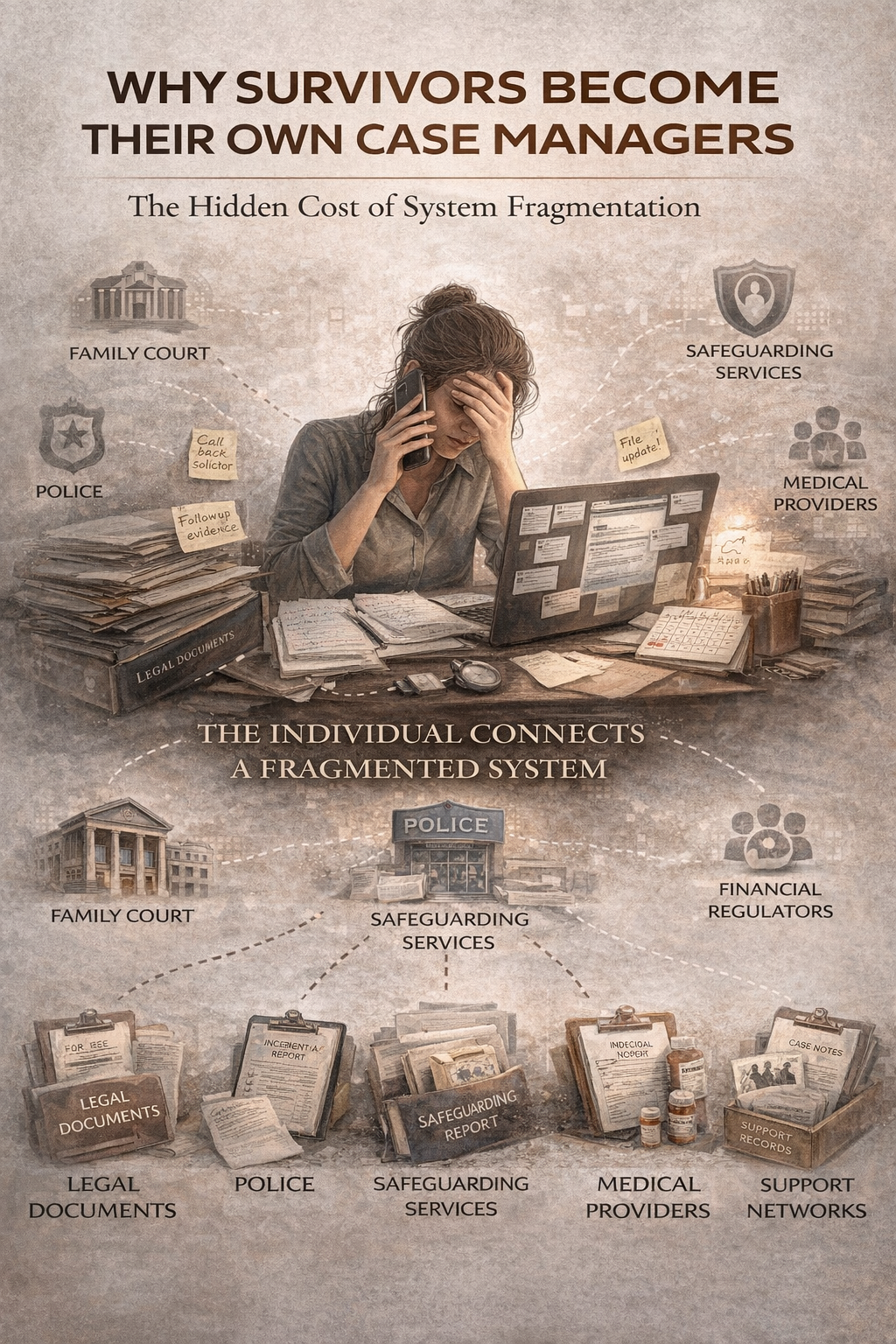
and reducing the need for individuals to manage their own case architecture
It seeks to ensure that:
information flows between institutions
patterns are recognised without repetition
and individuals are no longer required to function as system coordinators

The Clean Break Illusion:
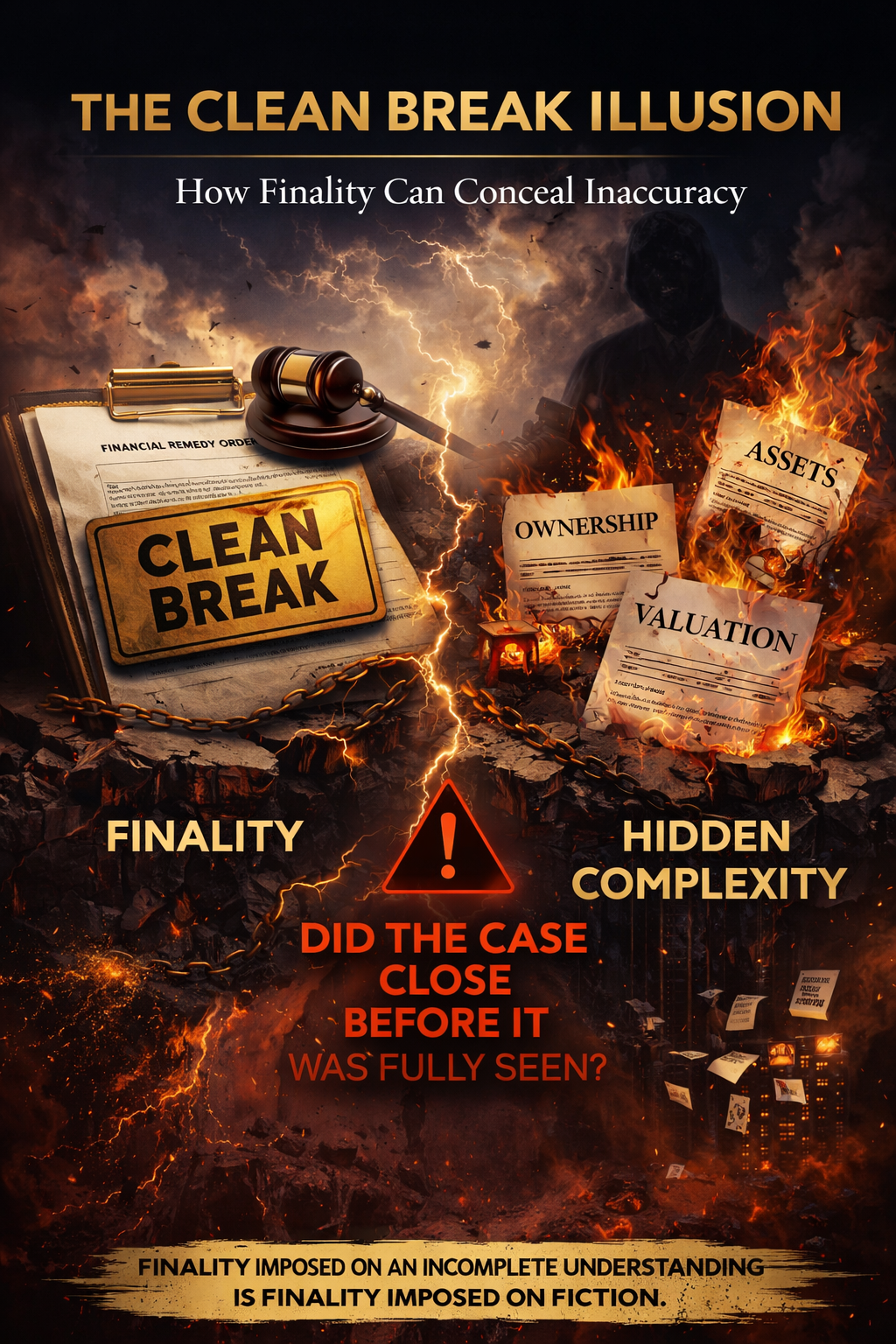
The clean break remains a legitimate and valuable mechanism within financial remedy proceedings.
However, its effectiveness depends entirely on the conditions under which it is applied.
Where:
the financial picture is incomplete
systems remain fragmented
and procedural pressures limit scrutiny
finality may not represent resolution.
It may represent closure over complexity.
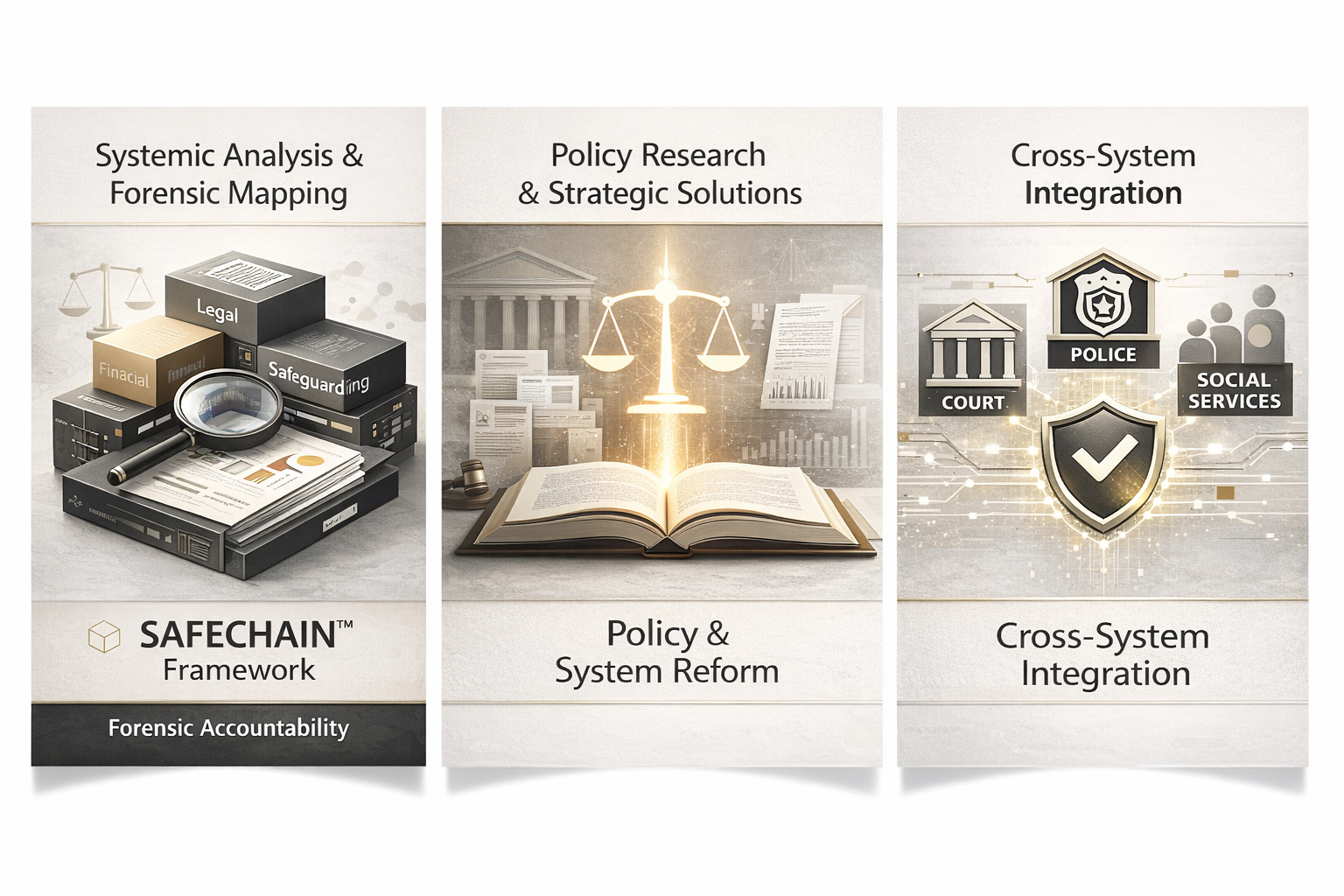
The Law Exists. The System Fails.
This Is Where SAFECHAIN™ Sits
SAFECHAIN™ is not commentary.
It is a forensic accountability framework designed to:
connect fragmented systems
identify inconsistencies across domains
and bring structural clarity to complex cases

The Structural Failure of Financial Remedy Proceedings:Why Disclosure, Procedure, and System Fragmentation Undermine Justice
Institutional Fragmentation: The “Silo” Problem
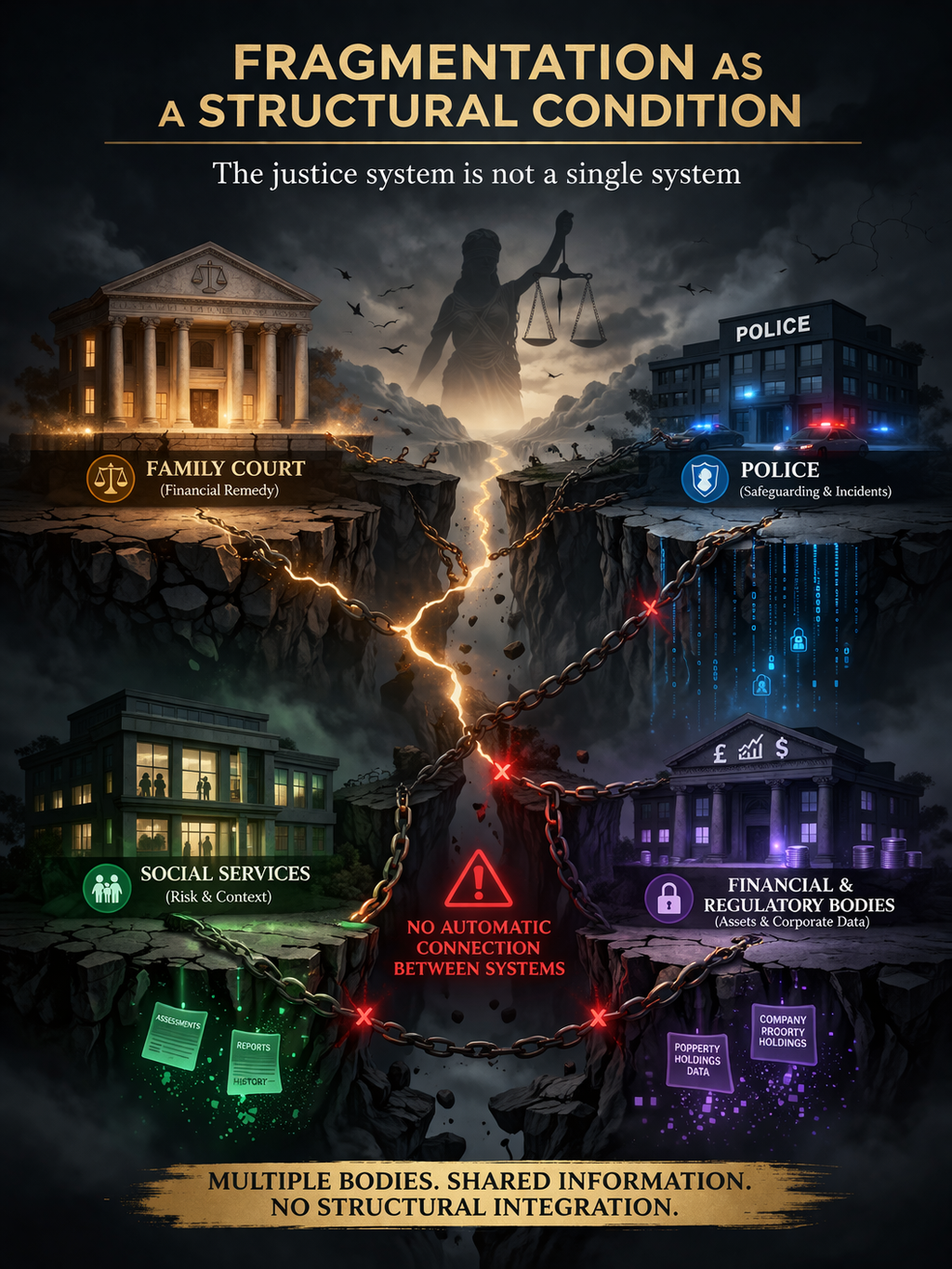
One of the most significant structural challenges is the lack of integration between:
Family Courts
Police and safeguarding agencies
Financial and regulatory bodies
Each system may hold relevant information, yet there is often no unified mechanism to:
reconcile discrepancies
identify patterns across domains
or present a fully integrated evidential picture
This creates the possibility that:
different versions of events exist across different systems
financial realities are not cross-referenced
and safeguarding concerns remain isolated
When Advocacy Becomes Strategy: The Risk of Creative Litigation in Domestic Abuse Cases
When Advocacy Becomes Strategy: The Risk of Creative Litigation in Domestic Abuse Cases
Creative litigation strategies in domestic abuse cases can shift outcomes through delay, narrative control, and financial positioning. This article explores risks and safeguards.
The Governance Gap in Safeguarding Systems
Reframing Safeguarding Responsibility
A key principle emerges from this analysis:
Safeguarding systems should not depend on the capacity of the individual experiencing harm to function effectively.
Instead, systems should be designed to:
absorb complexity
maintain continuity
coordinate processes internally
Why Survivors Are Forced to Become Their Own Case Managers
This represents a form of structural role displacement, with significant implications for safeguarding effectiveness and fairness.
Addressing this issue requires:
integrated safeguarding systems
coordinated governance frameworks
infrastructure capable of maintaining continuity across agencies
Without such reform, safeguarding systems risk:
transferring institutional responsibility onto those they are designed to protect
The Hidden Cost of Procedural Trauma in Domestic Abuse Cases
Domestic abuse safeguarding systems are designed to provide protection, accountability, and access to justice. However, increasing attention is being given to the phenomenon of procedural trauma—the psychological harm experienced by individuals navigating complex institutional processes. This article argues that procedural trauma is not incidental, but structurally produced through the interaction of institutional fragmentation, evidential demands, and adversarial legal processes. It introduces the concept of “procedural harm architecture” and situates SAFECHAIN™ as a governance-layer intervention aimed at reducing systemic retraumatisation while preserving legal integrity.
The Institutional Fragmentation Problem in Domestic Abuse Safeguarding
The Institutional Fragmentation Problem in Domestic Abuse Safeguarding
Why the Family Court System Struggles to Detect Coercive Control
a misalignment between legal structure and lived reality.
While legislation has evolved to recognise coercive control, institutional systems have not yet fully adapted to operationalise that recognition.
Addressing this gap requires:
structural reform
improved evidential continuity
enhanced inter-agency coordination
governance frameworks capable of recognising patterns over time
Without such developments, coercive control risks remaining:
legally recognised, but systemically under-detected
Why Domestic Abuse Safeguarding Needs Structural Reform
Without effective coordination between institutions, survivors may encounter a safeguarding system that feels fragmented rather than integrated.
Fragmentation Within Safeguarding Systems
Fragmentation occurs when institutional responses operate in parallel rather than in coordination.
In domestic abuse cases, fragmentation can appear in several ways:
Evidence relating to abuse may be held by different institutions without consolidation
Survivors may be required to provide similar information repeatedly across agencies
Institutional timelines may not align, creating prolonged uncertainty
Critical safeguarding indicators may remain dispersed across systems