
The Missing Link in Safeguarding: Why Continuity of Information Determines Outcomes
Safeguarding systems do not fail solely because information is missing.
They fail because information is not connected.
In many domestic abuse cases, critical insights exist across police, courts, healthcare, and housing systems — yet without continuity, the broader pattern of harm can remain obscured.

The Future of Safeguarding: Building Institutional Systems That Protect Survivors
Safeguarding systems in the United Kingdom have reached a critical point of evolution.
While domestic abuse is now recognised in law as a pattern of coercion, control, and psychological harm, the systems designed to respond to it often remain structured around institutional boundaries rather than lived realities.
The future of safeguarding will not be defined solely by legal recognition, but by whether institutions are capable of working together to recognise patterns of harm that unfold across multiple domains of a person’s life.

Manufactured Neutrality: When Equality of Arms Exists Only on Paper
Equality of arms does not mean equal rules.
It means equal ability to be heard.
Without that—
neutrality is only an appearance.
Manufactured Neutrality: When Equality of Arms Exists Only on Paper
When the same system teaches you how to argue—
and then asks you to judge—
the question is not intention.
It is structure.

The Recorder Paradox: When Advocacy and Adjudication Intersect
When the same system teaches you how to argue—
and then asks you to judge—
the question is not intention.
It is structure.
When Process Becomes Strategy
When process begins to shape outcome,
fairness becomes conditional.
Not on the law—
but on how the process is applied.

The Paradox of Procedure
The law, in its current form, is not silent on domestic abuse, coercive control, or financial manipulation. Statutory frameworks exist. Judicial guidance exists. Safeguarding duties exist.
And yet—outcomes continue to emerge that appear disconnected from those very protections.
This is the paradox.
Not of absence, but of application.
Within family proceedings, particularly at the Financial Dispute Resolution stage, process is intended to facilitate fairness. It is designed to create space for resolution, guided by judicial neutrality and informed discretion. However, where that process becomes displaced—moved across courts, detached from continuity, and presided over without contextual grounding—it begins to shift.
When a hearing is no longer anchored to its procedural origin, and when requests for adjournment are refused despite material context, the structure of fairness itself is placed under strain.
In such moments, procedure does not simply govern the outcome.
It shapes it.
The presence of part-time judicial roles introduces an additional layer of structural complexity. A system that permits dual participation—judicial and professional—must ensure that its safeguards are not only present, but actively functioning. Where perception of neutrality is weakened, even unintentionally, confidence in the system is affected.
This is not a question of individuals.
It is a question of architecture.
Because when evidential inconsistency is not reconciled, when medical vulnerability does not translate into procedural protection, and when financial narratives diverge without scrutiny—the system is no longer operating as a unified whole.
It is operating in fragments.
And within those fragments, the burden shifts.
From system to individual.
From structure to survival.
The result is not simply legal imbalance—it is lived consequence.
Loss of home.
Ongoing financial exposure.
Psychological and physical strain.
The law exists.
But where culture, structure, and application fail to move with it—
the protection it promises remains, in practice, just out of reach.

Why the Law Exists — But the Culture Hasn’t Caught Up
Domestic abuse law UK, coercive control legal framework, family court failures UK, trauma-informed justice, SAFECHAIN framework, evidential continuity, cultural lag legal system, human rights domestic abuse

Acknowledgement Is Not Accountability
Acknowledgement is not accountability.
Domestic abuse is now widely recognised in law and policy.
But recognition alone does not guarantee protection.
When systems evolve in language but not in structure,
harm may be understood in principle —
but not effectively addressed in practice.

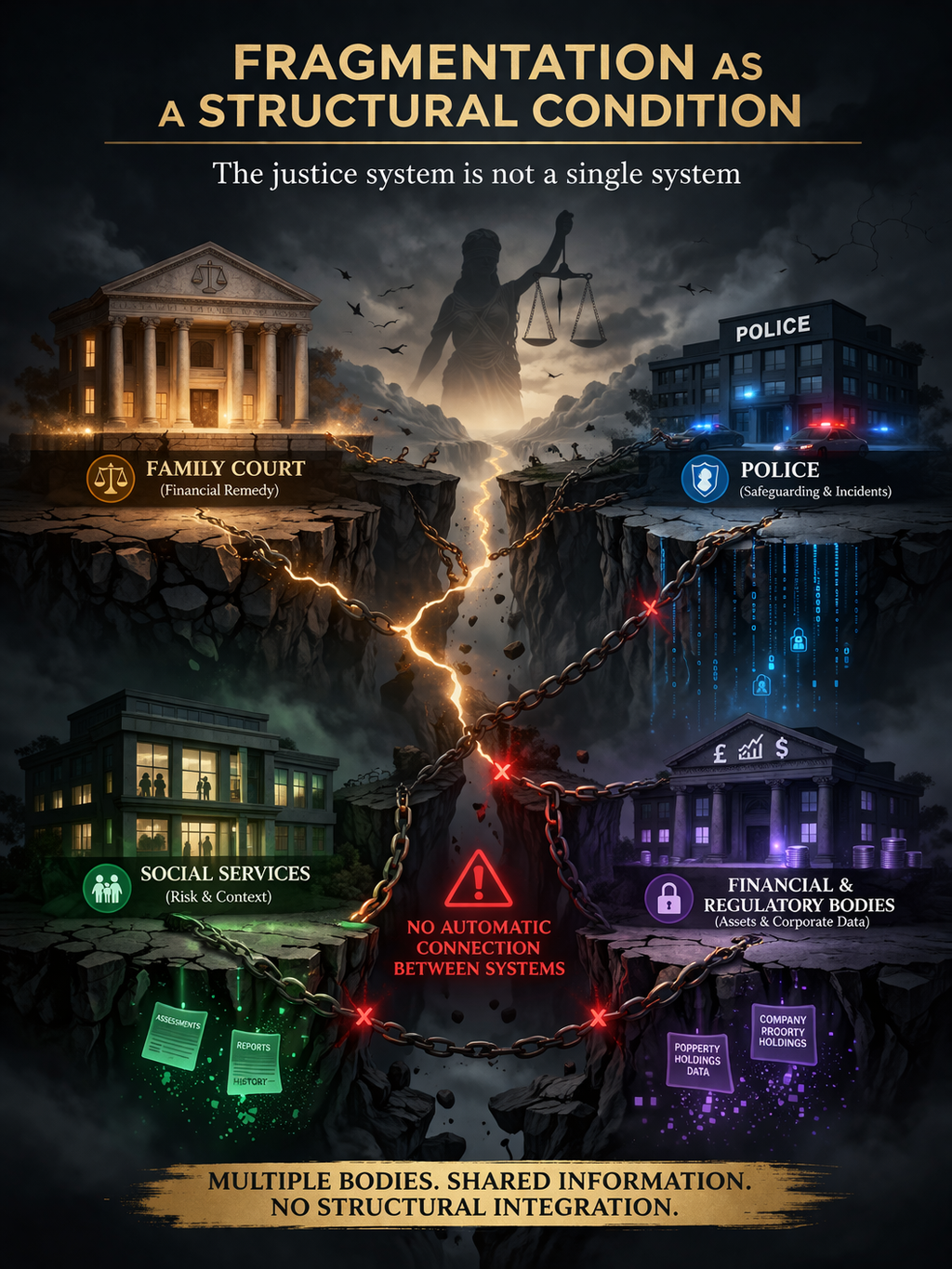
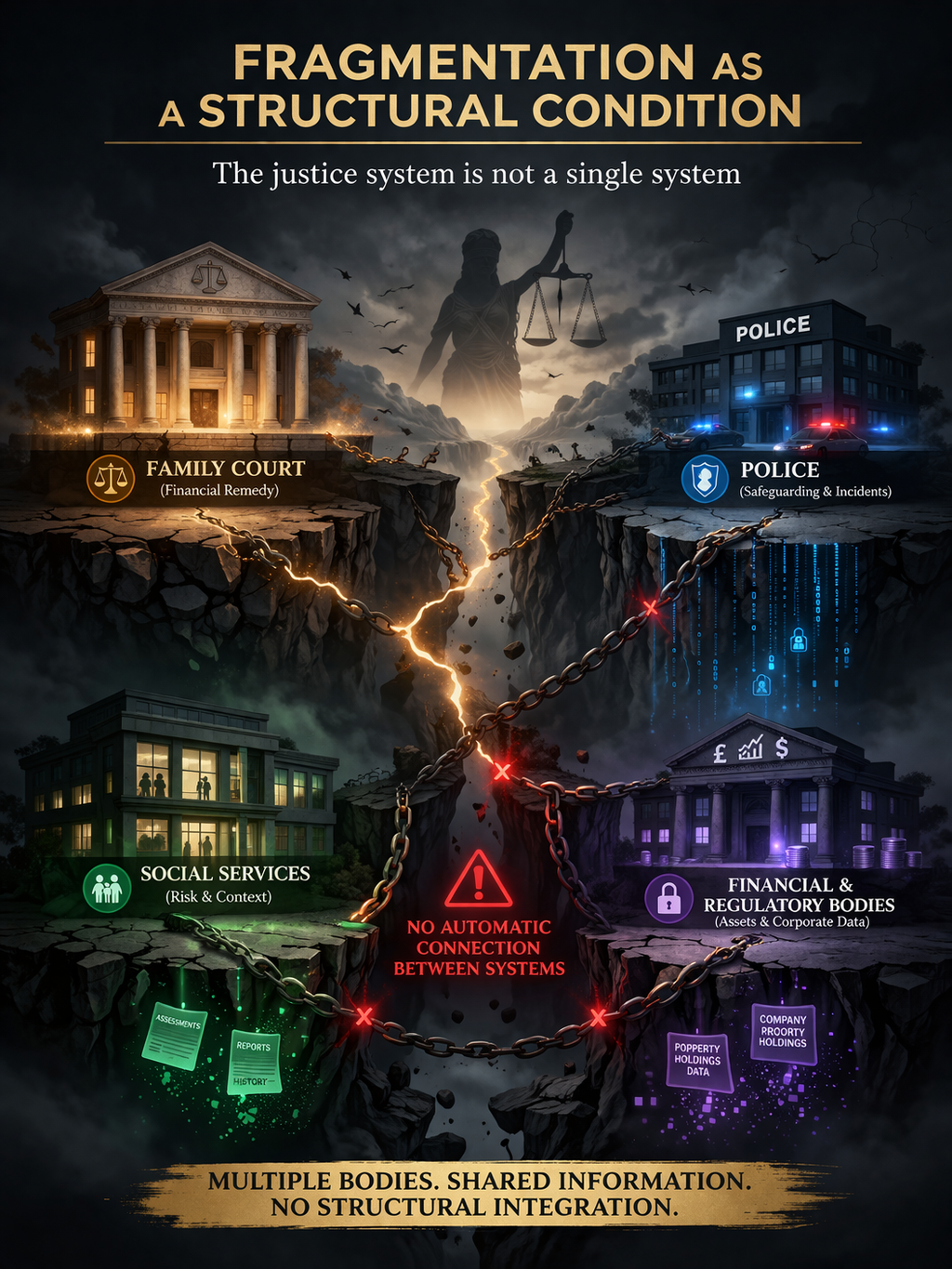
The System Isn’t Broken — It’s Fragmented
The system isn’t failing because it doesn’t exist.
It fails because it is not connected.
When safeguarding is split across institutions,
patterns of harm become fragmented —
and what should be visible becomes invisible.

The Bureaucratisation of Harm: How Systems Convert Abuse into Administrative Outcome
A powerful socio-legal article on how domestic abuse is stripped of context and recast by institutions as neutral administrative outcome.

Beyond Attrition: How Coercive Control Becomes Institutional Dispossession
Coercive control does not end when the relationship ends. Its most damaging phase may begin when the effects of abuse enter public systems that misread trauma as deficiency, distress as unreliability, and instability as personal failure. What follows is not merely institutional oversight, but institutional dispossession: the conversion of private abuse into public loss.

The Architecture of Attrition: A Socio-Legal Analysis of Induced Cognitive Instability and Serial Domestic Predation
This article examines a specialised pattern of coercive control in which chronic psychological stress is not incidental, but strategically induced to neutralise an intimate partner’s autonomy, stability, and socio-economic independence. It argues that what is often dismissed as interpersonal dysfunction may, in fact, constitute a patterned form of domestic sabotage: one that operates through cognitive attrition, economic disruption, and the serial recycling of victims. By reframing these behaviours within a socio-legal lens, the article calls for legal recognition of induced trauma-based attrition, expanded admissibility of patterned evidence, and stronger protections against litigation abuse.

SYSTEM ANALYSIS: STRUCTURAL FAILURE IN DOMESTIC ABUSE SAFEGUARDING
Domestic abuse safeguarding does not fail due to absence of systems.
It fails due to the absence of integration between them.
Across family courts, law enforcement, healthcare, housing, and financial oversight bodies, critical information is collected, recorded, and stored — but rarely aligned.
Each institution operates within its own framework.
Each holds a partial view.
No single system maintains a continuous, unified safeguarding record.
This results in evidential discontinuity, where patterns of behaviour — particularly coercive control — are fragmented across multiple touchpoints and therefore remain structurally unrecognised.
The consequence is not simply inefficiency.
It is systemic blind spots in risk identification, credibility assessment, and safeguarding response.
SAFECHAIN™ identifies this failure as structural, not incidental — and positions safeguarding as an infrastructure requirement, rather than a discretionary process.

From Lived Experience to Policy Innovation: The Origin of SAFECHAIN™
SAFECHAIN™ did not begin as a concept.
It began as a necessity.
Developed from direct engagement with fragmented systems, it reflects a structural gap — where institutions operate in parallel, but not in connection.
The issue is not absence of policy.
It is absence of integration.
And until safeguarding is designed as infrastructure,
systems will continue to see only part of the picture.

How Financial Disclosure Is Manipulated in Divorce Proceedings (UK)
Financial disclosure is intended to ensure fairness.
But when it relies primarily on self-reporting, it becomes vulnerable to manipulation.
From concealed income to corporate structures and selective disclosure, financial narratives can be strategically shaped — influencing outcomes long before they are tested.
Without robust verification, fairness is not guaranteed.
It is assumed.

The Hidden Cost of Procedural Trauma in Family Court Proceedings
Family courts are designed to deliver justice.
But for many survivors, the process itself becomes a second layer of harm.
Repetition, adversarial questioning, and prolonged uncertainty can mirror the very dynamics the system is meant to address.
This is not always intentional.
But it is structural.
And until process is designed with trauma in mind,
justice may continue to come at a cost.

The Institutional Fragmentation Problem in Domestic Abuse Safeguarding
Domestic abuse safeguarding does not fail because systems do not exist.
It fails because systems do not connect.
Across courts, police, healthcare, and housing, critical information is collected — but it remains siloed, fragmented, and rarely integrated into a single safeguarding narrative.
Each institution sees a version of the case.
No institution sees the whole.
This fragmentation creates a dangerous gap where patterns are missed, escalation is not recognised, and risk is assessed in isolation rather than in context.
As a result, victims are required to repeat, reconstruct, and revalidate their experiences across multiple systems — carrying the burden of coordination in a structure that was never designed to connect itself.
The issue is not absence.
It is disconnection.
And until safeguarding systems are built to operate as one, fragmentation will continue to obscure harm in plain sight.

Why the Family Court System Struggles to Detect Coercive Control
Coercive control is not invisible.
It is patterned, cumulative, and deeply embedded in behaviour over time.
Yet the family court system is structured to assess incidents — not patterns.
This creates a critical blind spot.
When harm is continuous rather than discrete, psychological rather than physical, and reinforced through financial and emotional restriction, it does not always present in a way the system is designed to recognise.
As a result, victims are often assessed on how they present, rather than what they have endured.
Distress is mistaken for inconsistency.
Fragmentation is mistaken for unreliability.
And control — when subtle and sustained — is reframed as conflict.
The issue is not simply one of awareness.
It is one of structure.
Until systems are designed to identify patterns, integrate context, and interpret trauma accurately, coercive control will continue to exist in plain sight — and remain undetected.If a system is designed to see incidents,
it will miss patterns.
If it is designed to assess performance,
it will misread trauma.
And if it cannot integrate complexity,
it will fail those most affected by it.
coercive control UK
family court system UK
domestic abuse law UK
safeguarding systems
trauma-informed justice
SAFECHAIN
institutional failure
procedural fairness
financial abuse
legal reform

Manufactured Poverty
Why This Matters in Domestic Abuse Cases
In cases involving coercive control, financial dynamics are often part of the pattern.
Control may manifest through:
restriction of access to funds
strategic presentation of financial position
pressure through legal costs
asymmetry in resources
If financial reality is not fully visible, the system may unintentionally reinforce:
power imbalance rather than correcting it