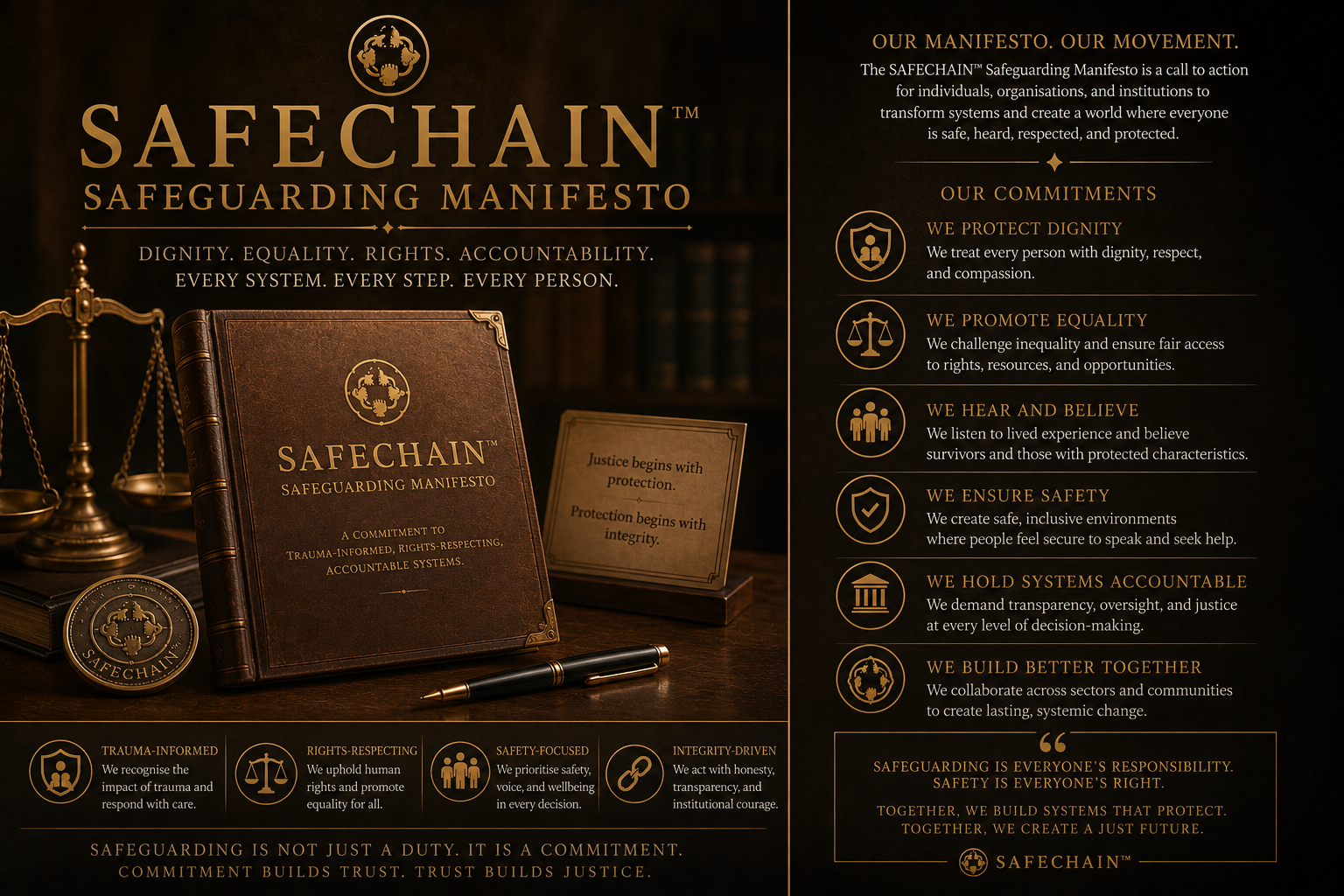
SAFECHAIN™ SAFEGUARDING MANIFESTO
PREAMBLE
The Architecture of Integrated Protection, Human Dignity, and Institutional Accountability
By Samantha Avril-Andreassen
PREAMBLE
SAFECHAIN™ was founded upon a simple but urgent recognition:
Modern safeguarding systems are fragmented.
Across domestic abuse services, courts, policing, housing, healthcare, banking, social services, education, immigration, and financial institutions, individuals experiencing vulnerability are repeatedly forced to navigate disconnected structures that often fail to communicate, fail to coordinate, and fail to protect.
The result is not merely administrative inefficiency.
The result is human harm.
SAFECHAIN™ therefore advances a safeguarding philosophy based upon:
continuity,
interoperability,
participation integrity,
trauma-informed protection,
procedural fairness,
and institutional accountability.
This manifesto establishes the foundational safeguarding principles upon which SAFECHAIN™ operates.
It is designed as:
a policy framework,
an ethical standard,
a governance model,
and a safeguarding doctrine for modern integrated systems.
ARTICLE I — HUMAN DIGNITY IS NON-NEGOTIABLE
Every individual possesses inherent dignity, autonomy, and equal human worth.
Safeguarding systems must therefore operate from the presumption that:
protection is a right,
dignity must be preserved,
and vulnerability must never be weaponised procedurally, economically, psychologically, or institutionally.
No safeguarding structure can claim legitimacy while producing:
humiliation,
retraumatisation,
procedural erasure,
economic deprivation,
or participation exclusion.
ARTICLE II — SAFEGUARDING MUST BE INTEGRATED
Fragmented systems produce fragmented outcomes.
SAFECHAIN™ rejects silo-based safeguarding structures that:
isolate institutions,
duplicate trauma,
transfer risk onto victims,
or force vulnerable individuals to repeatedly navigate disconnected systems alone.
Safeguarding must operate through coordinated institutional continuity between:
courts,
banks,
healthcare systems,
police,
schools,
housing providers,
regulators,
charities,
and safeguarding agencies.
Protection cannot depend upon institutional luck.
ARTICLE III — COERCIVE CONTROL MUST BE RECOGNISED SYSTEMICALLY
SAFECHAIN™ recognises coercive control as a multidimensional safeguarding issue that may involve:
emotional abuse,
psychological abuse,
financial abuse,
digital abuse,
procedural abuse,
social isolation,
intimidation,
surveillance,
reputational harm,
and economic entrapment.
Safeguarding systems must move beyond incident-based thinking and recognise patterns, cumulative harm, and behavioural domination.
Absence of visible injury does not mean absence of danger.
ARTICLE IV — ECONOMIC SAFETY IS A SAFEGUARDING RIGHT
Financial abuse is not merely a private financial dispute.
Economic deprivation may function as:
coercive control,
entrapment,
dependency enforcement,
survival destabilisation,
and post-separation abuse.
SAFECHAIN™ therefore recognises:
housing stability,
access to funds,
credit integrity,
economic participation,
and financial autonomy
as core safeguarding concerns.
No individual should be rendered destitute through procedural, institutional, or relational abuse.
ARTICLE V — PARTICIPATION INTEGRITY IS ESSENTIAL TO JUSTICE
Physical presence is not the same as meaningful participation.
Trauma, fear, cognitive overload, coercion, intimidation, neurodivergence, disability, language barriers, and economic vulnerability may significantly impair a person’s ability to engage safely and effectively within institutional systems.
SAFECHAIN™ therefore advances the principle of Participation Integrity™:
the requirement that systems assess whether participation is genuinely informed, safe, equitable, and psychologically accessible.
Justice without effective participation is procedural illusion.
ARTICLE VI — CHILDREN ABSORB SYSTEM FAILURE
Children are profoundly affected not only by interpersonal abuse, but by institutional instability surrounding them.
Where systems:
delay protection,
minimise harm,
intensify conflict,
create uncertainty,
or fail to coordinate,
children absorb those conditions psychologically, developmentally, emotionally, and neurologically.
Safeguarding children therefore requires safeguarding the systems around them.
ARTICLE VII — TRAUMA-INFORMED SYSTEMS MUST BE OPERATIONAL, NOT SYMBOLIC
SAFECHAIN™ rejects performative safeguarding.
Trauma-informed practice cannot exist merely within:
policy documents,
mission statements,
training slides,
or institutional branding.
A trauma-informed system must operationally demonstrate:
safety,
predictability,
transparency,
continuity,
communication,
proportionality,
and reduction of retraumatisation.
Safeguarding that increases trauma is safeguarding failure.
ARTICLE VIII — DATA, PRIVACY, AND DIGITAL SAFETY ARE SAFEGUARDING ISSUES
In modern systems, information misuse can become a form of harm.
SAFECHAIN™ therefore recognises:
privacy protection,
secure communications,
confidential reporting,
data integrity,
cyber safety,
and digital autonomy
as safeguarding requirements.
No safeguarding framework is complete without digital protection.
ARTICLE IX — INSTITUTIONS MUST BE ACCOUNTABLE FOR FORESEEABLE HARM
Where institutions possess:
knowledge,
warning signs,
safeguarding indicators,
or vulnerability data,
they must not ignore foreseeable harm.
SAFECHAIN™ advances the principle that:
institutional neutrality cannot justify passive exposure to preventable abuse.
Failure to act where harm is foreseeable raises serious safeguarding and ethical concerns.
ARTICLE X — INTEROPERABILITY IS THE FUTURE OF SAFEGUARDING
The future of safeguarding depends upon intelligent, interoperable systems capable of:
secure information-sharing,
continuity of protection,
coordinated risk assessment,
and cross-sector accountability.
SAFECHAIN™ therefore promotes safeguarding infrastructures that reduce contradiction between institutions and strengthen continuity of care, protection, and procedural integrity.
Disconnected systems leave vulnerable people carrying the burden of institutional failure.
ARTICLE XI — SAFEGUARDING MUST INCLUDE RESTORATION
Protection alone is insufficient.
True safeguarding must also support:
recovery,
restoration,
reintegration,
economic rebuilding,
psychological healing,
and long-term autonomy.
The purpose of safeguarding is not merely survival.
It is the restoration of dignity, safety, and human possibility.
ARTICLE XII — THE SAFECHAIN™ PRINCIPLE
SAFECHAIN™ operates from one foundational belief:
No individual should disappear between systems.
No victim should be erased through fragmentation.
No child should inherit institutional chaos as normality.
No human being should be forced to prove their humanity repeatedly to disconnected structures that fail to communicate with one another.
Safeguarding must become:
connected,
intelligent,
accountable,
humane,
and continuous.
That is the future SAFECHAIN™ exists to build.
“My pain became my gain.
They tried to bury me.
The system tried to erase me.
So I built a system that could never forget me.”
— Samantha Avril-Andreassen
CONTINUE READING
The Directive — Policy & Research Archive
Silent Screams, Loud Strength Podcast
UNMASKING JUSTICE — Masquerade Gala
30 October 2026 | Lainston House Hotel
© 2026 Samantha Avril-Andreassen. All rights reserved.
SAFECHAIN™ is a conceptual safeguarding infrastructure and policy framework authored by Samantha Avril-Andreassen. Reproduction or implementation of this framework without permission is prohibited. Version 1.0.