WHAT SAFEGUARDING ACTUALLY MEANS
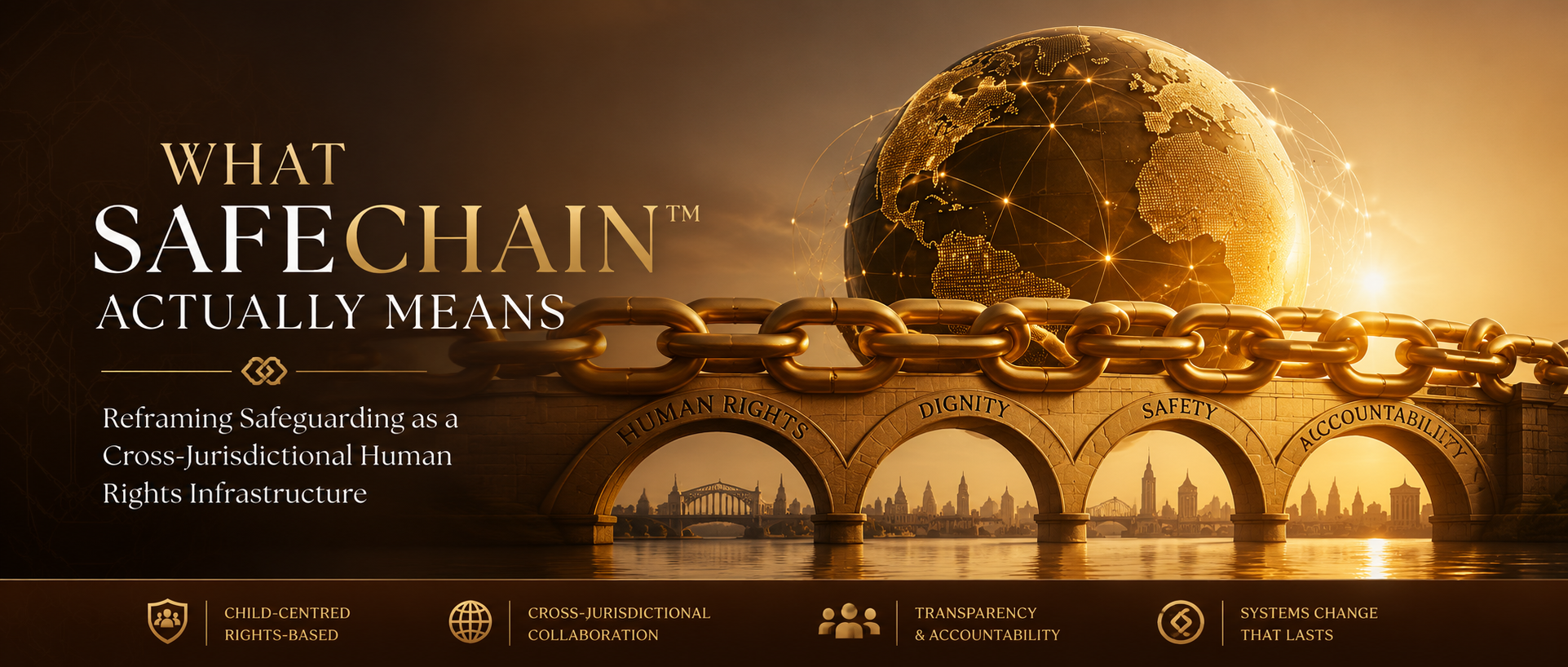
Safeguarding as a Cross-Jurisdictional Human Rights Infrastructure
WHAT SAFEGUARDING ACTUALLY MEANS
Reframing Safeguarding as a Cross-Jurisdictional Human Rights Infrastructure
A SAFECHAIN™ Policy Paper
Author: Samantha Avril-Andreassen FRSA
Framework: SAFECHAIN™ Intelligence Hub
Version: 1.0
© 2026 Samantha Avril-Andreassen. All rights reserved. SAFECHAIN™ is a conceptual safeguarding infrastructure and policy framework authored by Samantha Avril-Andreassen. Reproduction or implementation of this framework without permission is prohibited.
EXECUTIVE SUMMARY
Safeguarding is one of the most widely used and least coherently defined concepts within modern governance.
Across courts, healthcare systems, schools, policing bodies, social services, housing authorities, immigration systems, financial institutions, charities, religious organisations, workplaces, and international institutions, the term “safeguarding” is repeatedly invoked as though its meaning were universally understood.
It is not.
In practice, safeguarding has become fragmented, procedurally inconsistent, institutionally siloed, and dangerously reduced to reactive policy compliance rather than operational human protection.
This paper argues that safeguarding must be redefined not as a departmental policy function, but as a cross-jurisdictional human rights infrastructure grounded in:
prevention;
dignity;
participation;
structural accountability;
trauma-informed operational design;
interoperability between institutions;
and the preservation of human safety across all legal systems.
The paper examines safeguarding across:
England and Wales;
Scotland;
Northern Ireland;
European legal frameworks;
United Nations conventions and treaty systems;
Commonwealth jurisdictions;
and comparative public law principles.
It explores safeguarding in relation to:
family law;
criminal law;
public law;
housing law;
immigration law;
education law;
employment law;
healthcare regulation;
financial systems;
digital governance;
and institutional accountability.
The central argument is simple:
Safeguarding is not merely the prevention of immediate physical harm.
Safeguarding is the preservation of a person’s ability to survive, participate, remain visible, retain dignity, access justice, maintain autonomy, and exist safely within systems of power.
Where systems expose vulnerable people to procedural harm, coercive control, economic abuse, institutional blindness, evidential erasure, or structural abandonment, safeguarding has already failed.
SAFECHAIN™ proposes that safeguarding must evolve from fragmented policy language into a unified operational framework capable of identifying risk, preserving participation integrity, preventing institutional contradiction, and restoring accountability across interconnected systems.
INTRODUCTION
Modern safeguarding systems are built upon a paradox.
Institutions frequently claim to protect vulnerable individuals while simultaneously operating structures that intensify vulnerability.
A person may be recognised as vulnerable by one institution and disbelieved by another.
A survivor of domestic abuse may receive trauma recognition from a healthcare provider while simultaneously being subjected to retraumatising procedural environments in court.
A child identified as at risk by a school may remain unprotected because agencies fail to communicate effectively.
A financially abused individual may be recognised by a domestic abuse charity while continuing to suffer credit destruction, housing insecurity, and procedural disadvantage due to institutional fragmentation.
This contradiction reveals the central failure of safeguarding in the modern era:
Safeguarding systems frequently assess incidents rather than structures.
As a result, they often fail to identify:
cumulative harm;
procedural harm;
coercive systems;
economic entrapment;
participation impairment;
trauma physiology;
institutional silencing;
and structural invisibility.
Safeguarding has therefore become too narrow.
It is commonly treated as:
a compliance checklist;
a policy department;
a disclosure process;
a referral pathway;
or a reactive intervention after harm has already escalated.
This paper argues that safeguarding must instead be understood as a constitutional and operational duty to preserve human safety, dignity, participation, and continuity across systems.
DEFINING SAFEGUARDING
Traditional Definitions
In many jurisdictions, safeguarding is generally defined as:
protecting children and vulnerable adults from abuse, neglect, exploitation, or harm;
preventing risk;
promoting welfare;
and ensuring safe environments.
Examples include:
England and Wales
Under the Care Act 2014, safeguarding duties include protecting adults with care and support needs from abuse and neglect.
The Children Act 1989 and Children Act 2004 establish duties to safeguard and promote the welfare of children.
Scotland
The Adult Support and Protection (Scotland) Act 2007 focuses on adults at risk who are unable to safeguard themselves from harm.
European Union
The Charter of Fundamental Rights of the European Union protects dignity, equality, non-discrimination, and the rights of the child.
United Nations
The UN Convention on the Rights of the Child (UNCRC), Convention on the Elimination of All Forms of Discrimination Against Women (CEDAW), and Convention on the Rights of Persons with Disabilities (CRPD) all establish safeguarding-related obligations.
Commonwealth Jurisdictions
Many Commonwealth nations incorporate safeguarding obligations through constitutional rights, child protection statutes, anti-discrimination laws, domestic abuse legislation, and public law principles.
However, across jurisdictions, safeguarding definitions remain fragmented.
Most frameworks focus primarily on:
immediate abuse;
physical safety;
or reactive intervention.
This is insufficient.
WHAT SAFEGUARDING ACTUALLY MEANS
Safeguarding means preserving a person’s ability to exist safely, visibly, and meaningfully within systems of power.
This includes:
Physical Safety
Protection from violence, abuse, neglect, exploitation, trafficking, coercion, or physical harm.
Psychological Safety
Protection from intimidation, coercive control, degradation, manipulation, institutional retraumatisation, and emotional destabilisation.
Procedural Safety
Protection from procedural structures that impair meaningful participation, fairness, visibility, credibility, or access to justice.
Financial Safety
Protection from coercive debt, economic abuse, financial sabotage, predatory institutional behaviour, and structural impoverishment.
Evidential Safety
Protection against evidential erasure, testimonial distortion, institutional contradiction, and procedural invisibility.
Digital Safety
Protection against surveillance abuse, cyber coercion, data misuse, online exploitation, algorithmic discrimination, and digital exclusion.
Housing Safety
Protection from unsafe accommodation, retaliatory eviction, homelessness, housing instability, and structural displacement.
Institutional Safety
Protection from fragmentation between systems that results in contradictory treatment, repeated retraumatisation, or operational abandonment.
Participatory Safety
Protection of a person’s ability to participate meaningfully in legal, institutional, financial, educational, and social systems.
This is the foundation of Participation Integrity™.
SAFEGUARDING ACROSS AREAS OF LAW
FAMILY LAW
Family law is one of the most safeguarding-intensive legal environments in existence.
Yet many jurisdictions continue to process domestic abuse primarily through adversarial procedural structures not designed around trauma.
Key safeguarding issues include:
coercive control;
post-separation abuse;
litigation abuse;
unsafe cross-examination;
participation impairment;
financial abuse;
evidential distortion;
and procedural exhaustion.
United Kingdom
Important legal frameworks include:
Domestic Abuse Act 2021;
Practice Direction 12J;
FPR Part 3A;
PD3AA;
Human Rights Act 1998;
Article 6 ECHR;
Article 8 ECHR.
However, legal rights alone do not guarantee safeguarding.
Operational failures frequently arise where institutions:
misinterpret trauma responses;
prioritise procedural efficiency over safety;
fail to understand coercive control;
treat vulnerability as behavioural difficulty;
or confuse participation with physical attendance.
CRIMINAL LAW
Safeguarding within criminal systems requires:
victim protection;
witness protection;
trauma-informed interviewing;
evidential continuity;
anti-retaliation mechanisms;
and procedural fairness.
Across many jurisdictions, criminal justice systems continue to struggle with:
delayed prosecutions;
low conviction rates in domestic abuse cases;
victim attrition;
racial disparities;
disability discrimination;
and institutional distrust.
Safeguarding therefore requires not merely criminalisation of harm, but operational systems capable of sustaining victim participation safely.
PUBLIC LAW
Public authorities possess safeguarding obligations through:
human rights duties;
equality duties;
administrative fairness;
and proportionality principles.
Safeguarding failures may therefore arise through:
unlawful policies;
institutional neglect;
discriminatory practices;
failures to accommodate vulnerability;
or procedural unfairness.
In the UK, this intersects with:
the Equality Act 2010;
the Human Rights Act 1998;
public sector equality duties;
and judicial review principles.
HOUSING LAW
Housing is safeguarding.
Unsafe housing, homelessness, displacement, retaliatory eviction, inaccessible accommodation, and procedural housing instability all create safeguarding risks.
Housing insecurity frequently intersects with:
domestic abuse;
poverty;
disability;
trauma;
child welfare;
immigration status;
and financial abuse.
Safeguarding in housing law must therefore include:
habitability;
dignity;
stability;
accessibility;
and protection against retaliatory displacement.
IMMIGRATION LAW
Migrants, refugees, asylum seekers, and undocumented individuals often experience heightened safeguarding risks due to:
language barriers;
fear of deportation;
trafficking;
economic dependency;
discrimination;
and limited institutional trust.
International safeguarding frameworks therefore require:
anti-trafficking measures;
child protection;
refugee protections;
anti-discrimination safeguards;
and procedural fairness.
Relevant frameworks include:
Refugee Convention 1951;
Palermo Protocol;
ECHR;
UNCRC;
and anti-trafficking conventions.
EMPLOYMENT LAW
Safeguarding within workplaces includes:
protection from harassment;
discrimination;
coercion;
retaliation;
exploitation;
unsafe working conditions;
and psychological harm.
Increasingly, safeguarding must also include:
trauma-informed employment practices;
domestic abuse workplace protections;
neurodivergent accommodations;
and anti-retaliation systems.
EDUCATION LAW
Schools, colleges, and universities operate some of the most significant safeguarding obligations within society.
Educational safeguarding includes:
child protection;
anti-bullying protections;
disability accommodations;
online safety;
mental health support;
and protection against exploitation.
The UNCRC establishes that children possess independent rights to safety, dignity, participation, education, and protection from harm.
HEALTHCARE LAW
Healthcare safeguarding includes:
informed consent;
dignity;
patient autonomy;
mental health protection;
anti-discrimination;
confidentiality;
and trauma-informed care.
Failures within healthcare safeguarding may include:
medical gaslighting;
racial disparities;
denial of pain;
psychiatric coercion;
or institutional neglect.
DIGITAL SAFEGUARDING
Digital systems increasingly shape human safety.
Modern safeguarding must therefore address:
cyberstalking;
online grooming;
deepfakes;
AI bias;
algorithmic discrimination;
surveillance abuse;
digital coercive control;
and data exploitation.
Safeguarding can no longer exist solely in physical space.
INTERNATIONAL SAFEGUARDING FRAMEWORKS
UNITED NATIONS
Important UN safeguarding instruments include:
Universal Declaration of Human Rights;
UN Convention on the Rights of the Child;
CEDAW;
Convention on the Rights of Persons with Disabilities;
International Covenant on Civil and Political Rights;
International Covenant on Economic, Social and Cultural Rights;
Palermo Protocol;
Convention Against Torture.
These frameworks collectively establish:
dignity;
equality;
participation;
bodily autonomy;
freedom from degrading treatment;
and protection against exploitation.
EUROPEAN FRAMEWORKS
Important European safeguarding structures include:
European Convention on Human Rights;
Istanbul Convention;
Charter of Fundamental Rights of the European Union;
General Data Protection Regulation;
anti-trafficking directives;
equality directives.
The Istanbul Convention is particularly significant because it recognises domestic abuse as structural violence requiring coordinated institutional response.
COMMONWEALTH PRINCIPLES
Commonwealth legal systems frequently share:
common law foundations;
constitutional rights frameworks;
judicial review principles;
public law duties;
and anti-discrimination structures.
However, safeguarding standards vary significantly between jurisdictions.
A major challenge across Commonwealth systems is the gap between:
legal recognition;
and operational implementation.
THE FAILURE OF REACTIVE SAFEGUARDING
Most safeguarding systems remain reactive.
They intervene after:
violence;
breakdown;
crisis;
evidential collapse;
homelessness;
psychological deterioration;
or institutional failure.
Reactive safeguarding is structurally insufficient.
Safeguarding must instead become:
preventative;
interoperable;
trauma-informed;
operationally intelligent;
and structurally accountable.
PARTICIPATION INTEGRITY™
A core argument of SAFECHAIN™ is that safeguarding cannot exist without meaningful participation.
Participation Integrity™ recognises that individuals may be physically present while functionally unable to participate safely due to:
trauma;
fear;
coercive control;
financial dependency;
exhaustion;
disability;
institutional intimidation;
or procedural overload.
Safeguarding therefore requires:
accessible process design;
trauma-informed communication;
evidential continuity;
procedural accommodations;
and operational recognition of vulnerability.
SAFECHAIN™ AND THE FUTURE OF SAFEGUARDING
SAFECHAIN™ proposes a safeguarding infrastructure based upon:
interoperability;
institutional continuity;
cross-agency intelligence;
participation preservation;
anti-fragmentation systems;
and trauma-informed procedural design.
The framework recognises that safeguarding failures frequently arise not because individual policies do not exist, but because systems fail to communicate coherently.
SAFECHAIN™ therefore proposes:
integrated safeguarding flags;
evidential continuity systems;
coercive debt recognition;
procedural safeguarding protocols;
participation integrity assessments;
and institutional accountability mapping.
CONCLUSION
Safeguarding is not a department.
It is not a checklist.
It is not a disclosure form.
It is not a procedural afterthought.
Safeguarding is the operational preservation of human dignity, safety, participation, visibility, continuity, and justice.
A society cannot claim to safeguard vulnerable people while simultaneously:
erasing their evidence;
destabilising their housing;
exhausting them procedurally;
silencing trauma responses;
ignoring coercive control;
destroying financial stability;
or fragmenting institutional responsibility.
The future of safeguarding requires:
structural coherence;
trauma-informed systems;
cross-jurisdictional accountability;
interoperability;
and operational recognition that vulnerability is not weakness, but a condition requiring institutional responsibility.
Safeguarding must therefore evolve from policy language into living infrastructure.
That is the challenge of modern governance.
That is the challenge SAFECHAIN™ seeks to address.
REFERENCES AND LEGAL FRAMEWORKS
United Kingdom
Children Act 1989
Children Act 2004
Care Act 2014
Domestic Abuse Act 2021
Equality Act 2010
Human Rights Act 1998
Family Procedure Rules Part 3A
Practice Direction 3AA
Practice Direction 12J
European Frameworks
European Convention on Human Rights
Charter of Fundamental Rights of the European Union
Istanbul Convention
GDPR
United Nations
Universal Declaration of Human Rights
UN Convention on the Rights of the Child
CEDAW
Convention on the Rights of Persons with Disabilities
ICCPR
ICESCR
Palermo Protocol
Convention Against Torture
Scotland
Adult Support and Protection (Scotland) Act 2007
Children and Young People (Scotland) Act 2014
Commonwealth and Comparative Principles
Common law procedural fairness
Constitutional equality protections
Administrative law principles
Natural justice doctrines
🌐 SAFECHAIN™ Intelligence Hub
🎧 Silent Screams, Loud Strength
📚 Unmasking Justice by Samantha Avril-Andreassen
🎭 UNMASKING JUSTICE — Masquerade Gala | 30 October 2026 | Lainston House Hotel, Hampshire