THE PARADOX OF THE PART-TIME JUDGE
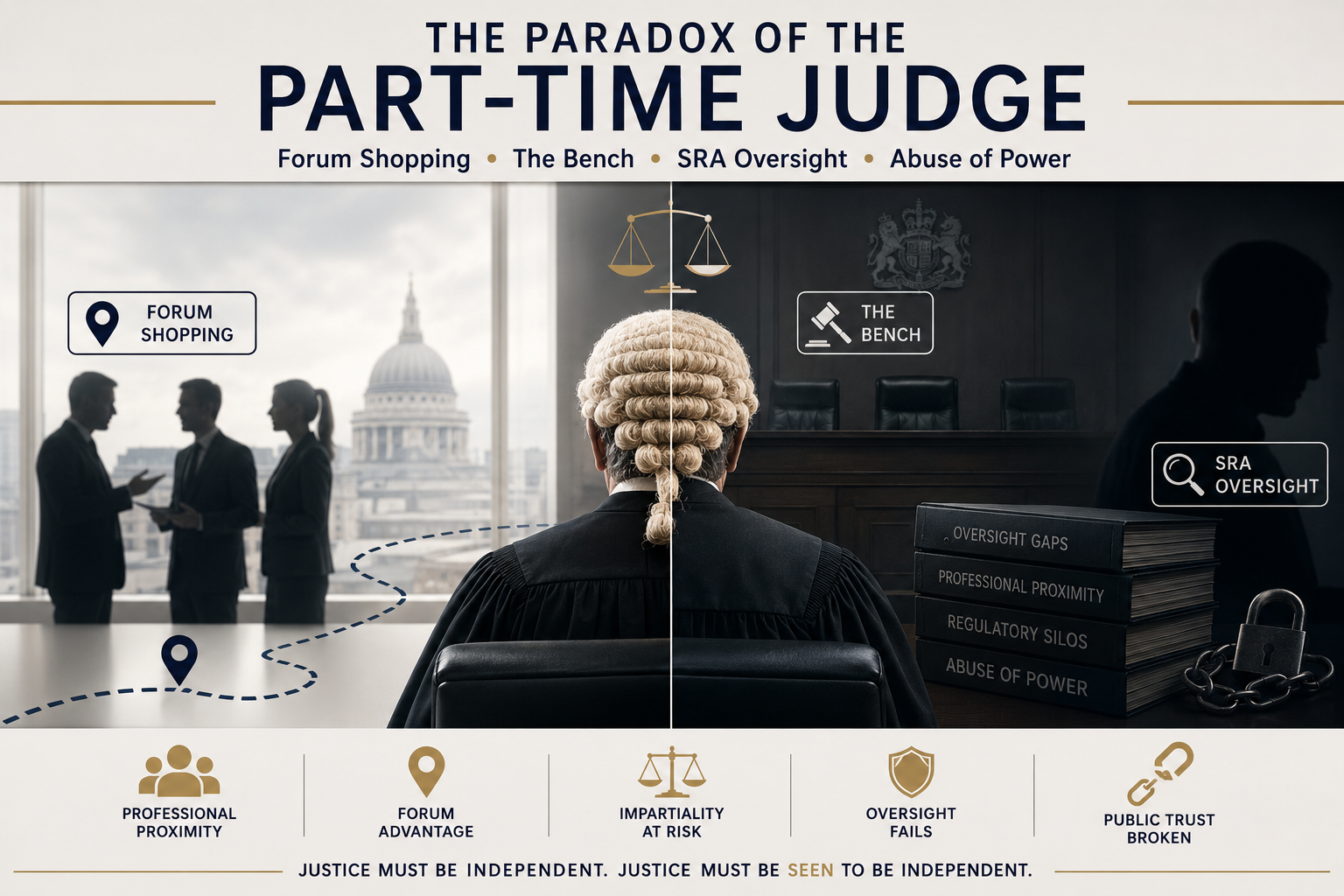
THE PARADOX OF THE PART-TIME JUDGE
Forum Shopping, Professional Proximity, Regulatory Capture, and the Structural Risk to Judicial Independence
Policy Paper
Reference: SAFECHAIN/JUD/2026/006
Status: Public Policy Submission Draft
Author: Samantha Avril-Andreassen
Founder, SAFECHAIN™ | FRSA | Systems Architect | Policy & Governance Framework Developer
EXECUTIVE SUMMARY
This paper examines a structural contradiction embedded within the administration of justice: the coexistence of judicial independence with professional interconnectedness inside the same legal ecosystem.
The issue addressed is not individual dishonesty. The issue is systemic design.
The modern legal environment permits:
part-time judges to remain embedded within active professional networks,
recurring interactions between the same practitioners and the same courts,
fragmented regulatory oversight,
procedural cultures that vary significantly between jurisdictions,
and tactical forum shopping based on perceived judicial tendencies and procedural predictability.
The result is a growing constitutional concern:
public confidence in justice increasingly depends not upon transparent structural safeguards, but upon assumptions regarding personal integrity.
This paper argues that:
judicial independence must be operationally protected,
equality of arms must be structurally enforceable,
and procedural fairness cannot remain dependent upon geography, familiarity, or litigation resources.
The paper proposes the creation of:
THE JUDICIAL INDEPENDENCE & PROCEDURAL INTEGRITY PROTOCOL (JIPIP)
This framework introduces:
anti-forum shopping protections,
judicial separation safeguards,
procedural integrity auditing,
integrated regulatory oversight,
randomised allocation structures,
and enforceable participation integrity standards.
The objective is not institutional attack.
The objective is constitutional stabilisation.
PART I — THE STRUCTURAL PARADOX
1. THE PART-TIME JUDICIAL MODEL
The part-time judiciary emerged historically as a mechanism intended to:
preserve specialist expertise,
strengthen judicial recruitment,
reduce institutional rigidity,
and ensure practical professional experience remained within the bench.
However, the operational environment of modern litigation has fundamentally changed.
The contemporary legal system functions within:
interconnected professional networks,
concentrated chambers ecosystems,
repeat-player litigation dynamics,
localised procedural cultures,
and economically incentivised adversarial structures.
Within this environment, the continued overlap between:
active legal practice,
judicial office,
chambers relationships,
and local legal familiarity
creates unavoidable risks to perceived and operational impartiality.
The paradox is therefore clear:
A structure originally intended to strengthen judicial competence may now undermine public confidence in judicial independence.
2. PROFESSIONAL PROXIMITY & STRUCTURAL FAMILIARITY
In many jurisdictions, particularly family and civil courts:
the same firms repeatedly appear before the same judges,
the same barristers rotate through the same court circuits,
and professional familiarity becomes structurally normalised.
This produces:
reputational assumptions,
procedural predictability,
informal expectations,
and familiarity-based influence dynamics.
The concern is not necessarily overt corruption.
The concern is institutional conditioning.
Repeated professional exposure risks creating:
unconscious affinity bias,
selective tolerance,
credibility weighting,
and procedural asymmetry.
Justice cannot operate safely where neutrality becomes culturally assumed rather than structurally protected.
3. THE CULTURE OF THE “KNOWN COURT”
Within litigation practice, practitioners frequently understand:
which courts rigorously enforce disclosure,
which judges actively scrutinise evidence,
which jurisdictions are perceived as procedurally relaxed,
and where tactical procedural pressure is more likely to succeed.
This creates a hidden procedural geography.
The consequence is forum shopping.
PART II — FORUM SHOPPING
4. DEFINITION
Forum shopping refers to the strategic selection, movement, or manipulation of jurisdictional placement to secure tactical procedural advantage.
It is not simply administrative convenience.
It is often a calculated attempt to:
secure favourable procedural culture,
exploit known judicial tendencies,
avoid rigorous scrutiny,
or maximise pressure against the opposing party.
This may include:
repeated transfer applications,
tactical issuing behaviour,
jurisdictional sequencing,
venue selection based on local legal familiarity,
or exploitation of procedural fragmentation.
5. FORUM SHOPPING IN FINANCIAL REMEDY & DOMESTIC ABUSE CASES
The risks intensify significantly where:
coercive control exists,
financial imbalance is severe,
disclosure disputes arise,
or one party lacks equivalent representation.
In such environments, procedural geography itself may become weaponised.
This creates:
unequal participation conditions,
increased psychological exhaustion,
disproportionate litigation pressure,
and structural inequality of arms.
Justice should never depend upon:
geography,
legal networking,
judicial familiarity,
or tactical procedural manoeuvring.
Yet many litigants increasingly perceive that it does.
PART III — REGULATORY CAPTURE & OVERSIGHT FAILURE
6. THE FRAGMENTED REGULATORY MODEL
The current legal system separates oversight into isolated silos:
Judicial Conduct bodies,
Solicitors Regulation Authority (SRA),
Bar Standards Board (BSB),
Legal Ombudsman,
procedural rule committees,
and internal judicial governance systems.
This fragmentation creates systemic blind spots.
Each body regulates fragments.
Few regulate the operational architecture itself.
As a result:
procedural abuse may be classified as advocacy,
litigation misconduct may become normalised,
and structural failures diffuse across institutions without unified accountability.
7. REGULATORY CAPTURE
Regulatory capture occurs when:
oversight structures become culturally aligned with the industries they regulate,
institutional defensiveness overrides public accountability,
or professional protectionism weakens enforcement.
Within legal systems, this may manifest through:
reluctance to challenge repeat professional actors,
minimisation of procedural misconduct,
tolerance of adversarial excess,
or institutional resistance to systemic critique.
The danger is not merely legal.
It is constitutional.
A justice system cannot maintain legitimacy where:
accountability mechanisms appear internally insulated,
complaints processes lack visible independence,
or procedural misconduct becomes economically tolerated.
PART IV — THE ECONOMICS OF PROCEDURAL EXHAUSTION
8. LITIGATION AS ECONOMIC PRESSURE
Modern litigation increasingly operates within an adversarial economic model where:
prolonged proceedings generate professional income,
complexity increases costs,
procedural disputes multiply financial pressure,
and delay weakens vulnerable parties.
This creates what may be termed:
THE PROCEDURAL ECONOMY OF EXHAUSTION
An environment where:
disclosure warfare,
repeated applications,
procedural ambiguity,
and tactical delay
can become economically advantageous.
The longer proceedings continue:
the greater the financial extraction,
the greater the emotional depletion,
and the weaker the capacity for meaningful participation.
PART V — HUMAN RIGHTS IMPLICATIONS
9. ARTICLE 6 ECHR
Article 6 of the European Convention on Human Rights guarantees:
the right to a fair hearing,
an independent tribunal,
procedural fairness,
and equality of arms.
Critically:
fairness must not merely exist.
It must be visibly operational.
The appearance of independence is constitutionally essential.
Where:
professional familiarity becomes entrenched,
procedural outcomes appear inconsistent,
or judicial allocation becomes strategically predictable,
public trust deteriorates.
10. EQUALITY OF ARMS
Equality of arms requires:
each party to possess a reasonable opportunity to present their case,
without substantial procedural disadvantage.
This principle collapses where:
one side possesses extensive legal infrastructure,
and the other faces:
trauma,
coercive control,
financial depletion,
or self-representation.
The imbalance intensifies where:
procedural manipulation is tolerated,
disclosure standards vary,
or courts fail to account for vulnerability.
PART VI — THE POLICY PROPOSAL
11. THE JUDICIAL INDEPENDENCE & PROCEDURAL INTEGRITY PROTOCOL (JIPIP)
CORE REFORMS
A. NATIONAL RANDOMISED JUDICIAL ALLOCATION
Introduce:
cross-regional judicial allocation,
anti-familiarity rotation,
and algorithmic assignment systems.
This reduces:
predictability,
insider dynamics,
and forum shopping incentives.
B. MANDATORY JUDICIAL SEPARATION RULES
Part-time judges should not:
sit within active professional ecosystems where ongoing practice relationships remain operational,
hear matters involving connected chambers,
or preside within overlapping professional networks.
Mandatory cooling-off periods should apply.
C. PROCEDURAL INTEGRITY AUDITS
Independent auditing bodies should assess:
disclosure enforcement rates,
adjournment patterns,
procedural consistency,
vulnerability accommodations,
and costs escalation.
Courts should be measured against fairness metrics, not merely administrative throughput.
D. MANDATORY EQUALITY OF ARMS ASSESSMENTS
Before substantive hearings, courts should assess:
financial imbalance,
participation capacity,
trauma impact,
representation inequality,
coercive control indicators,
neurodiversity,
and communication barriers.
Where imbalance exists:
procedural safeguards become mandatory.
Not discretionary.
E. INTEGRATED REGULATORY OVERSIGHT
The:
SRA,
BSB,
Judicial Conduct bodies,
and procedural governance institutions
should operate through unified procedural integrity reporting structures.
This prevents:
silo shielding,
fragmented accountability,
and regulatory diffusion.
F. ANTI-FORUM SHOPPING PROTOCOLS
Automatic review triggers should apply where:
proceedings transfer repeatedly,
unusual jurisdictional sequencing occurs,
procedural patterns suggest tactical allocation,
or litigation behaviour demonstrates strategic venue manipulation.
PART VII — SAFECHAIN™ INTEGRATION
12. THE SAFECHAIN™ PROCEDURAL INTEGRITY NODE
This paper proposes integration into the wider SAFECHAIN™ architecture through:
THE PROCEDURAL INTEGRITY NODE
This framework would:
monitor procedural congruence,
identify litigation anomaly patterns,
verify disclosure consistency,
and protect equality of arms.
The purpose is not surveillance.
The purpose is constitutional integrity.
13. THE CONSTITUTIONAL QUESTION
The justice system cannot:
preserve confidence through opacity,
rely upon assumptions of neutrality,
or maintain legitimacy where procedural consistency varies by geography and familiarity.
Judicial independence cannot depend upon trust alone.
It must be protected by design.
CONCLUSION
The paradox of the part-time judge is not a personal accusation.
It is a structural examination.
Where:
professional proximity,
fragmented regulation,
procedural inconsistency,
economic incentives,
and forum shopping
intersect, the risks are no longer theoretical.
They become constitutional.
The question is no longer whether reform is necessary.
The question is whether democratic institutions are willing to confront the structural realities capable of undermining public confidence in justice itself.
COPYRIGHT
© 2026 Samantha Avril-Andreassen. All rights reserved. SAFECHAIN™ is a conceptual safeguarding infrastructure and policy framework authored by Samantha Avril-Andreassen. Reproduction or implementation of this framework without permission is prohibited.
Document Reference: SAFECHAIN/JUD/2026/006
Version: v1.0